

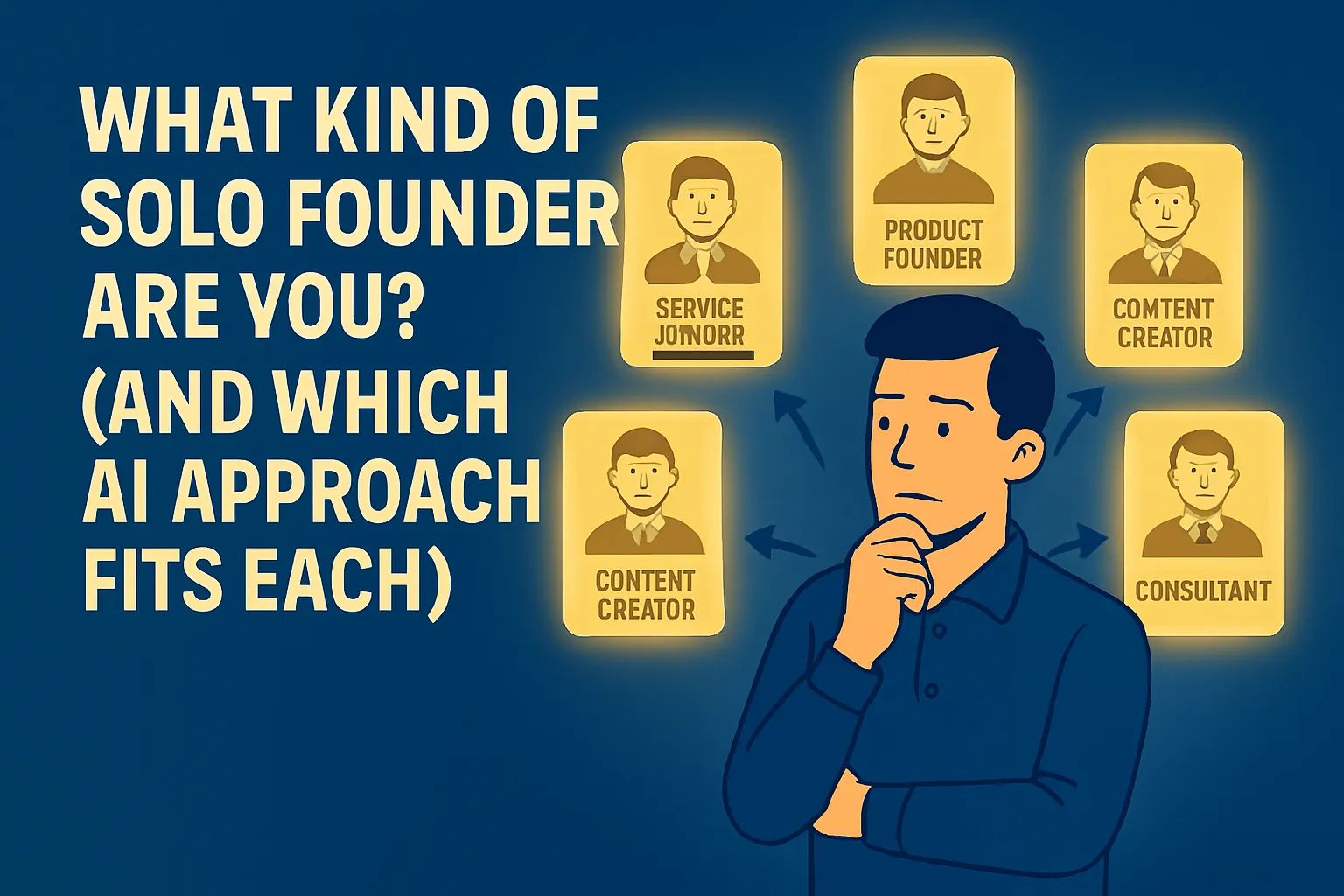
Most AI advice for solo founders treats "solo founder" like a single category. It isn't.
A freelance copywriter, an independent consultant, a one-person SaaS founder, and a content creator all run solo businesses. But their days look completely different. Their revenue models work differently. Their biggest time drains are different. The place where AI creates the most leverage for each of them is different.
Generic AI advice — "use AI for content and customer support" — works adequately for some of these businesses and poorly for others. What actually works is starting with the AI use cases that match the specific shape of your business, not the use cases that make sense for some average of all solo founders.
This article breaks down four archetypes. Find yours, read that section, and skip the rest — or read them all if you're curious how the approaches differ. Each section ends with a specific starting recommendation and the most relevant tools for that archetype.
How to find your archetype
You don't have to fit perfectly into one box. Many solo founders combine two archetypes — a consultant who also creates content, a service provider who's building a product on the side. If that's you, read your primary archetype first (the one that generates most of your revenue right now) and treat the second as supplementary reading.
The four archetypes:
The Service Provider — you sell your time and skills directly to clients. Design, writing, photography, web development, bookkeeping, social media management, coaching. Revenue comes from client work, retainers, or project fees.
The Consultant — you sell expertise and advice, typically at a higher price point than a service provider. Strategy, positioning, operations, finance, marketing, legal, or another specialized domain. The output is thinking, not just execution.
The Content Creator — your content is the business. Revenue comes from audience monetization: newsletters, courses, sponsorships, community memberships, affiliate income, YouTube, podcasting. The content itself drives everything.
The Product Founder — you've built or are building something that sells without requiring your direct time on each transaction. A SaaS tool, a digital product, an app, a template library, a plugin. Revenue scales without proportionally scaling your hours.
Archetype 1: The Service Provider
How your business works: Clients hire you to do things. Your revenue is tied to your capacity — the number of hours you can work, the number of projects you can run simultaneously, the speed at which you can deliver. Every efficiency gain in your workflow translates directly to more capacity, better margins, or more time back.
Your biggest AI opportunity: Not creativity or strategy — throughput. The things that cost you time in a service business are overwhelmingly execution tasks: writing proposals and contracts, communicating with clients, onboarding new projects, producing deliverables that follow a repeatable structure, handling administrative work. These are all tasks where AI creates immediate, measurable leverage.
Where AI helps most for service providers:
Proposals and scoping documents. You write the same proposal structure over and over, customized with different client details each time. AI doesn't write your proposals for you — you still need to think through the scope and pricing — but it eliminates the from-scratch drafting every time. Give Claude your standard structure and the relevant client details, and you have a 70% draft to edit rather than a blank page to fill. A proposal that takes 90 minutes now takes 30.
Client communication at scale. Status updates, follow-ups, project kick-off emails, feedback requests, scope change conversations — these are all structured communication tasks that follow patterns. AI drafts them; you review and personalize. The cognitive load of composing from scratch disappears.
Deliverable production. Depending on your service, AI may be able to handle significant portions of the first-draft deliverable itself. A copywriter can use AI for research and structural drafts. A web designer can use AI to write page copy. A social media manager can use AI to generate content options for client review. The creative direction and judgment remain yours. The mechanical production gets faster.
Onboarding new clients. Every new client gets the same set of instructions, questions, and context. That's a workflow that should be templated and, where possible, automated. AI helps you build the templates; automation tools like Zapier can trigger them at the right time.
What AI doesn't help with in a service business: The relationship. Your clients hire you because of you. AI can make your communication faster and your deliverables more consistent, but it can't build the trust that keeps clients retaining and referring. Don't use AI in ways that make your communication feel generic — the quality filter on every output still has to be you.
Starting recommendation: Start with proposals and client emails. Open Claude, paste in your last three proposals, and ask it to identify your typical structure and draft a reusable template. Then use that template as your starting point for your next proposal. One afternoon of setup, immediate ongoing payoff.
Most relevant tools:
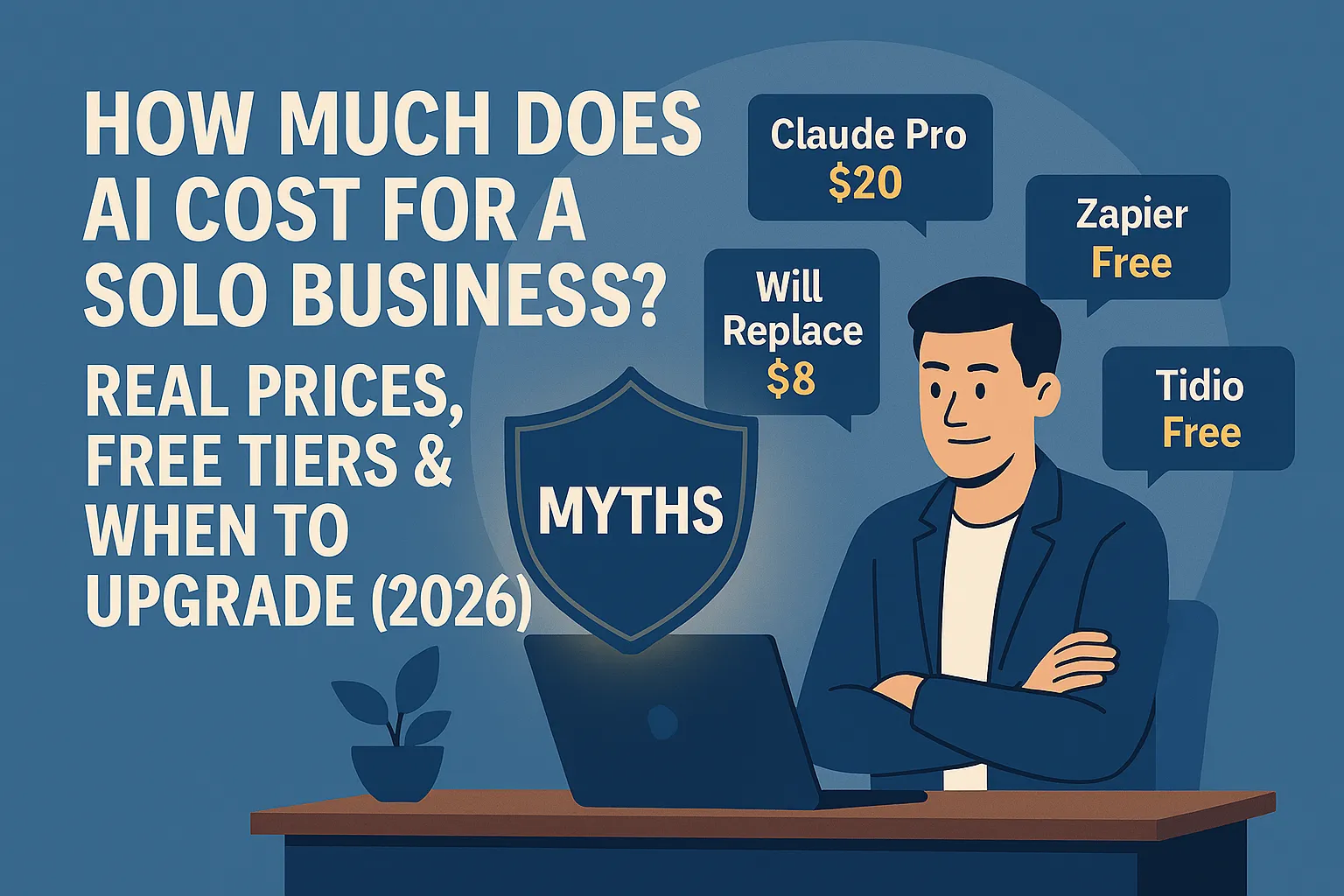
Claude Pro or ChatGPT Plus ($20/month) — your primary tool for all writing and drafting
Otter.ai ($8.33/month) — transcription for client calls so you're not taking notes during conversations
Zapier ($0 free tier to start) — automate client onboarding sequences once you've standardized them
Tidio (free tier) — handle inbound enquiries on your site so you're not manually answering the same questions
Archetype 2: The Consultant
How your business works: You sell expertise. Your value is in your judgment, your frameworks, your ability to see what others can't and tell clients what to do about it. The work is knowledge-intensive and the price point reflects that. Client relationships are typically deeper and longer than a pure service provider's.
Your biggest AI opportunity: Research velocity and deliverable quality. Consulting engagements are built on information — understanding a client's industry, synthesizing what the data shows, building the strategic frameworks that structure the recommendation. AI dramatically accelerates the research and synthesis phase, which means you get to the thinking faster.
There's also a specific and underappreciated opportunity in the billing model question. Traditional consulting's time-based billing is under direct scrutiny as AI compresses work that used to take three weeks into three hours. Consultants who use AI well don't just work faster — they reframe their value around outcomes and insight, not hours. That's a positioning shift, and it's a competitive advantage over consultants who haven't made it yet.
Where AI helps most for consultants:
Research and synthesis. Competitive landscapes, market research, industry reports, client background. What used to take a full day of reading and note-taking takes two hours when you can paste documents, ask targeted questions, and get synthesized answers. The quality of your preparation goes up because you've had time to think about what you found rather than just collect it.
Proposal and scope writing. Consulting proposals are document-heavy and typically customized. AI doesn't replace the strategic thinking behind a proposal, but it removes the blank-page problem for every section that follows a standard structure — situation, approach, deliverables, timeline, investment.
Frameworks and structured outputs. Decks, strategy documents, diagnostic frameworks, action plans. AI is good at producing structured first drafts of analytical documents when you give it the substance. You supply the thinking; AI structures it into a readable deliverable.
Meeting preparation and follow-up. A full brief before every client call. A clean summary with action items after. Otter or Fireflies handle transcription; Claude turns the transcript into a structured follow-up. What used to take an hour of post-call administration takes fifteen minutes.
What AI doesn't help with in a consulting business: The judgment that defines your value. AI can synthesize information but it can't tell a client what they don't want to hear, navigate the political landscape inside their organization, or make the strategic call that no framework can make for you. The better you use AI for the research and production layer, the more time and cognitive space you have for the judgment layer — which is where your value actually lives.
Starting recommendation: Start with client research. Before your next client call, gather everything you can find on them — their website, their LinkedIn, any documentation they've sent — paste it into Claude, and ask for a meeting brief: their likely priorities, the problems they probably want solved, three good questions to ask. That single use case, done consistently before every call, changes the quality of your client conversations immediately.
Most relevant tools:
Claude Pro ($20/month) — research synthesis and long-document work; specifically strong at analytical writing
Otter.ai Pro ($8.33/month) — transcription and action items for every client meeting
Notion AI (if you use Notion) — write and organize deliverables without switching tabs
Zapier (paid when ready) — automate proposal follow-up sequences and onboarding
Archetype 3: The Content Creator
How your business works: Your audience is your asset. You produce content — newsletters, videos, podcasts, courses, social posts — and monetize through subscriptions, sponsorships, affiliate relationships, digital products, or community memberships. Output volume and consistency drive growth. But output quality is what builds and keeps the audience.
Your biggest AI opportunity: Content operations. The production chain for content — ideation, research, drafting, editing, formatting, repurposing, distribution — has more repetitive, mechanical steps than almost any other solo business model. AI can take over large portions of the production layer, freeing you to focus on the things that actually differentiate your content: your perspective, your voice, your specific takes.
Where AI helps most for content creators:
Research and ideation. Finding angles, researching topics, understanding what's already been covered, identifying the gap your piece should fill. AI is a fast research partner — you can go from a topic to a solid understanding of the landscape in an hour instead of a half-day.
Draft production. The blank page problem is real in content creation. AI gives you a starting structure, a first pass at the argument, the points you might want to make. You then apply your perspective, your examples, and your voice. The output is yours — AI handled the scaffolding.
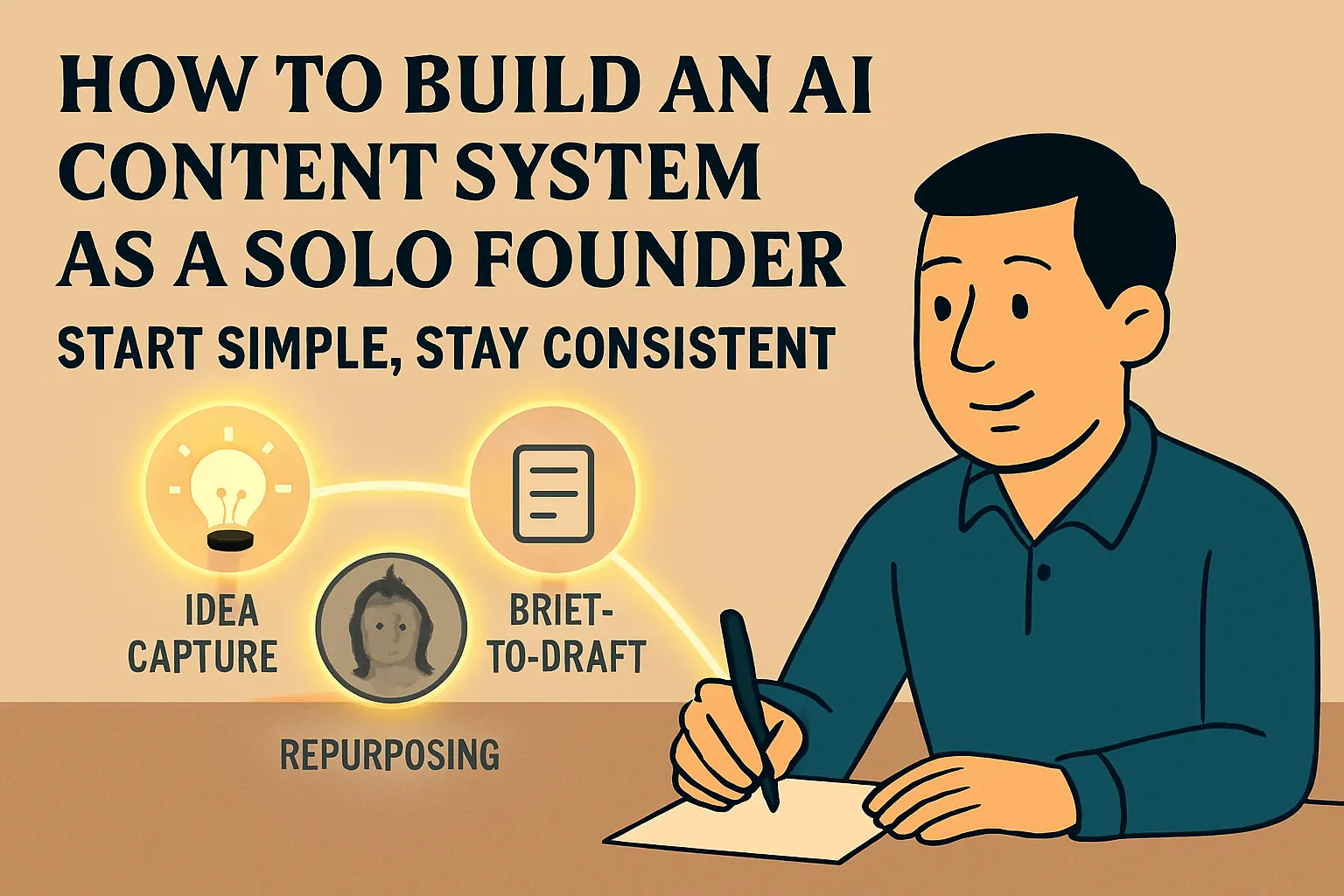
Repurposing. This is where content creators see some of the highest leverage. One long-form piece becomes a newsletter, a LinkedIn post, three tweet threads, an email sequence, a short video script. Each format has its own structure and length requirements. AI handles the reformatting; you apply a light editorial pass to each. A full week of content emerges from one strong original piece.
Newsletter and email production. The mechanics of newsletter writing — intro, sections, transitions, outro — follow patterns. AI drafts; you edit into your voice. The editing is faster than writing from scratch because you're reacting rather than generating.
The honest tension for content creators: Your audience follows you because of your perspective and voice — not because of polished production. AI that writes in a generic voice at high volume can actually damage what makes your content valuable. The right use of AI for a content creator is handling the mechanical layer (structure, research, reformatting) while your voice, your opinions, and your specific examples remain entirely yours. If a reader couldn't tell whether you or AI wrote it, that's a problem. If AI gave you the structure and you filled it with your thinking, that's the right balance.
Starting recommendation: Start with repurposing. Take your best piece of content from the last month. Paste it into Claude and ask for a LinkedIn post, a newsletter section, and three tweet-length points — all in your tone, specific instructions included. Compare the output to what you'd write manually. That experiment will tell you within 20 minutes how much time you can recover from your content operation.
Most relevant tools:
Claude Pro or ChatGPT Plus ($20/month) — drafting, research, repurposing
Otter.ai ($8.33/month) — if you record any audio or video, transcription turns it into text you can repurpose
Beehiiv or Substack — both have AI writing features built in if you use them as your newsletter platform
Zapier ($0 to start) — auto-distribute content across platforms once published
Archetype 4: The Product Founder
How your business works: You've built something — a SaaS product, a digital tool, an app, a template pack, a plugin — that generates revenue without requiring your time on every transaction. Your leverage is in the product itself. Your time goes to building, improving, marketing, and supporting it.
Your biggest AI opportunity: Development velocity, customer support, and marketing output. Product founders have a unique challenge: they need to operate across more distinct functions than almost any other solo archetype — product development, customer success, content marketing, sales copy, technical documentation. AI is a force multiplier across all of them.
Where AI helps most for product founders:
Product development and code. If your product involves code, AI coding assistants like GitHub Copilot, Cursor, or direct use of Claude for code generation dramatically accelerate development. Features that would take a week can take days. Debugging time drops significantly. This is the highest-leverage use of AI for technical product founders — your ability to ship is your competitive advantage, and AI makes you faster.
Customer support automation. A product business generates repeated customer questions at scale — how does X work, why did Y happen, how do I do Z. These are the ideal candidates for an AI chatbot trained on your documentation. The chatbot handles the common questions; you handle the edge cases and the genuinely novel issues. A solo product founder with a good support chatbot can handle the support load of a much larger user base without burning out.
Marketing copy and content. Product pages, email sequences, launch announcements, feature update posts, case studies, documentation. All of these are writing tasks that follow patterns and benefit from AI drafting. For a solo founder who needs to do all of this without a marketing team, AI makes it achievable.
Technical documentation. Documentation is the graveyard of solo product businesses — it's important, it takes time, and it often doesn't get written. AI significantly lowers the barrier. Give it the feature description and how it works, and it produces a first-draft help article in minutes.
What AI doesn't help with in a product business: Product intuition. Knowing what to build, which problems to prioritize, when to pivot — these require deep understanding of your users that AI can support (through research synthesis and user feedback analysis) but can't replace. The product decisions that matter most are still yours.
Starting recommendation: Start with customer support or documentation, whichever is more urgent. If you're fielding the same support questions repeatedly, set up a Tidio chatbot trained on your FAQ — a few hours of setup, permanent leverage. If your documentation is thin, take your three most-asked support questions and have Claude write full help articles for each. Both are high-impact, low-overhead starting points.
Most relevant tools:
Claude Pro ($20/month) — writing, research, code review, documentation
GitHub Copilot ($10/month) or Cursor ($20/month) — AI coding assistance if your product involves code
Tidio or Intercom Fin — AI-powered customer support chatbot trained on your docs
Zapier ($0 to start, paid when needed) — automate onboarding sequences and user communications
The one thing all four archetypes have in common
Every archetype has a different starting point, a different highest-leverage use case, and a different relationship with AI risk (the content creator's voice concern is different from the product founder's code quality concern, which is different from the consultant's judgment premium).
But the pattern of how AI adoption works is identical across all four: start with one specific time drain that matches your archetype, implement it properly, see the return, and build from there. The mistake that wastes time regardless of archetype is trying to use AI for everything at once before you've built a consistent habit with anything.
Look at the starting recommendation for your archetype. That's your next move — not a strategy session, not a tool audit, not more reading. One use case, this week, on a real piece of work.
Do this today: Go back to your archetype section and read the starting recommendation again. Identify the specific next instance of that task — the next proposal, the next client call, the next piece of content, the next support question. That's the one to do with AI. Not a hypothetical. The actual next one.
Next in AI Basics — Quick Wins: Your First AI Workflow as a Solo Founder: Do This in the Next 30 Minutes →
Or go back to the main article: ← Know Where You Stand



Comments (0)
Leave a Comment