

You've been hearing about AI for two years. You've read the headlines, watched a few demos, maybe opened ChatGPT once and weren't sure what to do with it. Now you're wondering: is this actually relevant to my business, or is it a distraction dressed up as opportunity?
That's the right question to be asking. And unlike most AI content you'll find, this guide won't tell you AI will save your business or that you're falling behind if you don't adopt it immediately. It'll tell you what's actually true — clearly, specifically, and without a sales pitch attached.
By the end, you'll know exactly what AI can and can't do for a solo founder, whether it makes sense for your specific situation, and if it does, precisely where to start.
What AI actually does in a one-person business
The most important thing to understand about AI at the solo founder level is that it doesn't transform your business. It handles tasks. Specific, definable tasks that currently take your time and don't require your unique judgment to complete.
Those tasks are where 95% of the value lives for most solo founders:
Writing and drafting. First drafts of emails, proposals, social posts, blog articles, client updates, onboarding instructions. AI doesn't replace your voice or judgment — it eliminates the blank page and gets you to a workable 70% draft in minutes instead of an hour.
Research and summarization. Competitive research, industry overviews, document summaries, market context before a client call. Work that used to take 2–3 hours takes 20 minutes when you can paste a document or topic into an AI and ask for the key points.
Customer questions. A chatbot on your website that answers the same five questions you get every week — pricing, process, timelines, FAQs. Set it up once, and it handles those conversations while you're doing other things.
Meeting notes and action items. A transcription tool records your calls, summarizes what was said, and pulls out the action items. You stop taking notes during calls and start being fully present in them.
Automating repetitive connections between tools. New lead fills out a form → gets added to your spreadsheet → receives a welcome email → creates a task in your project tool. A workflow you set up once and never touch again.
Thinking out loud with something that pushes back. At 11pm when you're second-guessing a pricing decision or a difficult email, AI gives you a sounding board. Not a replacement for experienced advice, but available when experienced advisors aren't.
That's the realistic scope. Not magic. Not transformation. Tasks, handled faster, so your time goes toward work that actually requires you.
Where to go deeper: What AI Can Actually Do for a Solo Founder (And What It Can't) →
Is it even worth it for someone like you?
Here's the honest answer: it depends on what you're using it for and how you start.
There's a version of AI adoption that works very well for solo founders — and a version that wastes your time. The version that works looks like this: you identify one specific task that costs you meaningful time each week, you find an AI tool that handles it, you implement it properly, and you recover that time. Then you do it again with the next thing.
The version that doesn't work looks like this: you sign up for several tools because AI seems important, you poke at them without a specific problem to solve, you get outputs that feel generic, and you conclude that AI doesn't really work.
The difference isn't the tools. It's the approach.
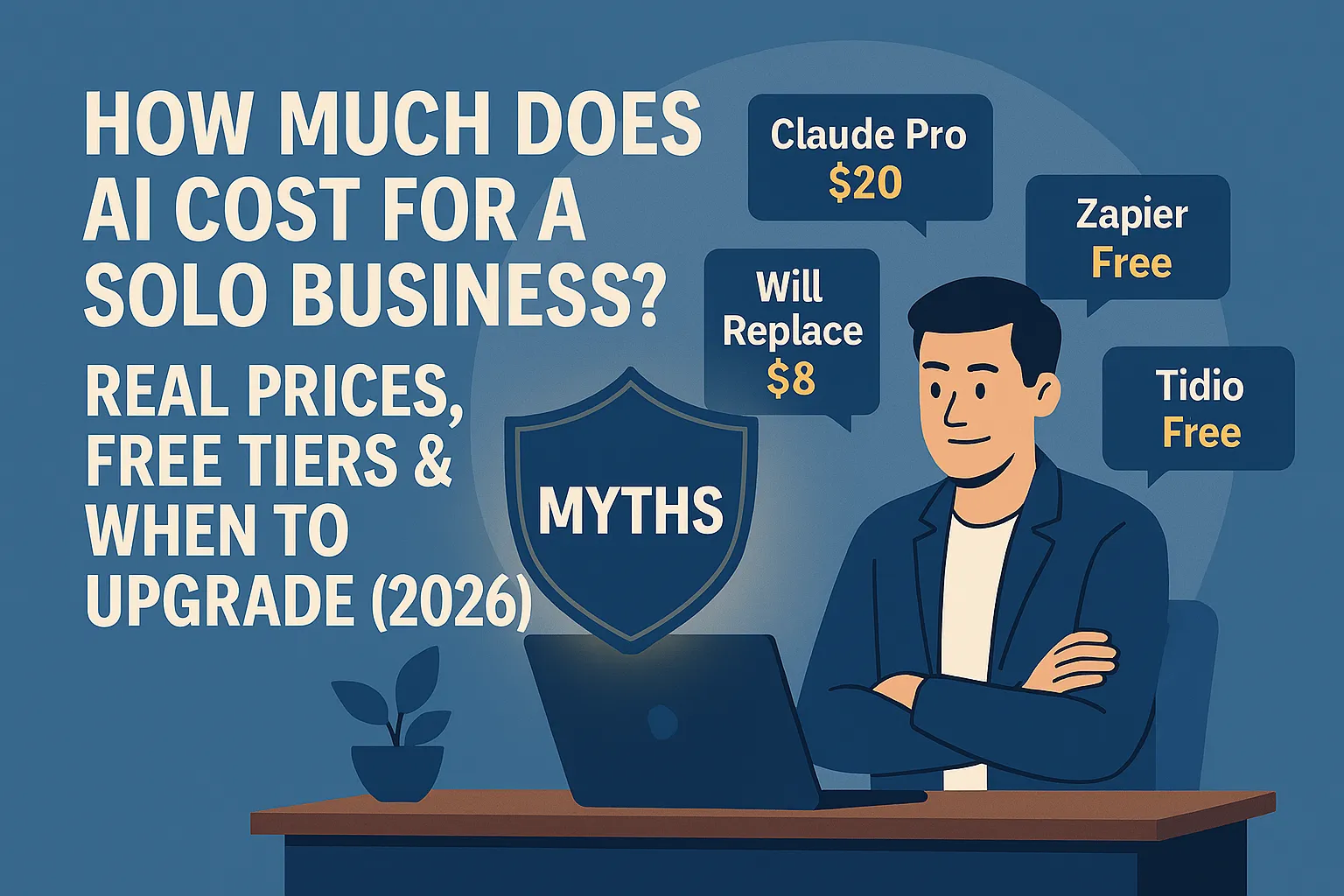
On cost: a lean AI setup for a solo founder costs between $0 and $30 per month. The tools that matter most have free tiers. Claude and ChatGPT both have free plans that are genuinely useful for testing. The paid tiers ($20/month for either) become worth it when you're using the tool consistently enough to hit the free tier limits — which typically takes a few weeks of real use.
On time: solo founders who implement AI deliberately — targeting specific time drains rather than hoping something useful emerges — typically recover 5–10 hours per week within the first 60 days. That's not a sales claim. It's the pattern that emerges consistently from survey data on AI-using solopreneurs. The range is wide because it depends heavily on what you implement and how.
The clearest signal that AI is worth it for you: you have repetitive tasks that happen weekly, don't require your unique judgment, and currently cost you real time. If that's true — and for almost every solo founder it is — the ROI calculation is straightforward.
Where to go deeper: Is AI Worth It for a One-Person Business? A Realistic Answer →
Why corporate AI advice doesn't apply to you
Most AI content you encounter was written with a corporate audience in mind. Enterprises deploying AI across departments, building custom models, running multi-year implementation programs. The advice makes sense for them. It doesn't make sense for you.
Here's the practical difference:
Enterprise AI implementation takes 12–18 months, requires a dedicated team, costs six figures minimum, and needs to integrate with legacy systems that have been accumulating debt since 2003. Before any AI does anything useful, there are months of data engineering, governance reviews, compliance checks, and change management.
Your AI implementation takes an afternoon. You open a browser tab, type something, and find out if it's useful. There's no IT approval. No procurement cycle. No change management because there's no one to manage.
This isn't a simplified version of what enterprises do. It's a fundamentally different activity.
And in several important ways, it actually favors you. You can change tools in an hour without budget approval. You have no legacy systems to untangle. Your feedback loop is immediate — you know within days whether something is working. Every efficiency gain goes directly back to you, not into a department report.
The one principle worth borrowing from how the best enterprise AI implementations work: start with one specific problem, not with the technology. That discipline is just as important at your scale — and it's the reason the approach laid out in these guides works.
Where to go deeper: AI for Solo Founders vs. AI for Big Companies — Why It's Completely Different →
The five myths that keep solo founders stuck
Most of the hesitation around AI adoption comes from one of five beliefs. Each has a kernel of truth and a conclusion that's much broader than the evidence supports.
"It's too expensive." The enterprise AI price tag is real. The price tag for the tools you'll actually use is not. Claude Pro and ChatGPT Plus are both $20/month. The free tiers of both cover weeks of genuine testing. A complete beginner AI stack costs $0 to start and $20–40/month when you're ready to pay for reliability.
"I'm not technical enough." You use them by typing in plain English. There is no technical barrier to the use cases you'll start with. What trips people up isn't complexity — it's not knowing what to ask the tool to do. That's solved by trying things on real tasks, not by acquiring skills.
"It'll replace me." AI replaces tasks, not businesses. Your clients work with you for your judgment, relationships, expertise, and accountability. AI can draft in your voice. It cannot be you in a client conversation, make a strategic call on your behalf, or build trust over time with the specific person you've been working with for two years.
"The outputs aren't reliable enough." Whether AI outputs are reliable enough depends entirely on the task. For writing a draft email, the stakes of an imperfect output are low — you edit before sending. For filing your taxes, the stakes are high — don't use AI alone. The rule is: treat every output as a strong first draft that needs your review, not a finished product.
"My business is too small / too niche." AI helps most with functions, not industries. Writing, research, customer questions, meeting notes, and repetitive tasks are universal. The ceramics studio founder, the B2B consultant, and the hypnotherapist all write emails, answer inquiries, and do research. The tools help all of them.
Where to go deeper: 5 AI Myths That Stop Solo Founders From Starting (And the Truth Behind Each) →
What AI tools actually cost (the real numbers)
One of the most persistent misconceptions about AI is that it's expensive. Here's the actual picture for a solo founder in 2026.
General AI assistant (the most important tool): Claude.ai free tier for testing; Claude Pro at $20/month when you need more. ChatGPT has an equivalent free tier and a $20/month Plus plan. OpenAI also launched a $8/month ChatGPT Go tier if you want more capacity than free but aren't ready for full paid.
Automation between apps: Zapier's free tier handles 100 tasks/month across two-step workflows — enough to test any automation you want to build. The paid plan is $19.99/month billed annually when you're ready for it to run reliably.
Meeting transcription: Otter.ai's free tier gives you 300 minutes/month with a 30-minute per-conversation cap — enough for shorter calls. Fireflies.ai is now the stronger free alternative: 800 minutes/month, no per-call cap. Otter Pro is $8.33/month for longer calls.
Customer chatbot: Tidio's free tier gives you 50 human conversations/month, resetting monthly. Usable for light testing on a smaller site.
Total to start: $0. Total for a solid working stack: $20–40/month depending on which tools you actually need beyond the AI assistant.
The real cost question was never the subscription fee. It's whether you implement the tool and use it consistently. A $20/month subscription you use daily has a return on investment that's not a close calculation. One you open twice a month is an expensive lesson.
Where to go deeper: How Much Does AI Actually Cost for a Solo Business? (Real Numbers, 2026) →
Where to go from here
If you've read this far, you're not a complete beginner anymore. You have a realistic picture of what AI does, what it costs, why the corporate case studies don't apply, and which beliefs to be skeptical of.
The next move depends on where you are:
If you still haven't tried anything: Start with the first article linked below — it gives you 7 specific use cases, each with a "start here" action you can take today. Pick the one that matches your biggest time drain and spend 20 minutes on it. That single session will tell you more about whether AI belongs in your workflow than anything you could read.
If you've tried a tool but felt stuck or unimpressed: Read the myths article and the "is it worth it" article. The most common cause of disappointing results is using the right tool for the wrong task, or not having a specific enough outcome in mind. These articles give you the framing to diagnose what went wrong and try again with a better approach.
If you're sold on AI but unsure where to start: The cost article tells you exactly what to get and in what order. Start free. Test on real tasks. Pay when the free tier limits are actively blocking you. Don't buy a stack before you know which tools you'll actually use.
All articles in this series
Orientation & Reality Check — the full reading path:
What AI Can Actually Do for a Solo Founder (And What It Can't) → — 7 real use cases with time and cost estimates. Your foundation article.
Is AI Worth It for a One-Person Business? A Realistic Answer → — When it works, when it doesn't, and the three-question framework for your specific situation.
AI for Solo Founders vs. AI for Big Companies — Why It's Completely Different → — Why everything you've read about enterprise AI doesn't apply to you — and where you actually have the advantage.
5 AI Myths That Stop Solo Founders From Starting (And the Truth Behind Each) → — Cost, technical skills, replacement fear, reliability concerns, and the "my business is different" belief — each addressed with real evidence.
How Much Does AI Actually Cost for a Solo Business? (Real Numbers, 2026) → — Exact prices, free tier limits, hidden gotchas, and the three-level stack breakdown.
Ready to move beyond orientation? Head to the next section: Know Where You Stand: Finding Your Starting Point With AI →



Comments (0)
Leave a Comment