

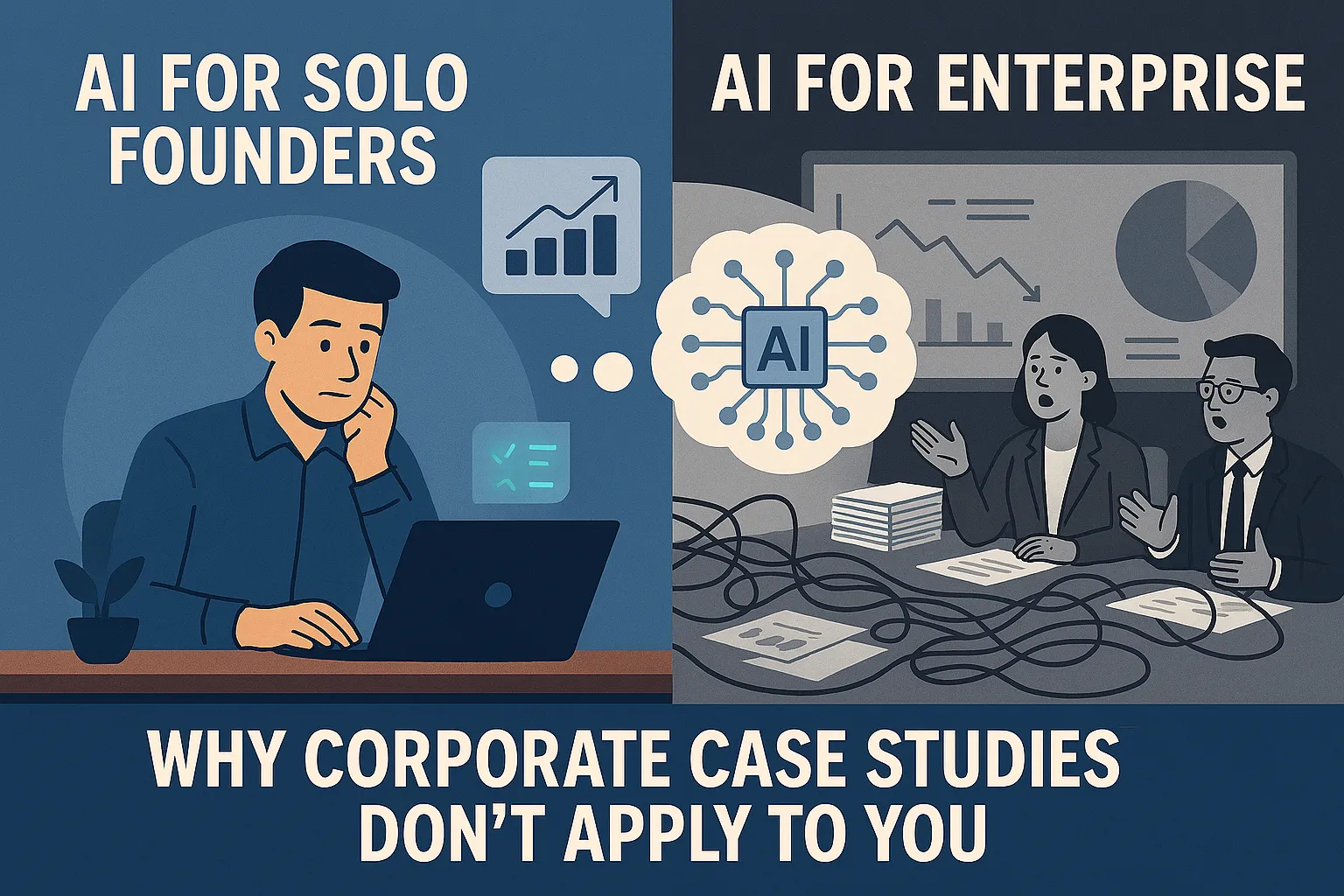
Every week there's a new headline. A bank deployed AI and saved $500 million. A retailer cut logistics costs by 30% with machine learning. A Fortune 500 company launched an AI strategy that took 18 months and a dedicated team of 40 people to build.
You read it. You nod. And somewhere in the back of your mind you start wondering if you're falling behind — if AI is something happening at a scale you can't touch, by companies with resources you'll never have.
Here's what you need to understand: those articles weren't written for you. They're describing a completely different thing, using the same word. The AI a solo founder uses and the AI a large enterprise deploys are so different in scope, cost, timeline, and complexity that comparing them is like comparing a kitchen knife to industrial food processing equipment. Both are tools. Both cut things. That's roughly where the comparison ends.
This article explains exactly what's different — and why, in several important ways, you actually have the better end of the deal.
What enterprise AI actually looks like
When a large company "implements AI," here's what that typically means in practice.
First, there's a strategy phase. Consultants get hired. A working group is formed. Executives align on priorities. An AI roadmap gets built, reviewed, revised, and approved. This phase alone can take three to six months and cost more than most solo founders make in a year.
Then there's the infrastructure phase. Enterprise AI needs to connect to existing systems — CRMs, ERPs, data warehouses, legacy software that's been running since 2003. Data engineering alone consumes 40–60% of implementation time and budget in a typical enterprise AI project. Before any AI does anything useful, someone has to figure out where the data lives, clean it, structure it, and make it accessible.
Then there's governance. Security reviews. Compliance checks. Legal sign-off. IT approval. Change management programs to get employees to actually use the new tool. The AI skills gap is cited as the biggest barrier to integration, and education — not role or workflow redesign — is the number one way enterprises are adjusting their talent strategies because of AI. That's how complex the human side of enterprise adoption gets.
And then there's the timeline. Small businesses can achieve initial results in 3–4 months with focused pilots. Enterprises should plan 12–18 months for comprehensive implementation. And that's for a single use case. Enterprises managing complex AI deployments are talking about multi-year programs, not an afternoon.
None of this is a criticism of how enterprises operate. It's just a description of the real constraints that come with size. When you have thousands of employees, dozens of systems, regulatory requirements, and a board to answer to, this is genuinely what AI implementation looks like.
But you don't have any of that. Which means none of those constraints apply to you.
What AI actually looks like for a solo founder
When you implement AI, here's what it looks like.
You open a browser tab. You go to Claude.ai or ChatGPT. You type something. You get an answer. You decide if it's useful.
That's it. That's the entire implementation process for your first AI tool.
No strategy phase. No infrastructure work. No data governance framework. No change management because there's no one to manage. You make a decision, you try the thing, and within 20 minutes you know whether it's worth continuing.
This is not a simplified version of what enterprises do. It's a fundamentally different activity. Consumer AI tools are built for individual convenience — help someone write an email, answer a quick question, generate an image. That's your starting point. And it turns out that "individual convenience at scale" is exactly what a solo founder needs most.
The tools you have access to — Claude, ChatGPT, Zapier, Notion AI, Otter.ai — were not built for enterprise deployment. They were built to be picked up, used immediately, and deliver value within minutes. The product design is oriented toward zero onboarding time, not toward enterprise procurement processes.
This means the entire conversation about AI being complex, expensive, and slow to deliver results simply doesn't apply to you.
Where the gap actually favors you
Here's the part that rarely gets said plainly: for a specific and important class of AI use cases, being a solo founder is an advantage over being a large company.
You can change direction in an afternoon. One of the most persistent problems in enterprise AI is that large companies discover a tool isn't working and take months to pivot because of procurement cycles, contracts, and internal politics. You can switch tools, change your approach, or abandon something that isn't working before lunch. Many of the strongest enterprise AI deployments actually began with individual contributors who had already experimented with tools like ChatGPT for personal productivity — individual employees acting like solo founders within large organizations. That's the behavior you exhibit by default.
You have no legacy systems to integrate. Enterprise AI projects spend the majority of their time and budget solving data problems that predate AI entirely — siloed systems, inconsistent data, decade-old software that needs to be connected to new tools. You probably run your entire business on five apps that already integrate with each other. Your "data infrastructure" is a Notion workspace and a Gmail account. Setting up an AI workflow takes an afternoon, not a quarter.
Your feedback loop is instant. When a large company deploys AI for customer service, it takes weeks to measure whether it's working, route feedback through the right teams, make approved changes, and test again. When you deploy an AI chatbot on your site, you see whether it's helping or hurting within days, and you can fix it before the week is out. The iteration speed available to a solo founder is genuinely incomparable to enterprise.
You capture the upside personally. When an enterprise saves $2 million with AI, that becomes a line item on a report. When you save 8 hours a week, that's 8 real hours you can put toward clients, product, or just not working on a Saturday. The person who benefits from every efficiency gain is you. There's no diffusion of benefit across departments, no need to justify the ROI to a committee. You feel it directly.
Why the case studies you read don't help you — and what to look for instead
Most AI content is written with a corporate audience in mind, even when it claims to be for small businesses. You can spot it by what it talks about.
If an article leads with ROI percentages across enterprise functions, data strategy, AI governance, or model selection for production deployment — it's not for you. If it talks about "AI transformation programs" or "scaling AI across the organization" — it's not for you. If the first step is "assess your data infrastructure" — it's not for you.
What content that's actually relevant to solo founders looks like:
It talks about specific tools with specific prices. It starts with one use case, not a comprehensive strategy. The implementation timeframe is measured in hours or days, not quarters. The first win is achievable this week. And the author clearly understands that you're doing every job in your business simultaneously, not overseeing an AI program from an executive role.
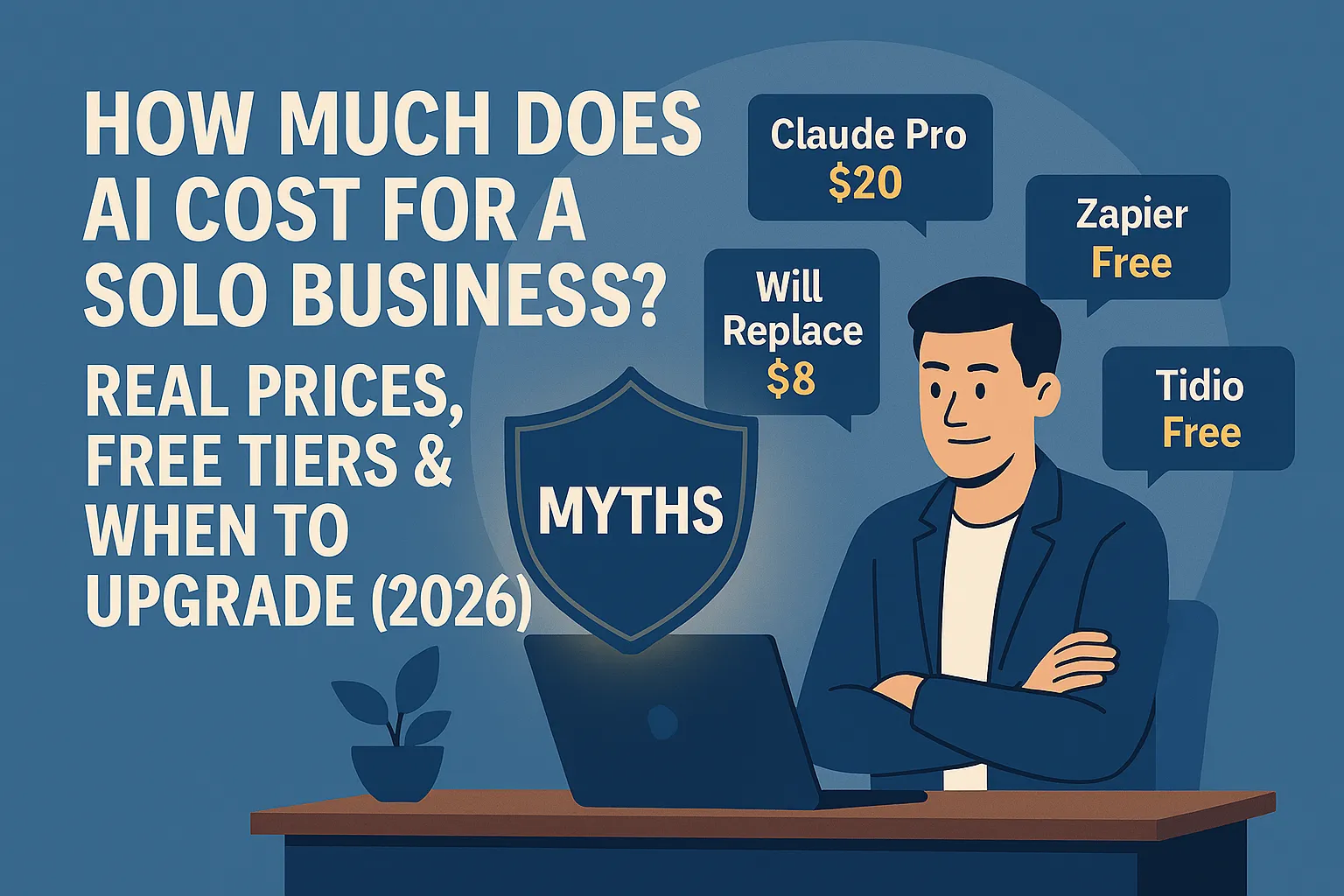
The reason this distinction matters is that reading enterprise AI content and then feeling like you're behind or doing it wrong is a real phenomenon among solo founders. You read about companies building custom models or deploying AI across their whole customer journey, and you feel like your ChatGPT subscription is embarrassingly small by comparison. It's not. It's appropriate for your situation. The company building custom models has problems you don't have — and that custom model is solving them. Your $20/month subscription is solving yours.
The one thing worth borrowing from how enterprises do it
There's one principle worth taking from how the most successful enterprise AI users operate: start with a specific problem, not with the technology.
The most common reason enterprise AI projects fail is that teams build AI for AI's sake, rather than solving specific problems. The implementations that succeed pick one high-value use case, prove it works, and build from there. The ones that fail try to transform everything at once.
That discipline — problem first, solution second — is the one thing from enterprise AI that absolutely applies to solo founders. Not the governance frameworks, not the infrastructure planning, not the multi-year roadmaps. Just: identify the specific thing that costs you the most time or money, ask whether AI can help with that specific thing, and find out.
If the answer is yes, you'll know within the week. If it's no, you've lost an afternoon. Either way, you move faster than any enterprise ever could.
The comparison that actually matters
Forget comparing yourself to large companies. The relevant comparison is between you right now and you in three months if you start using AI deliberately.
Among SMBs that use AI, 58% save more than 20 hours per month, and 66% estimate monthly savings of $500 to $2,000. That's not enterprise-scale transformation — it's a solo founder recovering real time and real money from a $20/month subscription and an afternoon of setup.
The gap between a solo founder using AI well and one who isn't has nothing to do with budget, technical skill, or the kind of infrastructure challenges enterprises deal with. It has to do with whether you've picked one specific thing to try and given it a serious attempt.
That's the whole game at your level. And unlike the enterprise version, it starts today.
Do this today: Think about the last thing you did manually that you've done before — drafting the same type of email, writing the same type of document, answering the same type of question. Open Claude.ai (free). Describe the task and ask it to help. You're not launching an AI strategy. You're just trying a tool for 20 minutes. That's the entire difference between where you are and where you want to be.
Next in AI Basics: 5 AI Myths That Stop Solo Founders From Starting (And the Truth Behind Each) →



Comments (0)
Leave a Comment