

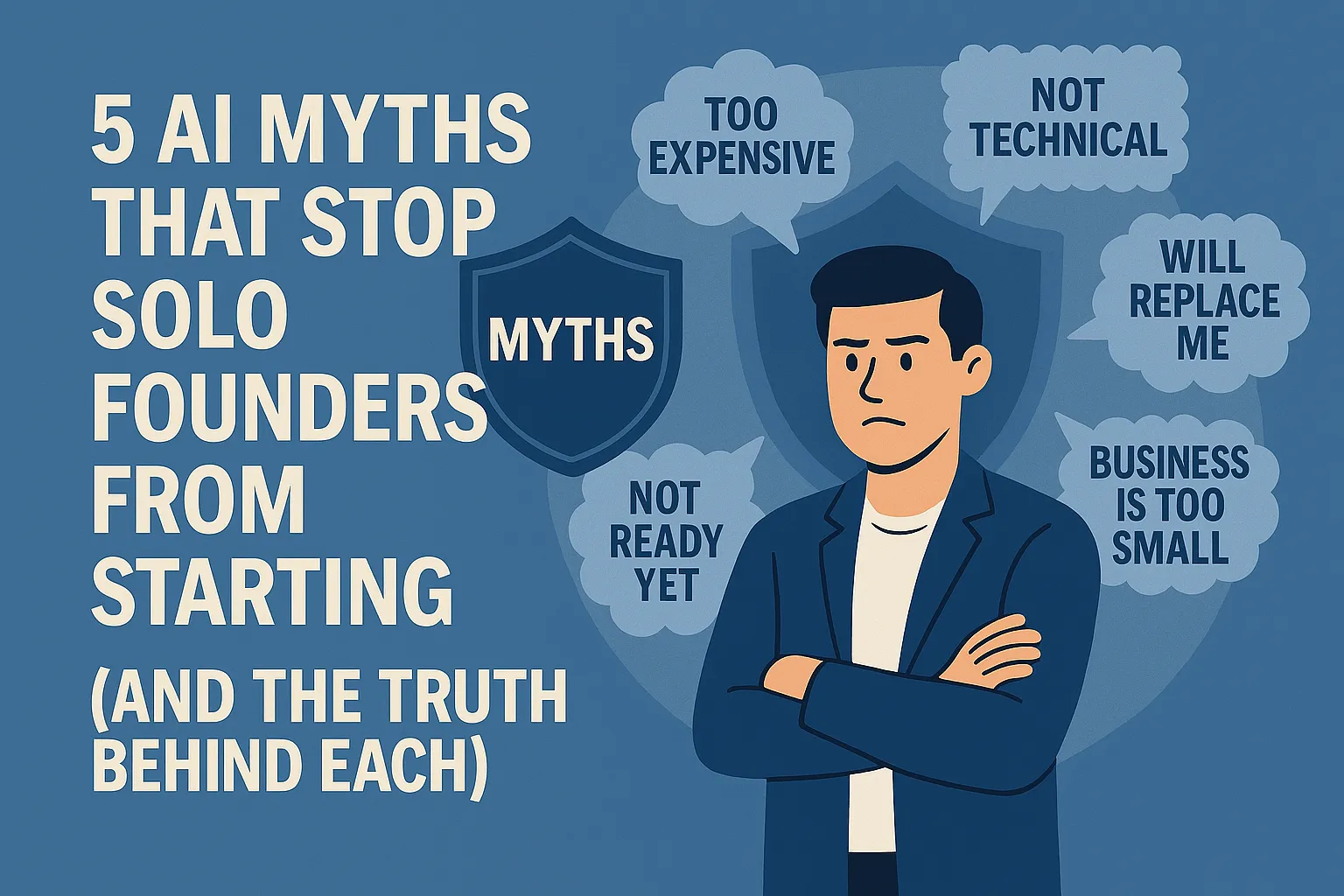
You've probably heard the noise. AI is going to change everything, automate everything, replace everyone. Or conversely — it's overhyped, it's only for tech companies, it's not reliable enough to trust with real work.
Most solo founders land somewhere in the middle of those two extremes: genuinely curious, but held back by a handful of specific beliefs that feel reasonable from the outside and are almost entirely wrong on the inside.
This article addresses the five most common ones — not with vague reassurances, but with specific numbers, real tools, and the actual truth as it stands in 2025.
Myth 1: "AI is too expensive for a one-person business"
Where this belief comes from: The AI headlines that reach most people are about massive enterprise deployments — companies spending millions on custom models, AI infrastructure, and implementation teams. When "AI for business" is defined by those stories, the assumption that it's a rich company's game is understandable.
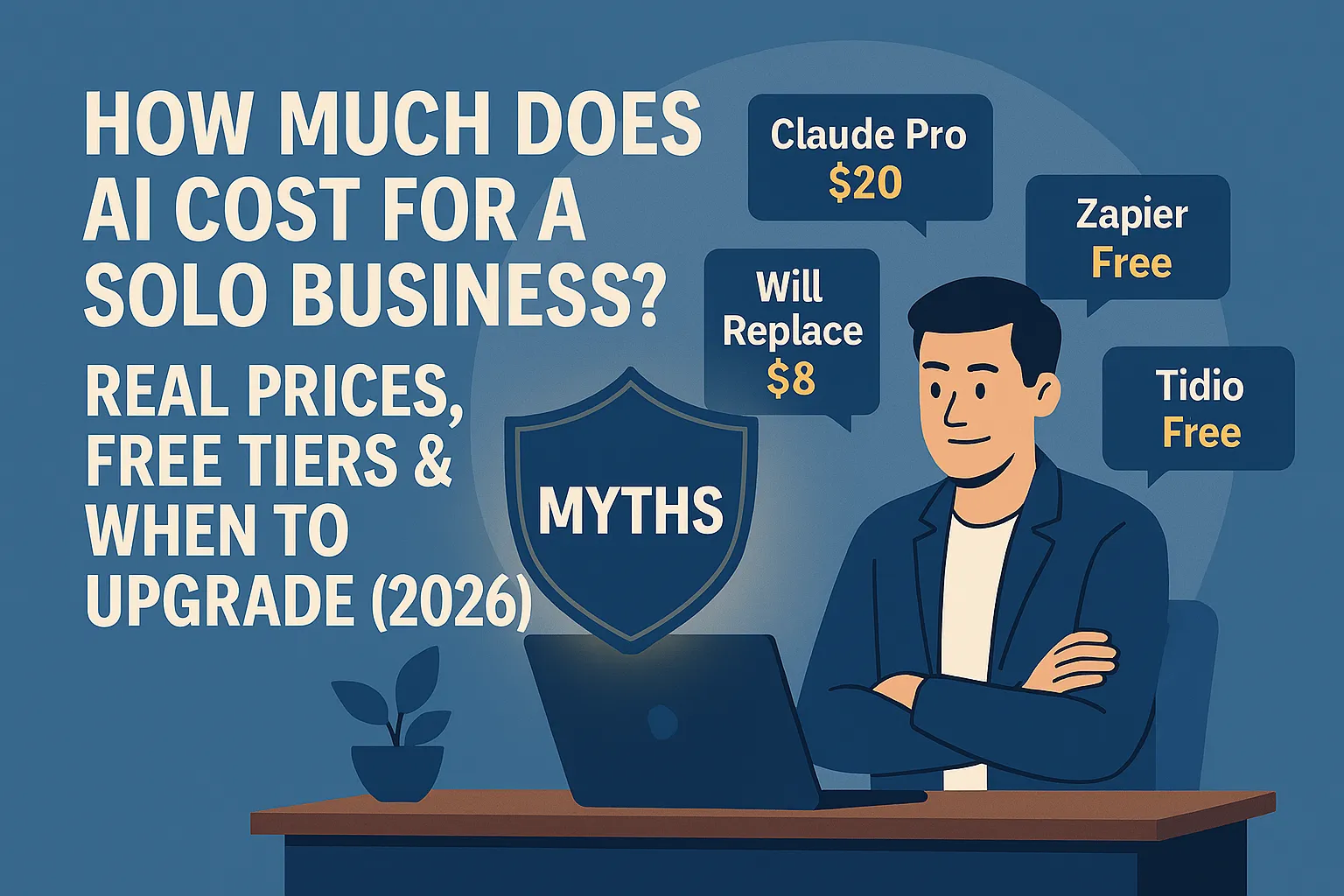
The actual truth: The tools that matter most to a solo founder cost between $0 and $20 per month. That's not a simplification — that's the real price of the tools that will cover 90% of what you actually need.
Claude.ai and ChatGPT both have free tiers that are genuinely useful for testing and light use. Their paid plans (Claude Pro, ChatGPT Plus) each cost $20/month — the price of two lunches. Zapier, which automates tasks between your apps, has a free tier that handles five workflows, which is enough to start. Otter.ai, which transcribes and summarizes your meetings, is free for up to 600 minutes per month.
89% of small business owners reported that someone in their business currently uses AI tools — which tells you something important: AI adoption is not correlated with budget. It's correlated with willingness to try.
The cost myth persists partly because people confuse "AI" with "building AI." Building custom AI models is expensive. Using AI tools that already exist is not. You don't need to build anything. You need to sign up for a tool someone else built, open it in a browser tab, and start using it. That's a different activity entirely.
The real cost of a starter AI stack for a solo founder:
General AI assistant (Claude Pro or ChatGPT Plus): $20/month
Automation (Zapier free tier): $0
Meeting transcription (Otter.ai free tier): $0
Customer FAQ chatbot (Tidio free tier): $0
Total to start: $20/month. Less than a Netflix subscription.
Myth 2: "I'm not technical enough to use AI"
Where this belief comes from: The word "AI" carries a residue of complexity from its origins. Machine learning, neural networks, Python scripts, API keys — if that's what "using AI" means, then yes, it requires technical skills. So when non-technical founders hear that AI is available to them, they assume there's a catch. There must be some coding involved. Some setup they won't be able to figure out.
The actual truth: The tools solo founders use most are designed specifically for people without technical skills. You use them by typing in plain English. That's it.
Open Claude.ai. Type: "Help me write a follow-up email to a client who hasn't responded in two weeks." You get a draft. No setup. No code. No configuration. You didn't do anything technical. You described what you wanted in the same language you'd use to ask a colleague.
Most small business owners report a medium or high comfort level using AI in their operations — everyday business people are already navigating these tools, not just tech experts.
Even automation tools — which sound more technical — have been rebuilt for non-technical users. Zapier's interface is visual drag-and-drop. You select your apps, choose a trigger event, choose what should happen next, and it runs. No coding required. Zapier and Make.com connect thousands of applications without any coding — you select the source app, choose a trigger event, select the destination app, and map fields with dropdowns.
The learning curve for most tools is measured in hours, not weeks. Modern AI tools work through simple conversations, drag-and-drop interfaces, or template-based workflows requiring zero coding knowledge — and the learning curve is 2–8 hours of focused practice.
What trips people up isn't technical complexity. It's not knowing what to ask the tool to do. That's a different problem — and it's solved by trying things on real tasks, not by acquiring technical skills.
The honest note: Some AI use cases do require technical skills. Building custom integrations, working with APIs, setting up complex multi-step automation with error handling — these get technical fast. But those aren't beginner use cases. The first six months of using AI for your business don't require any of that. Start where you are.
Myth 3: "AI is going to replace me and make my business irrelevant"
Where this belief comes from: This is the most emotionally loaded myth, and the one that operates most quietly. It's not always articulated directly — sometimes it shows up as a vague resistance to adopting AI, a feeling that learning these tools is somehow capitulating to something that's working against you.
The fear has a rational kernel: AI is genuinely replacing some categories of work. Content written purely for SEO filler, basic template design, simple data entry, first-level customer service scripts. If your entire business value was in producing those things at volume, AI is a real threat.
The actual truth: For a solo founder, AI replaces tasks — almost never the business.
Your clients work with you for your judgment, your relationships, your specific expertise, your taste, and your accountability. AI can draft an email in your voice. It cannot be you in a client conversation. It cannot make the strategic call about whether a project direction is right. It cannot build trust over time with the specific person you've been working with for two years.
AI takes tasks, not jobs. It's better at writing emails than leading a team. You still need humans — you'll just use them smarter.
The more productive frame is this: AI is a force multiplier for what you already do well. A consultant who uses AI to handle research, first-draft deliverables, and meeting notes doesn't become less valuable to clients — they become more responsive, more thorough, and able to take on more without burning out. The quality of their judgment goes up because they have more time and cognitive space to apply it.
The solo founders most at risk from AI are the ones delivering commodity work — work where the output is all that matters and any competent person (or tool) could produce it. If that describes your business, that's worth confronting directly — but the answer isn't to avoid AI. It's to move up the value stack.
The one thing worth taking seriously: AI will compress the market for certain types of work. If you write generic blog posts, design basic social graphics, or do entry-level data analysis, those services are getting harder to sell at premium rates. That's not a reason to fear AI — it's a reason to be clear about what specifically you bring that AI doesn't, and to make sure you're being paid for that.
Myth 4: "AI isn't ready yet — the outputs aren't reliable enough"
Where this belief comes from: Most people have a story. They tried AI once. It made something up. It gave them an answer that was confidently wrong. It produced content that sounded plausible but was factually off. They took that experience and applied it to every AI use case, concluding that the tools aren't trustworthy enough for real work.
The original experience was probably accurate. AI does hallucinate. It does make things up with confidence. Anyone who tells you otherwise is either working with very narrow, well-constrained use cases or has a product to sell you.
The actual truth: Whether AI outputs are "reliable enough" depends entirely on the task — and for the tasks that matter most to solo founders starting out, the reliability is more than sufficient.
Here's a simple filter. For any task you're considering using AI for, ask: If the output is wrong, what happens?
For writing a draft email, a wrong output means you edit it before sending. Low stakes. For researching a topic, a wrong output means you verify before using the information. Low stakes. For automating a routine task you've already tested, a wrong output means the automation runs incorrectly once and you fix it. Low stakes.
For filing your taxes, for giving medical advice to a client, for making a legal determination — the stakes are high, and you should not trust AI outputs without qualified human review. This isn't a surprise limitation; it's an obvious one.
The mistake is treating AI unreliability as a binary — either it's reliable enough to use everywhere without checking, or it's unreliable and unusable. The real picture is more specific: AI is very reliable for tasks where you can evaluate the output before it matters, and unreliable for tasks where you can't or won't.
Entrepreneurs who have integrated AI into their workstreams use an average of four AI tools across nearly twenty distinct areas of their business. These aren't reckless people ignoring quality. They're founders who understand which tasks AI handles well and which ones need their oversight.
The practical rule: Treat every AI output as a strong first draft, not a finished product. Review before you use. Never publish without reading. Never send without checking. That habit — not a belief that AI is always right — is what makes AI adoption work.
Myth 5: "My business is too small / too niche / too different for AI to help"
Where this belief comes from: Most AI content is written for generic business contexts — e-commerce, SaaS, marketing agencies. A solo founder who runs a hypnotherapy practice, or a ceramics studio, or a B2B consulting firm in a narrow vertical reads those examples and concludes that AI is for "other kinds of businesses." Their workflows are too specific. Their clients too particular. Their industry too specialized.
The actual truth: The things AI helps most with aren't industry-specific. They're function-specific. And the functions are almost universal.
You write things. So does every other business. AI helps you write them faster. You communicate with clients and prospects. So does every other business. AI helps you draft, follow up, and respond. You need to understand information — industries, competitors, research, documents. So does every other business. AI summarizes and explains. You have repetitive administrative tasks. So does every other business. AI automates them.
The ceramics studio founder still writes emails, updates their website, posts on social media, and answers customer questions. The B2B consultant still writes proposals, prepares for client calls, and produces deliverables. The hypnotherapist still markets their services, follows up with enquiries, and handles scheduling. None of those functions are too niche for AI to assist with.
Where niche does matter — and this is worth knowing — is in the quality of AI outputs when the work itself is highly specialized. If you're a biotech regulatory consultant producing compliance documents, AI's first drafts will need heavier editing than if you're a marketing consultant producing positioning briefs. But "needs more editing" is different from "not useful." It still saves time. It still removes the blank page problem.
55% of small businesses already use some form of AI — often without even realizing it, through tools like email automation, chatbots, or scheduling software. In many cases, solo founders are already benefiting from AI embedded in tools they use daily. The question isn't whether AI can help your kind of business. It's which specific function to start with.
What all five myths have in common
Each of these beliefs shares a structure: a kernel of truth, wrapped around a conclusion that's much broader than the evidence supports.
AI can be expensive — for enterprise deployments. It isn't, for the tools you'll actually use.
Some AI use cases do require technical skills. The ones you'll start with don't.
AI will replace some categories of work. It won't replace the judgment, relationships, and accountability that make a solo founder's business valuable.
AI outputs are unreliable in high-stakes, unverified contexts. In the workflows you'll start with, that's manageable.
AI is built for generic contexts more than niche ones. The functions it helps with are universal enough that niche matters less than you'd expect.
The pattern is: the myth takes a real limitation, strips it of context, and applies it universally. The truth requires adding the context back.
The one thing that actually stops most people
Here's what the research actually shows about why solo founders don't adopt AI. 71.9% of owners who hadn't adopted AI said "I don't know enough about new digital tools" as a key factor — not that it was too expensive, or too technical, but simply a knowledge gap.
That's an easier problem to solve than any of the five myths above. You're already solving it by reading this.
The next step isn't to resolve every concern before starting. It's to pick the smallest possible thing to try — one task, one tool, fifteen minutes — and see what happens. None of the myths above survive contact with actual experience.
Do this today: Take the myth from this list that resonated most — the one you've been carrying. Then open Claude.ai (free) and spend 15 minutes using it on the task most connected to that fear. If you thought it was too expensive, the free tier just disproved that. If you thought you weren't technical enough, you'll find out in the first five minutes. Experience moves faster than reasoning here.
Next in AI Basics: How Much Does AI Actually Cost for a Solo Business? (Real Numbers, 2026) →


Comments (0)
Leave a Comment