


Here's a stat that should make you pause: 95% of companies investing in AI see no measurable return on it. Billions spent. Pilots launched. Tools deployed. And most of them — nothing.
So you'd be completely rational to look at all the AI hype and ask: is this actually worth my time and money, or am I about to fall for the most expensive trend since NFTs?
Here's the answer, and it's more useful than a yes or no: it depends entirely on what you're using it for and how you start. There's a very specific version of AI adoption that works for solo founders, and a very specific version that wastes your time. This article shows you how to tell the difference.
Why the "AI fails 95% of the time" stat is actually good news for you
Before you use that number as a reason to skip AI entirely, you need to understand what it actually means.
That 95% failure rate comes from MIT's GenAI Divide report, which looked at large enterprises — companies with internal AI teams, six-figure budgets, months-long pilot programs, and layers of bureaucracy. They failed because they built the wrong things, in the wrong order, for the wrong reasons. They treated AI like a transformation program rather than a practical tool.
You are not them.
Research from the Wharton School found that companies with less than $2 billion in revenue are seeing faster AI financial returns than large enterprises — specifically because they can move quickly, adopt tools without internal approval chains, and implement workflow changes without convincing 14 departments. As a solo founder, you're the most agile possible version of this. You don't run pilots. You just try something, and if it works, you keep it.
The same MIT report found that the 5% of companies seeing real results from AI all shared one pattern: they picked one specific pain point, executed well, and built from there. That's exactly what solo founders do by default. You don't have the resources to spray and pray across your entire operation. You fix the thing that hurts the most, first.
So no, the 95% failure rate isn't your number. It belongs to organizations that have the resources to fail at scale. You have the advantage of having no choice but to start small and stay focused.
The honest ROI picture for a one-person business
Let's talk actual numbers, because "AI saves you hours" is the kind of claim that doesn't mean anything until it's specific.
Here's what solo founders and solopreneurs consistently report after deliberate AI implementation:
Writing and content tasks: AI drafts take 15–20 minutes instead of 90 minutes. If you write three pieces of content a week, that's roughly 4 hours recovered per week. At a conservative $75 hourly rate, that's $300/week in reclaimed time — from a $20/month tool.
Email and customer communication: Founders who draft responses with AI report cutting email time from 2+ hours per day to under an hour. The quality is often better because the draft gives them something to react to rather than starting from blank.
Research and decision-making: Summarizing a 40-page report, researching a market, or comparing three software options used to take 2–3 hours. With AI, it's 20–30 minutes. Not because AI is always right, but because it gets you to 80% of what you need fast, and you verify the rest.
Automation: The ROI curve here is steeper and slower. Setup takes time — typically 2–4 hours for a basic workflow. But once it runs, it runs forever. A founder who automates their new-lead follow-up sequence recovers 30–45 minutes every single week from that point forward. Compounded over a year, that's 26+ hours back.
The honest total: solo founders who implement AI deliberately — not by signing up for tools and hoping something happens, but by targeting specific time drains — typically recover between 5 and 10 hours per week within the first 60 days. The range is wide because it depends heavily on what you're doing and how you implement it.
When AI is worth it for a solo founder
AI earns its keep in very specific conditions. If these match your situation, you should be using it.
You do repetitive writing tasks weekly. Proposals. Client updates. Social posts. Newsletter sections. Follow-up emails. Blog posts. If you do any writing more than once a week, AI is worth it on that alone — the time math works from day one.
You have high-volume, low-complexity customer questions. If you're answering the same five questions repeatedly through email, chat, or DMs, a simple AI chatbot or automated response system pays for itself in the first week. Your time is worth more than inbox triage.
You're research-heavy. Consultants, strategists, advisors, and anyone who regularly has to understand new industries, clients, or competitors — AI is a research assistant that never sleeps. The quality of your thinking improves when you spend less of it on information retrieval.
You have manual data-moving tasks. Copying a lead from a form into a spreadsheet. Moving a completed task from one tool to another. Sending the same type of message when a trigger happens. These are not tasks. They're taxes on your time, and they can be automated.
You're solo and time is your hardest constraint. This one is almost definitionally true. If you're running everything yourself, your time is the ceiling on your business. Every hour AI handles a task that didn't require your judgment is an hour you can spend on the work only you can do.
When AI is not worth it (and where solo founders waste their time)
Here's the part most people skip. AI is not worth implementing if any of these are true for your specific situation.
You want it to think strategically for you. AI is very good at executing well-defined tasks and very bad at replacing genuine strategic judgment. If your bottleneck is figuring out your positioning, choosing the right market, or deciding whether to pivot — AI won't solve that. You'll get confident-sounding output that may or may not be right, and you'll have no way to evaluate it without the expertise you're trying to replace.
You want it to replace human relationships. Your best clients work with you because of you. Not your emails, not your content, not your chatbot. Using AI to handle communication with your highest-value relationships is a way to slowly erode the thing that's actually driving your revenue.
You're trying to automate chaos. If your workflow is broken, automating it makes a broken process run faster. Before you automate anything, it needs to be a repeatable, working process. AI amplifies what already works. It doesn't fix what doesn't.
You have a very high-touch, bespoke service where each client gets completely custom work. If every engagement starts from zero and every deliverable is one-of-a-kind, the writing assistance and template-based tools deliver less value. The ROI is there, but it's smaller — and the risk of AI outputs blending into your voice is higher.
You're only doing it because you feel like you should. This is the most common and most expensive reason to adopt AI. Tool-collecting without a specific problem to solve leads to subscription fatigue, wasted setup hours, and a lingering sense that AI "doesn't really work" — when the real issue was that you never picked a specific job for it to do.
The framework: how to know if AI is worth it for your specific business
Stop trying to evaluate AI in the abstract and answer three concrete questions instead.
Question 1: What's my single biggest time drain that doesn't require my unique judgment?
Write down everything you did last week. Circle the tasks you did more than twice. Star the ones that felt like execution rather than thinking — the stuff that could theoretically be done by a competent assistant if you had one. That's your AI opportunity list.
Question 2: What would I do with an extra 5 hours a week?
If the answer is "work on higher-value things," then the ROI case for AI is straightforward — you're trading low-value hours for high-value ones. If the answer is "I don't know," you might not be ready to implement AI yet, because you don't have a clear picture of what it's freeing you up for.
Question 3: Can I test this in one afternoon before committing?
Good AI use cases for solo founders almost always pass this test. You don't need a three-month pilot. You need 90 minutes to try the thing on a real task and see if the output is useful. If you can't test it that quickly, it's probably too complex for where you are right now.
If your answers are: "Writing client emails and doing research every week," "I'd spend more time on business development and client work," and "Yes, I can try this today" — then yes, AI is worth it for you. Start today.
If your answers are vague, strategic, or involve things only you can do — wait until you've identified something more concrete.
The cost reality: what you'll actually spend
Let's kill the idea that AI requires a significant investment, because it doesn't — not at the solo founder level.
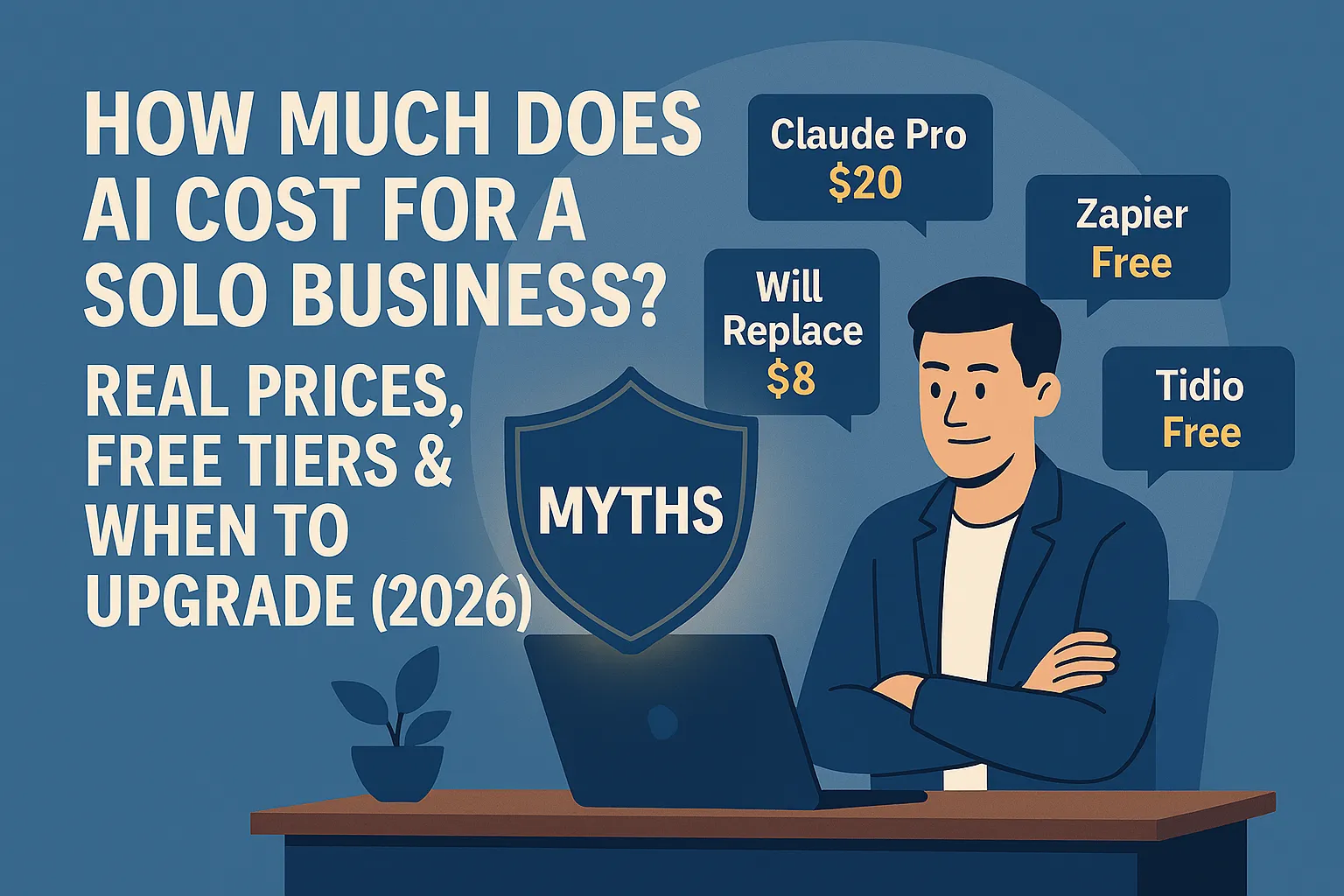
A starter AI stack for a one-person business costs between $0 and $50 per month. Specifically:
A general AI assistant — Claude Pro or ChatGPT Plus — at $20/month handles 80% of writing, research, summarization, and thinking-partnership use cases. The free tiers of both work for testing before you pay anything.
If you want to automate tasks between apps, Zapier's free tier handles five basic automations, which is enough to start. The $20/month plan handles most solo founders' needs.
If you want a customer-facing chatbot, Tidio's free plan covers basic FAQ automation for a small site.
That's $20–40/month total. Against the hours it saves, the ROI is not a close calculation. The question is never whether it's affordable. The question is whether you'll actually implement it rather than let the subscription sit unused.
The real risk of not using AI
There's a version of this question that doesn't get asked enough: what's the cost of not using AI?
You're not competing against other solo founders who aren't using AI. You're competing against solo founders who are. In the same hours, they're producing more content, responding faster, researching better, and operating with less friction. The gap between an AI-augmented solo business and a manual one is widening. It's not dramatic yet, but it compounds.
More practically: if you're spending 3 hours a week on tasks AI could handle in 45 minutes, that's 2+ hours a week you're choosing not to invest in growth. Over a year, that's roughly 100 hours — about 12 full work days — you could have put toward clients, products, or just finishing work at a reasonable hour.
That's the honest cost of the status quo.
How to start without wasting a week setting things up
If you've decided AI is worth it for your business, here's the only approach that actually works for beginners: start with one task, not one tool.
Don't ask "which AI tool should I get?" Ask "what's the most painful repetitive thing I did this week?" and then ask "can I solve this with AI in the next hour?"
In most cases the answer is yes, and the tool you need is already available for free.
The founders who get lasting ROI from AI are the ones who solve one thing, see it work, and build from there. The ones who sign up for five tools and try to transform their operations in a weekend are the ones who write in forums six months later saying AI didn't work for them.
One thing. This week. See what happens.
Do this today: Open Claude.ai (free). Type out the one task you do every week that feels like execution work — not thinking, just doing. Ask Claude: "How could you help me with this?" Read what it says. Try it on a real example. That 20-minute experiment will tell you more about whether AI is worth it for your specific business than anything else you'll read today.
Next in AI Basics: AI for Solo Founders vs. AI for Big Companies — Why It's Completely Different →



Comments (0)
Leave a Comment