

Most AI advice skips the question that actually matters first.
Not "which tools should I use?" Not "how do I automate my business?" Not "how do I build a seven-figure operation with AI?" Those questions all assume something that hasn't happened yet: that you know where you currently stand and what's genuinely appropriate for your situation.
Start with the wrong tool for your level and you'll hit friction, conclude AI doesn't work, and spend the next six months avoiding the thing that could have saved you eight hours a week. Start with the right use case for the wrong type of business and you'll get results that feel marginal — not because the approach is wrong in principle, but because it's wrong for the specific shape of your work.
This section of AI Basics exists to solve that before anything else. Not to tell you to try everything. To help you find the specific starting point that fits where you actually are, so that your first experience with AI in your business is one you'll want to repeat.
Why starting point matters more than tool selection
The AI tool landscape in 2026 is not suffering from a shortage of options. Solo-founded startups have surged from 23.7% to over 36% of new businesses in just six years, and tool vendors know it. There are hundreds of AI tools competing for the solo founder's attention, many of them marketed with the same vocabulary: no code, no team, build in a weekend, scale to seven figures.
The problem isn't access to tools. It's knowing which one to start with given where you actually are.
Here's what actually causes most AI adoption failures at the solo founder level. Not bad tools. Not complexity. The failure mode is a mismatch between the founder's current stage and the sophistication of what they're attempting. A founder who has never built a consistent AI habit trying to set up a multi-step AI agent workflow will fail — not because the workflow is wrong in principle, but because the foundation isn't there yet. A founder spending their second week in AI basics reading advanced automation playbooks will feel behind and overwhelmed, even though they're exactly where they should be.
The right starting point is determined by two things: where you are in AI adoption right now, and what type of business you're running. Get both of those right, and the tools almost select themselves.
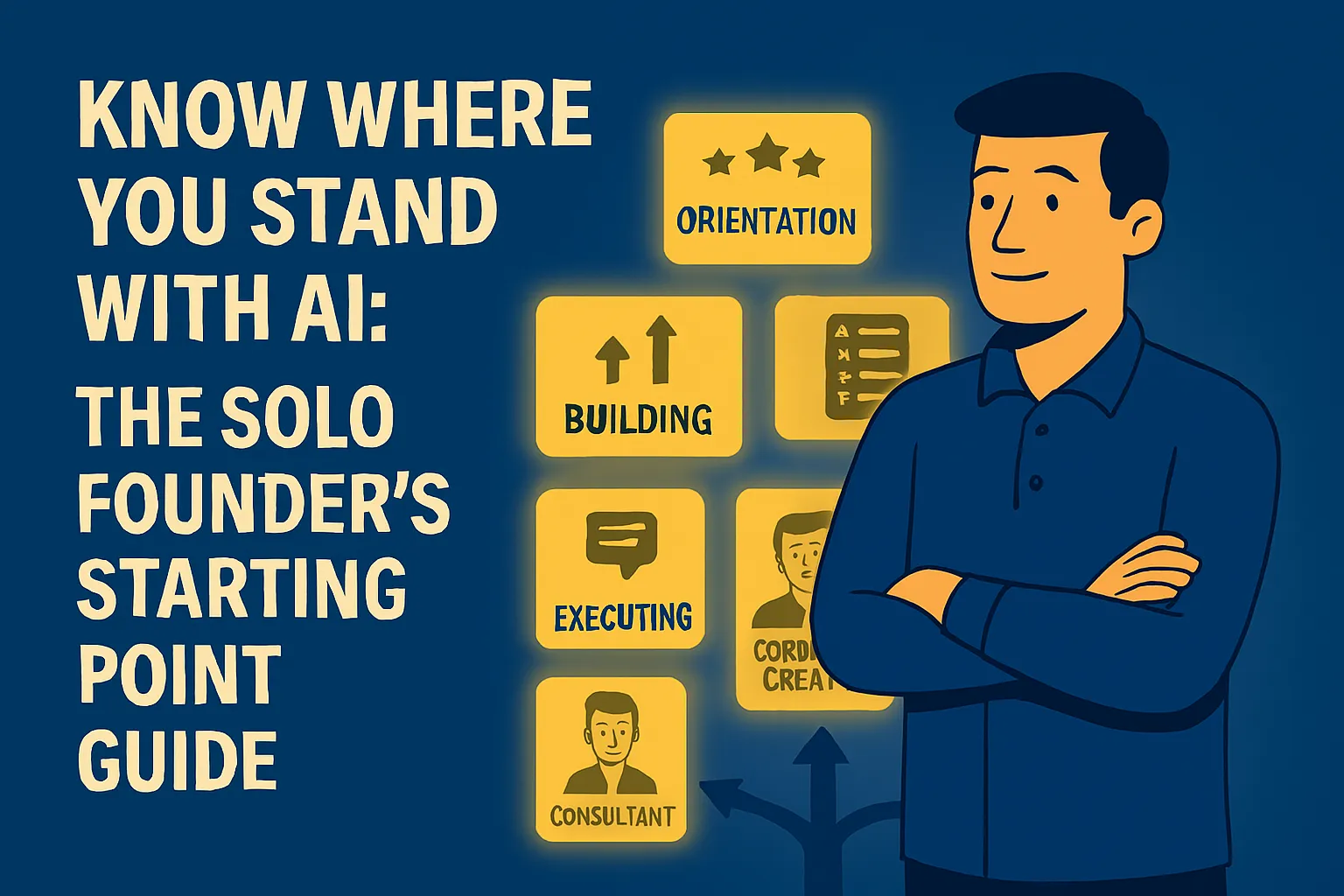
Find your AI level: Beginner, Building, or Executing
Before choosing any tool or workflow, you need an honest picture of where you are. The three levels aren't a hierarchy of worth — they're a sequence of readiness. Every advanced user started at Level 1.
Level 1 — Orientation. You haven't properly started yet. You may have opened ChatGPT once or twice but don't have a consistent habit. AI feels foreign, outputs feel generic, and you're not confident you know how to make it useful for your specific situation. The issue isn't skill — it's exposure. You haven't had enough good experiences with the right tools on the right tasks to build a foundation.
Level 2 — Building. You've started. You use AI sometimes — usually for writing, occasionally for research — and you get useful results, but inconsistently. You haven't committed AI to any specific category of work yet. The pattern is reactive: you reach for it when something feels like a good fit, not because it's your established default.
Level 3 — Executing. AI is genuinely embedded in how you work. You use it across multiple functions. You have at least one automation running. You write prompts that get what you need. You know where AI helps in your specific business and where it doesn't.
Not sure which level describes you? The full diagnostic — with ten specific questions and detailed next steps for each result — is here:
→ AI Maturity Quiz for Solo Founders: Find Out Where You Actually Stand
Take this before anything else if you're unsure. The quiz result determines which content in this section is most relevant to where you are right now.
Understand the tool landscape before picking
One of the most common ways solo founders waste time with AI is choosing a tool before understanding the category it belongs to. They sign up for an automation tool when they need an AI assistant. They try to use a general AI chatbot for something that needs a specialist tool. They invest time in learning a category 4 product (AI agent builders) before they've built the habits that make category 1 products valuable.
The four categories of AI tools that matter for solo founders — in the order you should encounter them:
AI Assistants are conversational AI tools you talk to: Claude, ChatGPT. You type something, they respond. This is your foundation. Every other category depends on having built a working habit here first. If you don't have this, start here.
Automation Tools connect your apps and run workflows automatically when triggers happen: Zapier, Make.com. You define the rules; they execute without you. This is your second category — relevant once you have repeating manual processes that move data between tools.
AI-Enhanced Specialist Tools do one job extremely well with AI built in: Otter.ai for meeting transcription, Tidio for customer-facing chatbots, Notion AI for workspace writing. You install them for a specific function, not as a general assistant.
AI Agent Builders let you create something that works like a small autonomous assistant — taking a goal and figuring out how to achieve it across multiple steps and tools. This is the most powerful category and the most complex. It's Level 3 territory.
The complete breakdown of all four — what each category can and can't do, the specific tools in each, and how to evaluate new tools before signing up — is here:
→ AI Tool Categories Explained for Non-Technical Founders (And Which You Need First)
The five use cases that work regardless of where you
Every level, every business type, every archetype has one thing in common: there are five specific tasks that AI handles well from day one, require no setup beyond a free account, and save real time the first time you try them.
Drafting emails you write repeatedly. Follow-ups, proposals, client check-ins, enquiry responses. Give AI the context, get a draft, edit and send. The blank page disappears.
Summarizing documents and long reads. Paste in a report, a contract, a long email thread. Ask for the three things you need to know. What took an hour takes ten minutes.
Researching a lead or prospect before a meeting. Give AI everything you have on the person or company — website, LinkedIn summary, emails. Ask for a meeting brief. Go in prepared every time instead of sometimes.
Repurposing one piece of content into multiple formats. Write the original once. Ask AI for the LinkedIn version, the newsletter version, the social posts. Your content operation shrinks from a full day to a morning.
Answering your most common customer questions. Use AI to write template responses for your five most repeated enquiries. Or deploy a chatbot that handles them entirely. Either version recovers meaningful time from your inbox.
Each use case has a specific prompt structure, an honest note on where it breaks down, and a realistic time estimate:
→ The 5 AI Use Cases That Work on Day 1 for a Solo Business
Match your AI approach to your type of business
Where you are on the maturity curve determines when to start. But the type of business you run determines where to start — which use cases create the most leverage for you specifically, which tools are most relevant, and which risks to watch for.
Four archetypes, four different AI priorities:
Service providers (designers, writers, developers, bookkeepers, coaches) — your leverage is throughput. AI's biggest contribution is eliminating from-scratch drafting on proposals, client emails, and deliverables. Every hour recovered is a direct capacity gain.
Consultants — your leverage is research velocity and preparation quality. AI compresses the research and synthesis phase, which means you get to the strategic thinking faster. The billing model question — as AI compresses work that used to justify hours-based fees — is also a competitive positioning opportunity worth engaging with directly.
Content creators — your leverage is content operations. AI handles the mechanical production layer (structure, research, reformatting) so your perspective, voice, and specific takes remain the differentiator while output volume and consistency improve.
Product founders — your leverage is parallel execution. AI speeds up development, handles customer support at scale, and generates marketing output, letting you move across all three functions without the context-switching cost that normally slows solo product businesses.
Which archetype sounds like you? Which starting recommendation matches your biggest current time drain? The full breakdown — with specific tools, concrete starting recommendations, and honest notes on what AI doesn't help with in each archetype — is here:
→ What Kind of Solo Founder Are You? (And Which AI Approach Fits Each)
Your personalized next step
This section gives you four ways to find your starting point. The right path depends on where you are:
If you genuinely don't know your level yet — take the maturity quiz first. Ten questions, honest answers, a result with a specific next step. That's the entry point.
If you know you're at Level 1 and have never really tried AI — go straight to the five day-one use cases. Pick the one that matches your biggest manual time drain this week. Do it with AI. That first experience is the foundation everything else builds on.
If you've tried AI but felt stuck or inconsistent — read the tool categories article. The most common cause of disappointing results is using the right tool for the wrong job, or not knowing what category of tool to reach for. Understanding the landscape fixes this.
If you know your level but aren't sure how AI fits your specific type of business — read the archetypes article. Your business type determines which use cases create the most leverage for you, which the general advice misses entirely.
There is no universal starting point. But there is a right starting point for your specific situation. The content in this section is built to help you find it.
All articles in this series
Know Where You Stand — the full reading path:
AI Maturity Quiz for Solo Founders: Find Out Where You Actually Stand → — Ten questions, three result levels, specific next steps for each. Your diagnostic entry point.
The Solo Founder AI Stack for Beginners: Start With These 3 Tools → — Opinionated, specific, priced. Not a 50-tool roundup — three tools, why each, how to start without overwhelm.
AI Tool Categories Explained for Non-Technical Founders (And Which You Need First) → — AI assistants, automation tools, specialist tools, agent builders — what each category does and why the order you encounter them matters.
The 5 AI Use Cases That Work on Day 1 for a Solo Business → — Five specific tasks, five copy-paste prompts, realistic time estimates, honest limits. Start here if you want to try something today.
What Kind of Solo Founder Are You? (And Which AI Approach Fits Each) → — Service provider, consultant, content creator, product founder — your archetype determines your starting point and your highest-leverage use cases.
Ready to move beyond orientation? Head to the next section: Series 3 — First Wins: Get AI Working in Your Business This Week →
Or go back to the full AI Basics hub: ← AI Basics for Solo Founders



Comments (0)
Leave a Comment