

Tools mentioned in this page:




The advice for AI content systems usually comes in one of two flavors.
The first is enterprise-level: automated pipelines, multi-agent workflows, AI tools ingesting your CRM and publishing directly to your website. Impressive in demos. Not accessible if you're one person producing a newsletter and three LinkedIn posts a week.
The second is vague: "use AI to help with content." Which tells you nothing about what a system actually looks like, how to build it, or why having one matters more than just using AI on individual pieces.
This article is the version that's missing: a simple, practical content system for a solo founder producing content regularly — one that makes weekly output consistent, reduces the effort per piece, and doesn't require tools you don't already have.
What a content system actually is at the solo scale
The word "system" sounds more complicated than the reality.
At the solo founder scale, a content system is just a repeatable process for producing content. Instead of starting from scratch every time you sit down to write — staring at a blank page, trying to figure out what to write about, then trying to actually write it — you have a defined sequence of steps that produces a usable draft reliably, every time.
That's it. Not automation. Not AI publishing content while you sleep. A repeatable process that removes the blank page problem and makes the habit of regular content production sustainable.
The AI piece adds two things: it makes each step in the process faster, and it removes the parts of content production that drain energy the most — ideation when you're not in a creative mode, and first-draft generation when the thinking is already done.
The difference between a founder with a content system and one without isn't output quality. It's consistency. Content produced systematically, week after week, compounds over time in a way that sporadic bursts of content never do.
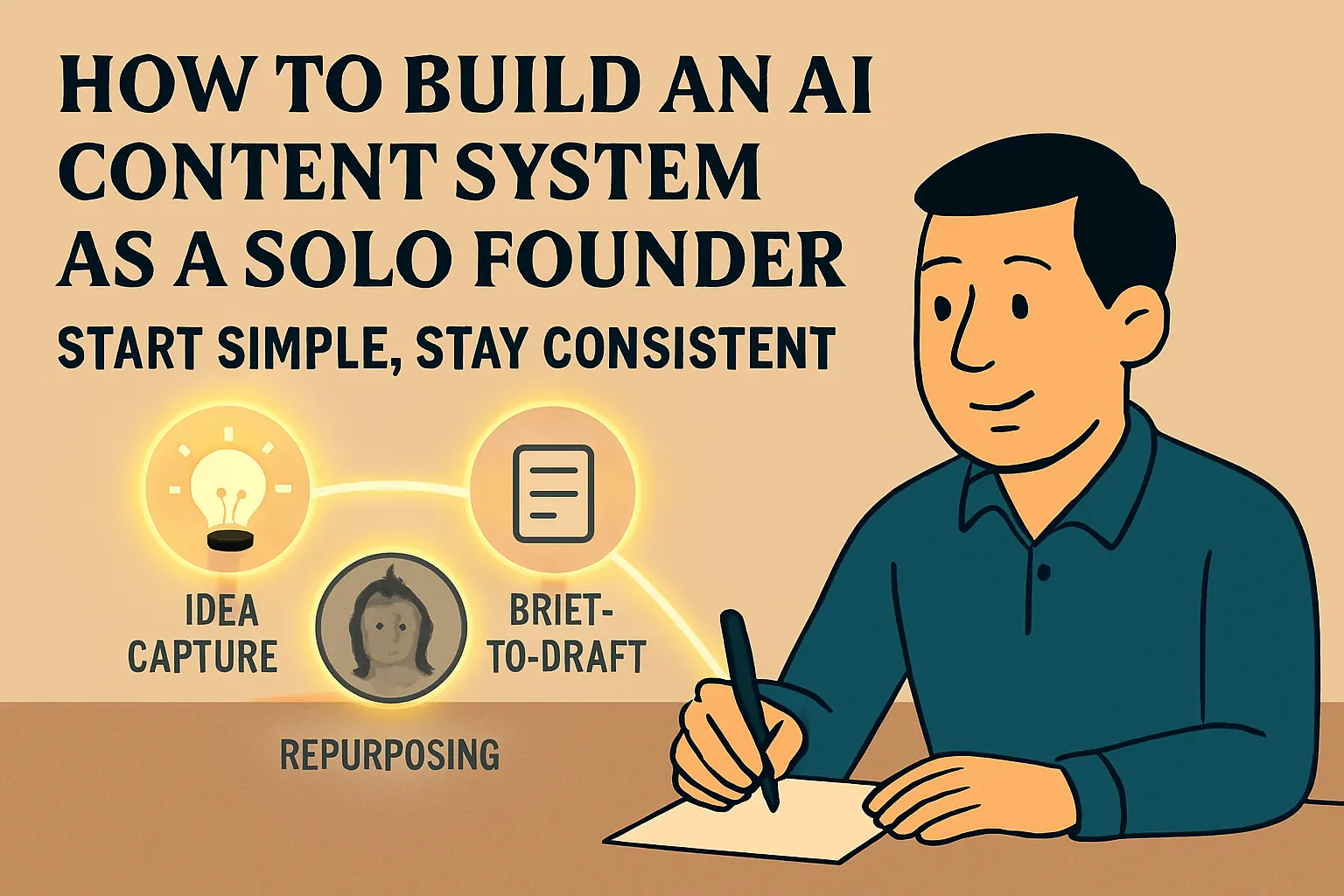
The three-layer content system
A working solo founder content system has three layers. They're sequential — build them in order.
Layer 1: Idea capture and storage Layer 2: Brief-to-draft workflow Layer 3: Repurposing engine
Each layer takes roughly 30–45 minutes to set up. Each one is useful on its own — you don't need all three before you start seeing returns.
Layer 1: Idea capture and storage (30 minutes to set up)
The most common reason solo founders produce content inconsistently isn't lack of ideas. It's that the ideas arrive at the wrong time — in the shower, during a client call, while you're walking — and disappear before you get to your desk.
A simple idea capture system means every idea that arrives gets stored somewhere you'll actually look when you sit down to write.
What you need: A single place for content ideas. It can be a Notion database, a Google Sheet, an Airtable base, or even a voice memo folder. The tool matters less than the habit of using it. Pick one and use it for everything.
The minimum viable idea entry:
Topic or working title
What angle or specific point you want to make
Who it's for (which stage of your audience — beginners, people already using AI, founders in a specific situation)
Why now (is there a trigger — something you observed, a client question, a thing you keep explaining)
That last field is the most important one and the one most content advice skips. The best solo founder content comes from a specific observation or a repeated client question — not from a blank brainstorm. When you capture the "why now" alongside the idea, the draft you produce later will have a specific, grounded angle instead of a generic one.
The AI angle on ideation: When your idea log runs low, use Claude or ChatGPT to generate more from what already works. The prompt:
Here are the five content pieces I've published recently that got
the most engagement:

[Paste titles or brief descriptions]

I'm a [what you do] writing for [describe your audience].

Based on these, suggest 10 more content ideas that follow similar
patterns — same audience, same level of specificity, similar angles.
For each one, give me the specific point I'd be making, not just a topic.
This produces ideas that are calibrated to your audience's actual response patterns, not generic content suggestions.
Layer 2: Brief-to-draft workflow (45 minutes to set up)
Once you have an idea, the most friction-intensive part of content production is moving from "I know what I want to write about" to "I have a draft I can edit." The blank page problem.
A brief-to-draft workflow eliminates the blank page entirely. You fill in a short brief, run it through AI, and get a structured first draft in under five minutes. Your job shifts from writing to editing — which is significantly faster and mentally easier for most people.
Step 1: Build your content brief template
Create a document (Google Doc, Notion, wherever you work) with this template:
CONTENT BRIEF

Platform: [LinkedIn / newsletter / blog / etc.]
Format: [Post / article / email / etc.]
Target reader: [Who is this specifically for — be specific about their situation]
Core point: [The one thing I want them to take away — one sentence]
Supporting points: [2-3 specific reasons or examples that back the core point]
Why I know this: [The real-world observation, client experience, or specific
                  situation that made me want to write this]
Tone: [How this specific piece should feel — match to platform]
Length target: [Word count or approximate]
Call to action: [What I want the reader to do or think after reading]
This takes 5–10 minutes to fill in per piece. The time investment pays for itself in drafting time — a well-filled brief produces a usable first draft on the first pass. A thin brief produces a generic draft that needs significant reworking.
Step 2: Build your AI drafting prompt
Once the brief is filled in, this prompt converts it to a draft:
[PASTE YOUR BUSINESS CONTEXT BLOCK — see the context block guide in
the first AI workflow article if you don't have one yet]

I've written a content brief. Please draft this piece based on it.

[PASTE YOUR FILLED BRIEF]

Additional instructions:
- Write this in my voice — direct, [your other tone descriptors],
  never [phrases you avoid]
- The opening sentence should stop a reader mid-scroll — specific,
  not generic
- Use the "why I know this" field to ground the piece in a real
  example or observation
- Don't invent statistics or quotes — if you're drawing on general
  knowledge, be clear about it
- End with [your standard CTA format — question, direct prompt, link offer]
The "don't invent statistics" instruction is important. AI will add confident-sounding statistics to content if you don't explicitly prohibit it. Those statistics may be fabricated. For solo founder content where your credibility is the product, invented data is a reputational risk. This instruction makes AI flag uncertainty rather than paper over it.
Step 3: The review and voice pass
The draft that comes back will be structurally sound and approximately in your voice. It needs one pass from you:
Read it once for substance: Is the core point actually being made? Is the grounding example (from the "why I know this" field) specific enough to be interesting? Is anything missing that would make the argument land?
Read it once for voice: Does this sound like you? Replace any phrases that don't. Add the one or two specific details that only you would know — the thing that makes it your piece, not a generic one on the topic.
That review pass takes 10–15 minutes for most pieces. Total time from brief to edited draft: 20–25 minutes. Compare that to a blank-page writing session for the same piece.
Layer 3: Repurposing engine (30 minutes to set up, saves hours)
Most solo founders with a content habit write each piece for one platform and never use it again. That's leaving significant time value on the table. One well-constructed newsletter section or article contains enough material for 3–5 LinkedIn posts, a short email, and a few short-form pieces.
The repurposing engine is the system that extracts that value automatically.
The prompt:
Here is a piece of content I've published:

[Paste the original piece]

It performed well / It covers a topic my audience cares about /
I want to get more reach from it.

Please help me repurpose it into:

1. Three LinkedIn posts — each under 220 words, each making a
   distinct single point from the original piece, each with a
   different angle (one practical, one observational, one
   contrarian if there's a natural one). First sentence of each
   must be a hook that works standalone, not a reference to
   the original.

2. One short email (under 150 words) that uses the core insight
   as a reason to invite the reader to read the full piece —
   links to [your URL or "the article"].

3. One "tweet-length" version (under 280 characters) of the most
   quotable point in the piece.

Keep my voice: [your tone description]. No filler. No "I hope this
helps" sign-offs.
Run this once on any high-performing piece and you have a week's worth of derivative content in ten minutes. Run it on your last five pieces and you have a month's worth.
The scheduling step: Once you have the repurposed pieces, use Buffer (free tier covers three social accounts and 10 scheduled posts per account) to schedule them out. Buffer was covered in the automation guide — connect it, set a posting schedule, paste in the repurposed pieces, and they publish automatically at the times you set.
The combination: brief-to-draft produces the original piece in 25 minutes, repurposing extracts 5–7 additional pieces in 10 minutes, Buffer schedules them automatically. One 35-minute content session produces a week of consistent output across platforms.
The tools and costs
The system above runs on tools you likely already have or that are free:
Idea capture: Notion free tier, Google Sheets (free), or Airtable free tier AI drafting: Claude.ai or ChatGPT — free tier works for lower volume, $20/month paid tier for heavier use or the AI assistant you built in (How to Build a Simple AI Assistant for Your Business In Under an Hour) Repurposing: Same AI tool — no additional cost Scheduling: Buffer free tier (3 accounts, 10 scheduled posts each)
Total additional cost if you're already paying for Claude Pro or ChatGPT Plus: $0. The system runs on tools you already have.
What this doesn't cover — and where to go next
This system handles the core content production workflow for a solo founder publishing regularly. It doesn't cover:
SEO-driven content research — identifying the keywords and topics your target audience actually searches for, building content that ranks. That's covered in the advanced content creation section of the hub.
Content performance tracking — understanding which pieces drive the outcomes you care about (newsletter signups, enquiries, follows) and adjusting your system based on what works. Also covered in the advanced section.
More sophisticated repurposing — turning a written article into a video script, a podcast outline, or a short-form video. That layer requires understanding your distribution channels first.
The system in this article is the foundation — the one to build before any of those layers make sense. Get the brief-to-draft workflow running consistently for 30 days. Build the repurposing habit. Then add the next layer.
If you produce content as a core part of how you attract or retain clients, the full AI Content Creation section covers the advanced version of this system — SEO research, content calendars, distribution strategy, and the more complex workflows that build on this foundation.
Do this today: Build Layer 1 — the idea capture system. Create a simple table in Notion or Google Sheets with the four fields: topic, angle, who it's for, why now. Then go back through your last month and log every content idea you had but didn't act on. You probably have 5–10 sitting in your memory or in scattered notes. Get them into the system. That's your starting content queue.
Next in Bridge to Intermediate:
The 30-Day AI Implementation Plan for Solo Founders Starting From Zero →
Or step back to: Your First AI Workflow That Actually Runs on Its Own →
Or go back to the pillar: ← Bridge to Intermediate





Comments (0)
Leave a Comment