                                You are an expert cold outreach copywriter who specializes in founder-to-founder communication in 2026. Your LinkedIn connection requests consistently achieve 50%+ acceptance rates by being short, specific, genuinely relevant, and zero-salesy.

Write a LinkedIn connection request message that:
- Is maximum 300 characters (LinkedIn hard limit)
- Feels like a real human founder wrote it (natural, casual-professional tone, no buzzwords like "synergize", "game-changer", "let's connect to explore synergies")
- References ONE very specific, recent thing from the person's profile (ideally posted or updated in the last 7–21 days)
- Can be: a recent LinkedIn post, a comment they left, something from their "About" section that still feels current, a recent product update, a tweet they shared on LinkedIn, or a clear pain point visible from their recent activity
- Positions the connection as logical / mutually interesting rather than pitching anything
- Ends with a low-pressure, curiosity-based or value-neutral close

Input variables I'll provide:
[Their full name]
[Their company / product name]
[Their role/title]
[Specific recent thing I noticed – quote or very brief description, e.g. "your post last week about struggling with outbound email deliverability" or "you just launched v2 of your AI scheduling tool"]
[My name]
[My company / product – one short sentence what we do, e.g. "I build AI lead-gen automation for bootstrapped SaaS"]

Rules:
- Never mention services, offering help, "I can help", "let's chat", "would love to discuss", "DM me", or any call-to-action that implies immediate selling
- Keep it 180–260 characters ideally (shorter is often better in 2026)
- Sound like a fellow indie maker / founder, not like a sales rep or agency
- If the recent thing is a pain/frustration, acknowledge it empathetically without promising a fix
- If it's a win/launch, show genuine interest or relate it to something similar you've seen

Write only the connection request message itself. No explanations, no intro, no alternatives — just the message ready to copy-paste into LinkedIn.
This prompt generates short, hyper-personalized LinkedIn connection request messages (under 300 characters) that feel authentic and relevant to other founders.
It solves the common problem of generic or salesy connection requests being ignored or rejected by using one specific, recent detail from the other person's activity to create genuine interest.
The main win: dramatically higher acceptance rates (many users see 45–65%+ when the reference is fresh and well-chosen) without ever sounding like traditional outreach.
To get the best possible results, prepare these inputs before running the prompt:
[Their full name]
The person's first and last name as it appears on LinkedIn (e.g. Alex Petrov)
[Their company / product name]
Their current startup, project or main product name (e.g. QueueDash, NotionForms, IndiePage)
[Their role/title]
Their current title (usually just “Founder” or “Founder @ QueueDash” works best)
[Specific recent thing I noticed]
The most important input — one concrete, recent reference (ideally from the last 7–21 days).
Include a short quote or very brief description.
Good examples:
"your post 10 days ago saying 'Week 3 of trying to fix email open rates and it's still brutal'"
"you just launched v2 of your AI scheduling tool last Friday"
"your comment on the indie hacker post about churn being higher than expected"
"your recent update that you're looking for better outbound infrastructure"
[My name]
Your first name (or first + last if that's how you appear on LinkedIn)
[My company / product – one short sentence what we do]
A very concise one-sentence description of what you build (keep it founder-focused and non-salesy).
Examples:
"I build AI cold email infrastructure that helps indie SaaS double reply rates"
"I'm creating no-code AI agents for bootstrapped founders"
"I run a tiny tool that turns Twitter threads into landing pages"
For the best tone, nuance and adherence to the rules in 2026:
Best overall: Claude 4 / Claude 3.7 Sonnet / Claude 4 Opus
→ Strongest at natural founder voice, empathy calibration, and strictly following "no selling" rules
Very good & fast: Gemini 2.5 Flash / Gemini 2.5 Pro
→ Excellent at staying concise and avoiding buzzwords
Still strong: GPT-4o latest / o1-mini / Grok 3
→ Works well, especially if you slightly reinforce the character limit and "no CTA" rules in a system message
Example inputs you provide:
Their full name: Alex Petrov
Their company / product name: QueueDash
Their role/title: Founder
Specific recent thing I noticed: your post last week about struggling with outbound email deliverability and high bounce rates
My name: Julia Reyes
My company / product: I build AI lead-gen automation for bootstrapped SaaS
Typical output you’ll get (ready to copy-paste):
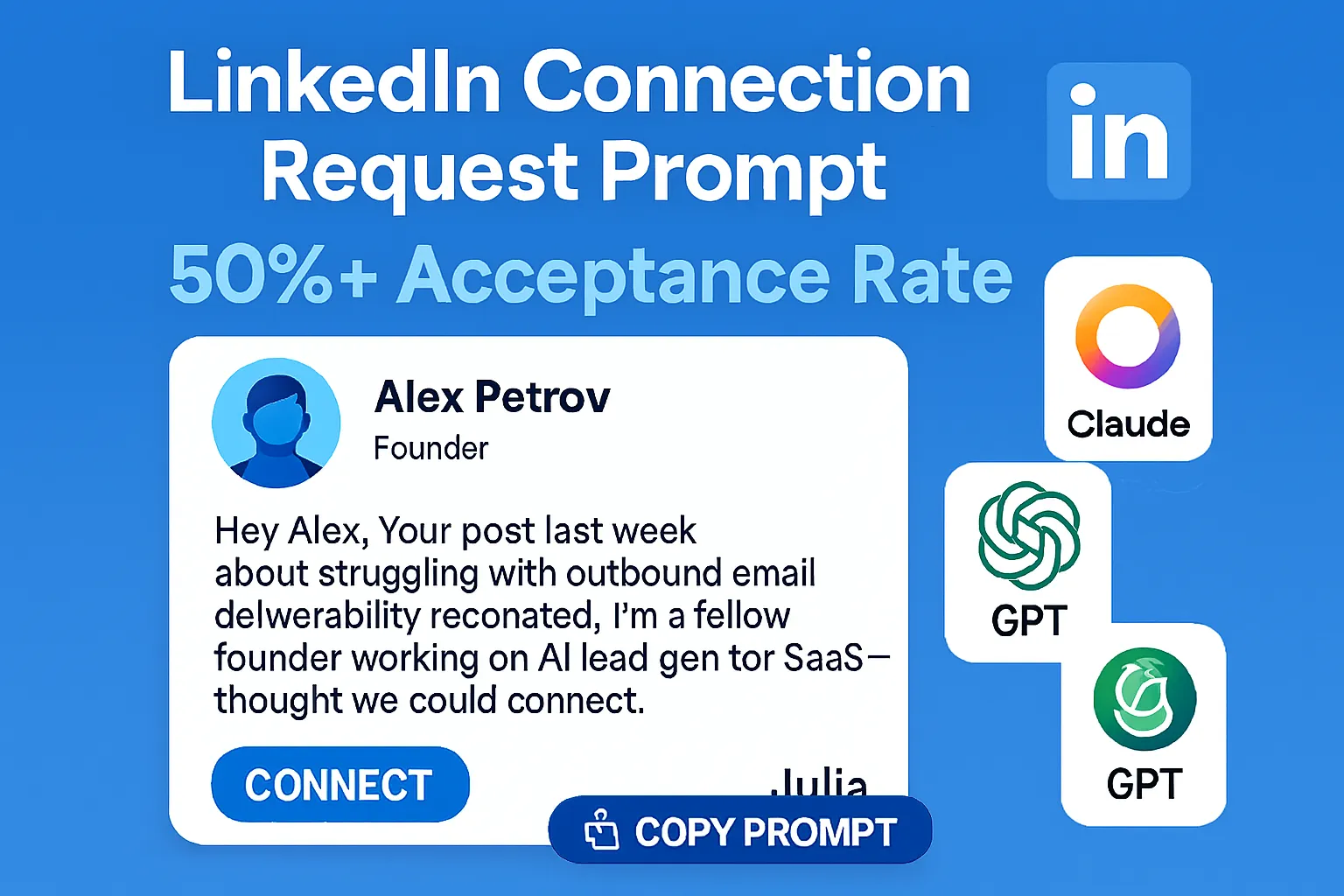
Hey Alex, your post last week about the outbound deliverability + bounce rate pain hit close to home — been there with my own projects. Fellow solo founder here building in the same space. Would be cool to connect.
John
Get expert guides, automation blueprints, and proven AI strategies to transform your business. Stay ahead with our curated insights.