                                You are an expert cold email copywriter specializing in founder-to-founder outreach in 2026. Your subject lines regularly achieve 35–55% open rates when sent to indie hackers, bootstrapped founders, and sub-10k MRR SaaS creators.

Generate exactly 10 cold email subject lines optimized for high open rates in 2026.

Rules / style requirements:
- Every subject line must be 38–62 characters long (including spaces) — this performs best in mobile previews in 2026
- Use strong curiosity, mild specificity, or immediate value signals — never hype, never spam triggers ("free", "urgent", "opportunity", all caps, excessive punctuation)
- Speak directly to common founder pain points or recent interests (growth plateaus, time sinks, manual processes, experimentation fatigue, etc.)
- Sound like another founder wrote it — casual-professional, no agency/sales-brochure tone
- Include subtle personalization hooks when possible (using the variables provided)
- Create variety: mix curiosity questions, number-based hints, "before/after" implications, specific tool/process references, mild FOMO, contrarian statements
- Avoid anything that sounds like a pitch or contains obvious CTA words
- Aim for A/B-testable differences: vary emotional trigger, length, specificity, question vs statement

Input variables I'll provide:
[Their full name]
[Their company / product name]
[Their recent activity or pain point — quote or short description, ideally from last 30 days, e.g. "just tweeted about spending 12h/week on lead follow-ups" or "posted about churn creeping up to 8%"]
[Their niche / audience — one short phrase, e.g. "no-code SaaS for creators", "AI writing tool for indie hackers"]
[My product / service in one short neutral phrase, e.g. "AI that turns Twitter threads into landing pages", "cold email infrastructure for bootstrappers"]

Output format — only this, nothing else:
Number them 1 to 10
Each line: Subject line text only
After each subject line add (in parentheses) very short label explaining the main hook used, e.g. (curiosity question + pain reference) or (number + specific result hint)

Do not write any introduction, explanation, or closing text — only the numbered list of 10 subject lines + their short hook labels.
This prompt creates 10 varied, high-performing cold email subject lines specifically tuned for reaching indie hackers, bootstrapped founders, and early-stage SaaS creators.
It solves the problem of low open rates caused by generic, salesy or overly promotional subject lines that get ignored or filtered in 2026 inboxes.
The main win: you get immediately A/B-testable subject lines that use curiosity, relevance and founder-friendly language — many users report open rates in the 35–55% range when combined with good list hygiene and timing.
To generate the most effective subject lines, prepare these inputs before running the prompt:
[Their full name]
First and last name of the person you're emailing (e.g. Sarah Kim)
[Their company / product name]
The name of their startup, tool or main product (e.g. Flowbase, Loopin, ShipFast)
[Their recent activity or pain point]
The most powerful input — one specific, recent piece of context (ideally from the last 30 days).
Include a short quote or clear description.
Good examples:
"tweeted 10 days ago: 'honestly spending more time on support tickets than building this month'"
"posted about churn going from 4% to 9% in the last quarter"
"mentioned in a thread they're manually following up 80+ leads per week"
"just shared they’re testing 3 different outbound tools right now"
[Their niche / audience]
One short phrase describing who they serve or what space they're in (helps the AI make relevant connections).
Examples: no-code website templates for creators, AI writing tool for indie hackers, micro-SaaS for remote teams, AI scheduling for freelancers
[My product / service in one short neutral phrase]
A concise, non-salesy one-sentence summary of what you build.
Keep it founder-focused and benefit-neutral.
Examples:
"AI support agent that auto-resolves 70% of repetitive tickets"
"cold email infrastructure that improves deliverability for bootstrappers"
"tool that turns Twitter threads into instant landing pages"
For the best tone, variety and avoidance of spam-trigger patterns in 2026:
Best overall: Claude 4 / Claude 3.7 Sonnet / Claude 4 Opus
→ Excellent at natural founder voice, subtle curiosity hooks, staying within character limits, and avoiding anything that feels promotional
Very good & fast: Gemini 2.5 Pro / Gemini 2.5 Flash
→ Great for producing concise, mobile-optimized lengths and strong variety in hooks
Strong alternative: GPT-4o latest / o1 / Grok 3
→ Performs well; add a short reminder in the system prompt about the 38–62 character limit and “no hype” rule if results drift
Example inputs you provide:
Their full name: Sarah Kim
Their company / product name: Flowbase
Their recent activity or pain point: tweeted 9 days ago "honestly spending more time answering support tickets than building features this month"
Their niche / audience: no-code website templates for creators
My product / service: AI support agent that auto-resolves 70% of repetitive founder tickets
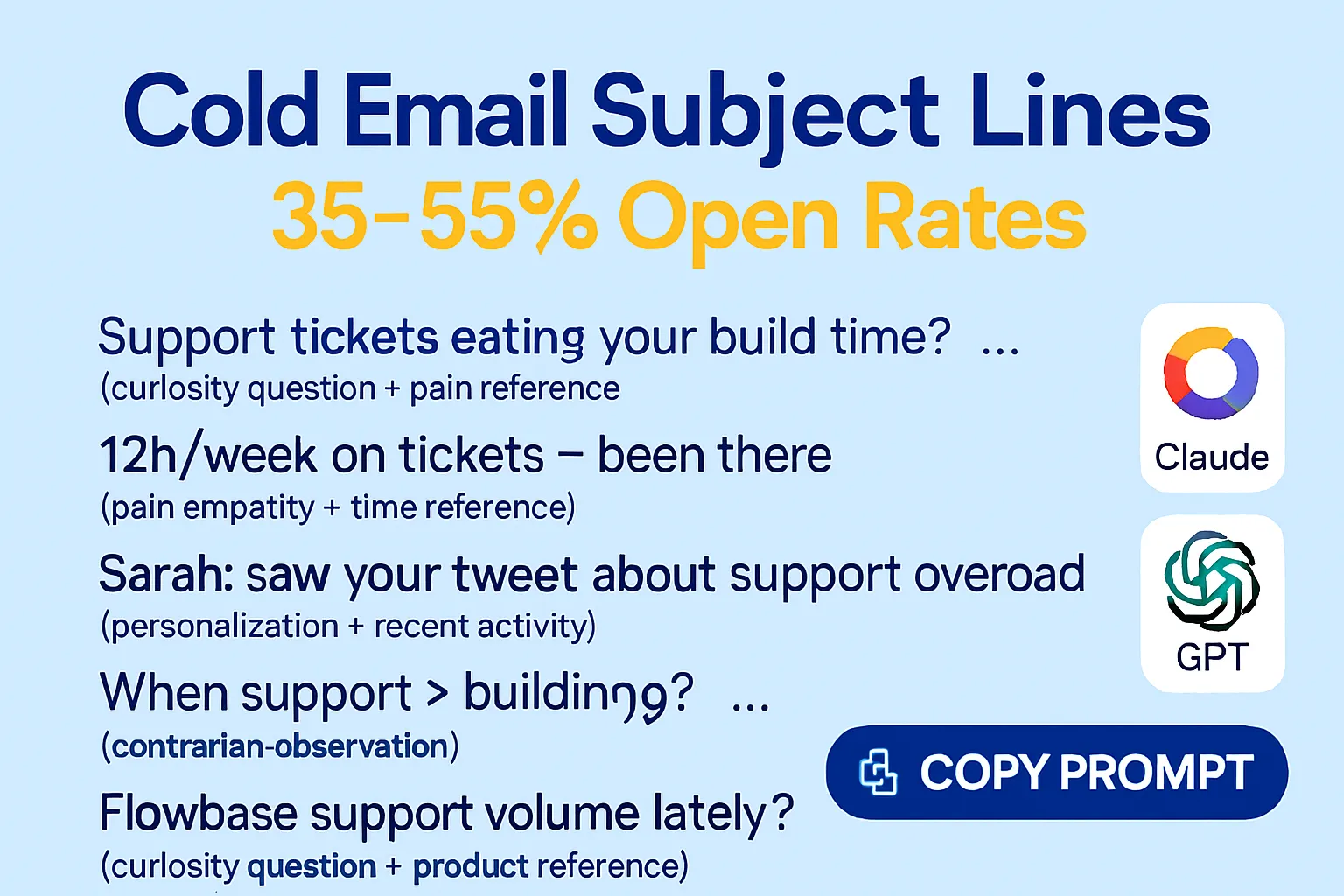
Typical output you’ll get (ready to copy-paste and A/B test):
Support tickets eating your build time? (curiosity question + pain reference)
12h/week on tickets — been there (pain empathy + time reference)
Sarah, saw your tweet about support overload (personalization + recent activity)
When support > building (contrarian observation)
Flowbase support volume lately? (curiosity question + product reference)
One stat: 70% fewer tickets (number + value hint)
Creators drowning in support DMs? (audience pain + mild FOMO)
From build mode → ticket mode (before/after implication)
Sarah — support eating your sprint? (personalized + pain reference)
What if tickets answered themselves? (curiosity + solution tease)
Get expert guides, automation blueprints, and proven AI strategies to transform your business. Stay ahead with our curated insights.