

The Data That Should Stop You in Your Tracks
PwC surveyed 4,454 CEOs across 95 countries and asked them one simple question: is AI actually making you money?
The answer is brutal.
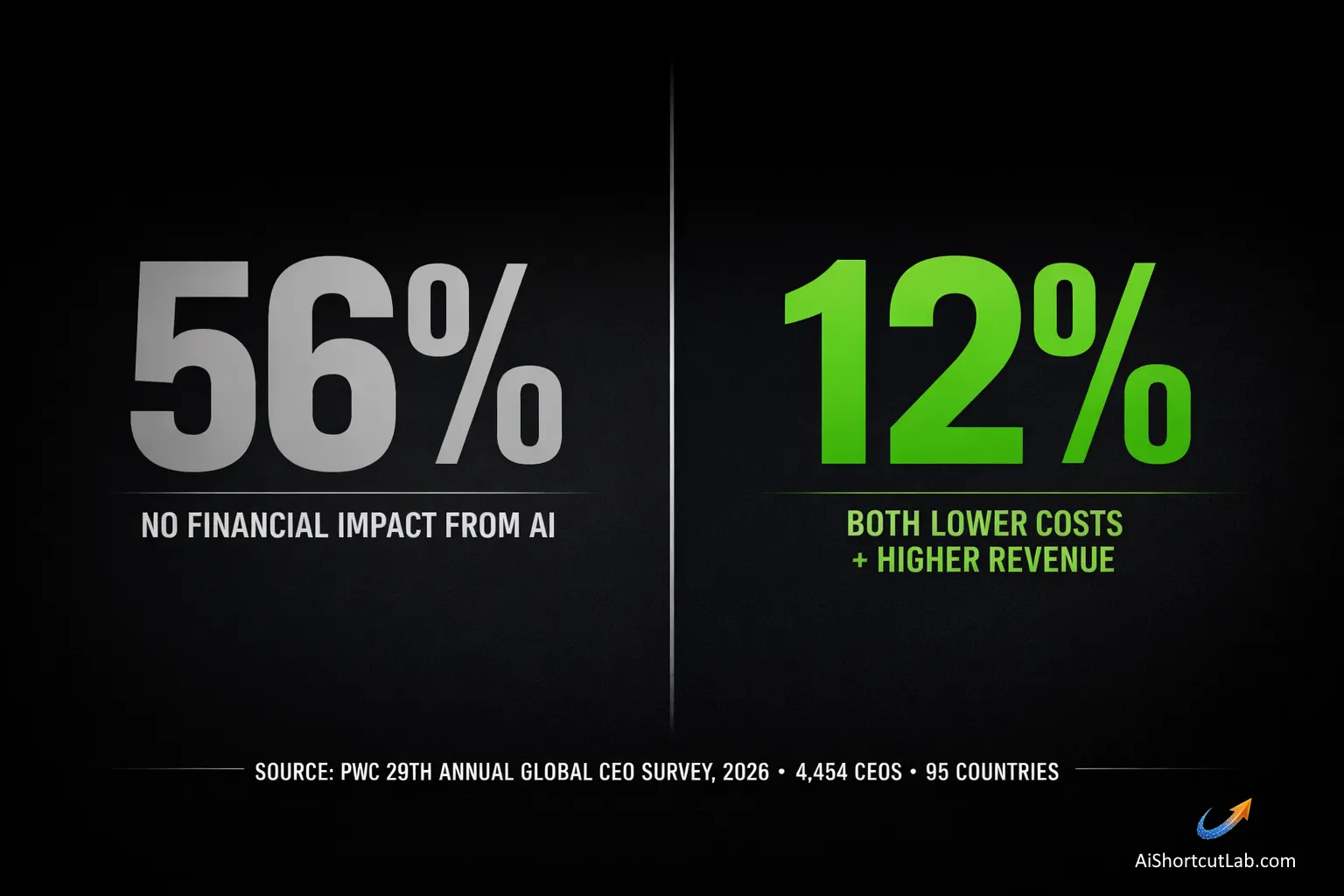
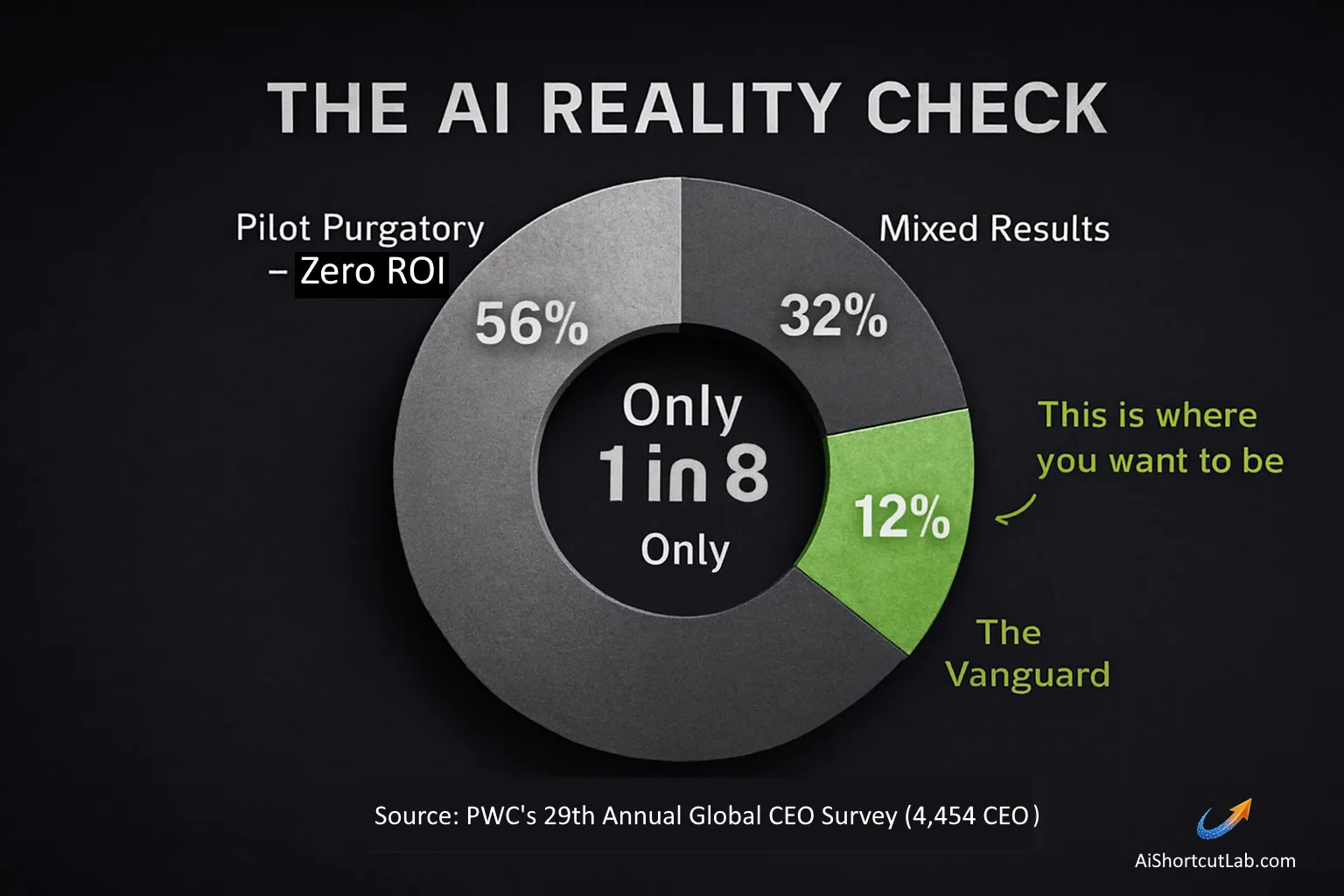
56% of CEOs — more than half — report zero financial impact from AI. No revenue gains. No cost savings. Nothing.
Only 12% — one in eight — have successfully used AI to both cut costs and grow revenue.
These aren't small businesses with no budget. These are the world's largest corporations, sitting on billions in capital, entire AI teams, and enterprise software contracts that cost more per month than most solo founders make in a year.
And they're stuck.
PwC calls it something diplomatically understated: they say companies are running "isolated, tactical AI projects" that "often don't deliver measurable value." The blunter term for what's happening is Pilot Purgatory — a place where AI gets used enough to feel like progress, but never deeply enough to create results.
Here's the thing. If you're a solo founder watching this play out from the sidelines, this isn't discouraging. It's the biggest competitive window you've had in years. And most people aren't looking at it that way.
Why the Giants Are Losing (And Why That's Completely Predictable)
Big companies don't fail at AI because of bad intentions. They fail because of structure.
Here's what actually happens inside a large enterprise that wants to implement AI:
A team identifies an opportunity. They write a brief. Legal reviews it. IT assesses integration risk. A pilot gets approved with a capped budget. The pilot runs for a quarter, produces mixed results (because every pilot does), gets reviewed by a committee, and then — if it's lucky — gets approved for "further exploration."
By the time the company finishes exploring, the tool has already gone through three major updates, the original champion has moved to a different department, and a new team has to start the learning curve from scratch.
PwC's report is refreshingly direct about the root cause. The companies that aren't seeing results are treating AI as a tactical add-on — they're bolting it onto existing workflows rather than rebuilding workflows around it. They're using AI to marginally speed up what they already do, instead of using it to do things they couldn't do before.
The report calls for "enterprise-scale deployment consistent with company business strategy" with "a clearly defined road map for AI initiatives." Which is exactly what bureaucracy makes nearly impossible to execute.
The term that matters here, and the one you should remember, is the difference between using a tool and building a system.
Almost everyone — 56% of the world's biggest CEOs included — is using tools.
A handful of winners are building systems. That distinction is what separates the 12% from everyone else.
What the Winners Actually Do (The "Vanguard" Gap)
PwC identifies the successful 12% with a specific label: the Vanguard.
The Vanguard aren't just using better tools. They've deployed AI differently — across more of their business, and specifically in the parts of the business that touch revenue, not just cost.
Here's the number that matters: 44% of Vanguard companies apply AI directly to their products, services, and customer experiences. Among the remaining 88% stuck in Pilot Purgatory, only 17% do this.
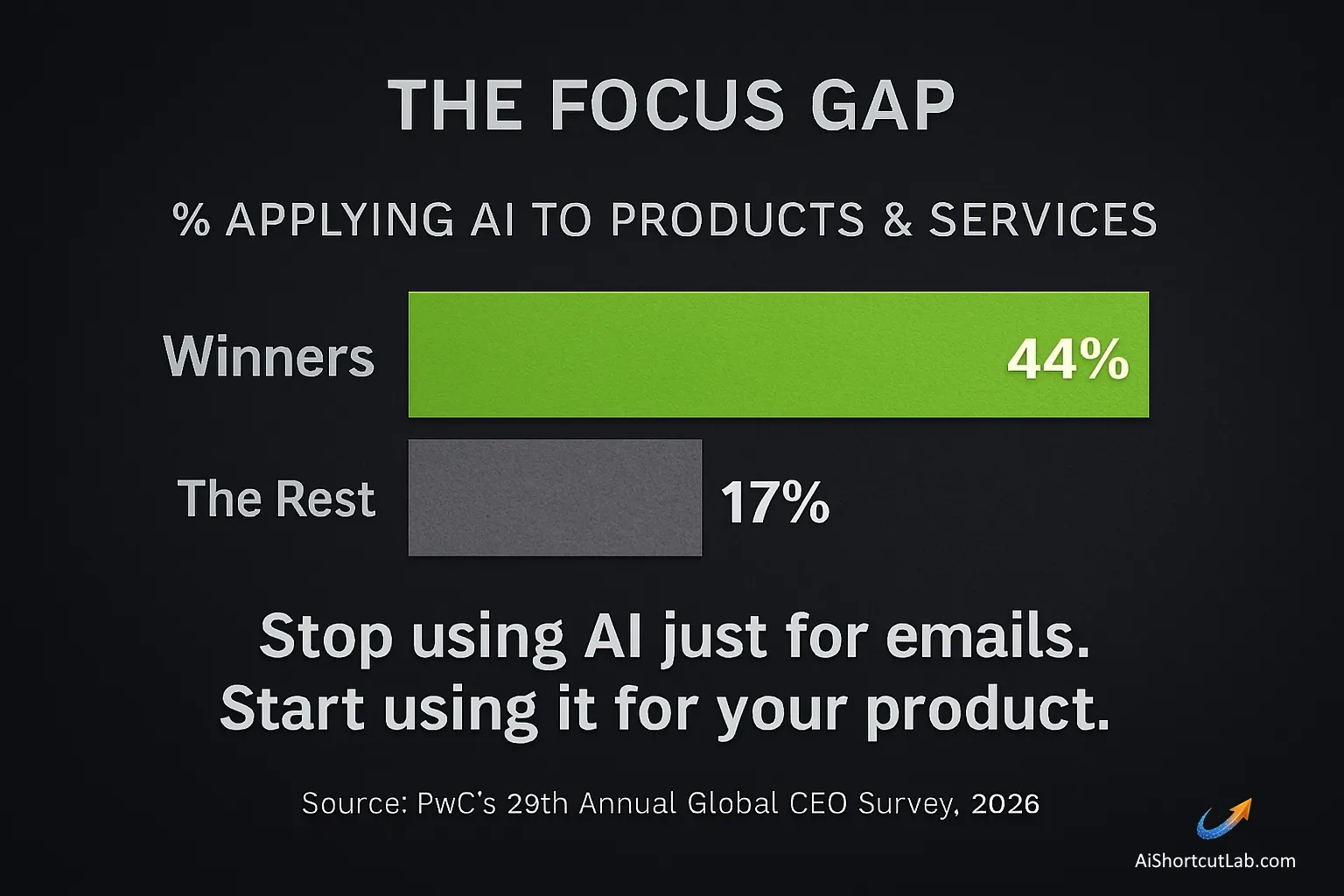
Read that again. The winners are almost 3x more likely to be using AI in what they actually sell — not just in how they operate internally.
This reveals a pattern that makes complete sense once you see it:
The average company uses AI to write internal emails, summarize meeting notes, and maybe help the marketing team generate social posts. It's productive, sure. But it doesn't change what they charge for or how many customers they can serve.
The Vanguard uses AI in the product itself. They're using it to make their service faster, more personalized, or more scalable. They're using it to reach customers they couldn't reach before, qualify leads more intelligently, or deliver outputs that weren't possible without a much larger team.
That's where revenue gets generated. Not from automating your inbox.
The Solo Founder Advantage: Why You Can Do This Faster Than Any CEO
Here's what the PwC report can't say directly (because it's written for corporate audiences), but what the data implies loudly:
Solo founders are structurally better positioned to join the Vanguard than large enterprises are.
Not because you have more resources. Because you have fewer barriers.
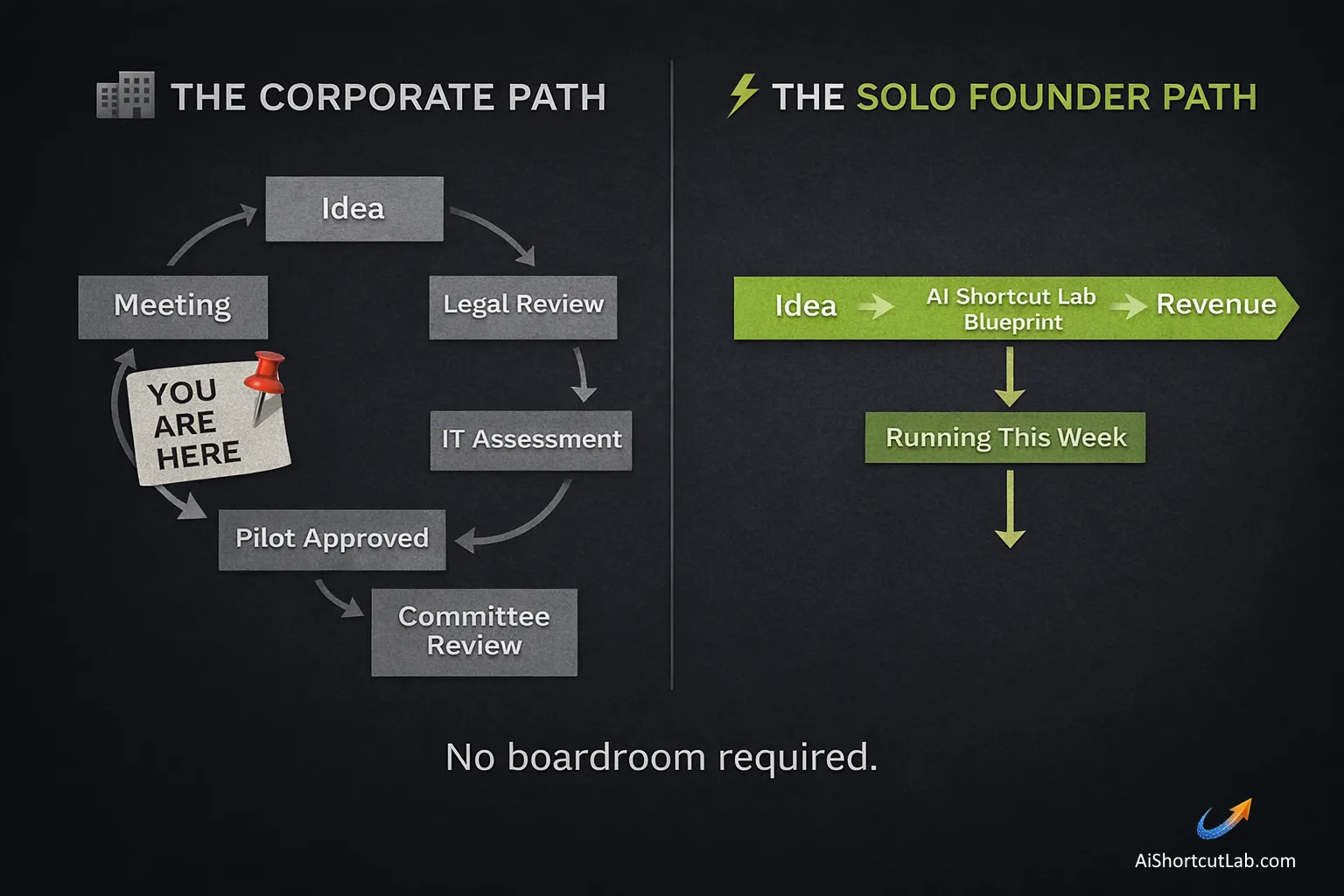
Speed of implementation. When you identify an automation that could save you 10 hours a week, what's your timeline from decision to deployment? Days. Maybe hours. There's no compliance review, no IT dependency, no cross-functional alignment required. You see it, you build it, you test it, you ship it. A large enterprise running the same decision through its normal process would still be in the committee stage six months later.
Full-stack integration. In a large company, the marketing team uses a different system than the sales team, which uses a different system than the support team — and getting those systems to talk to each other requires months of IT work and often a six-figure integration project.
As a solo founder, you are the full stack. Your marketing AI, your sales AI, and your operations tools can be connected in an afternoon. You don't need permission from three departments to build a workflow that crosses functional lines.
No legacy infrastructure to protect. Large companies built their operations on systems that predate AI by decades. Retrofitting AI into those systems is genuinely hard — it requires changing processes that have calcified over years, retraining people who've developed habits around old tools, and managing the political risk of disrupting what's currently working. You don't have that problem. You can build clean.
Alignment between decision and execution. PwC notes that the Vanguard requires "an organisational culture that enables AI adoption." In a solo operation, you are the culture. You don't need to convince a skeptical executive team. You don't need to manage change across departments. When you decide to commit, you're committed.
The CEOs in PwC's survey spend nearly half their time — 47% — on issues with a time horizon of less than one year. They're trapped managing immediate problems, which leaves less time for the transformation work that actually moves the needle.
You have a choice they don't. You can decide today to spend time on building, not just managing.
The Execution Gap Is Your Revenue Opportunity
There's a phrase worth coining here: the AI Execution Gap.
It's the space between companies that are experimenting with AI and companies that are deploying it at the level that actually produces results. Right now, that gap is enormous. Only 12% of the world's most sophisticated, best-resourced companies have crossed it.
But crossing it isn't about having more resources. The PwC data makes that clear. It's about how you deploy AI, not how much you spend on it.
The Vanguard companies share three characteristics that you can replicate right now, at any budget level:
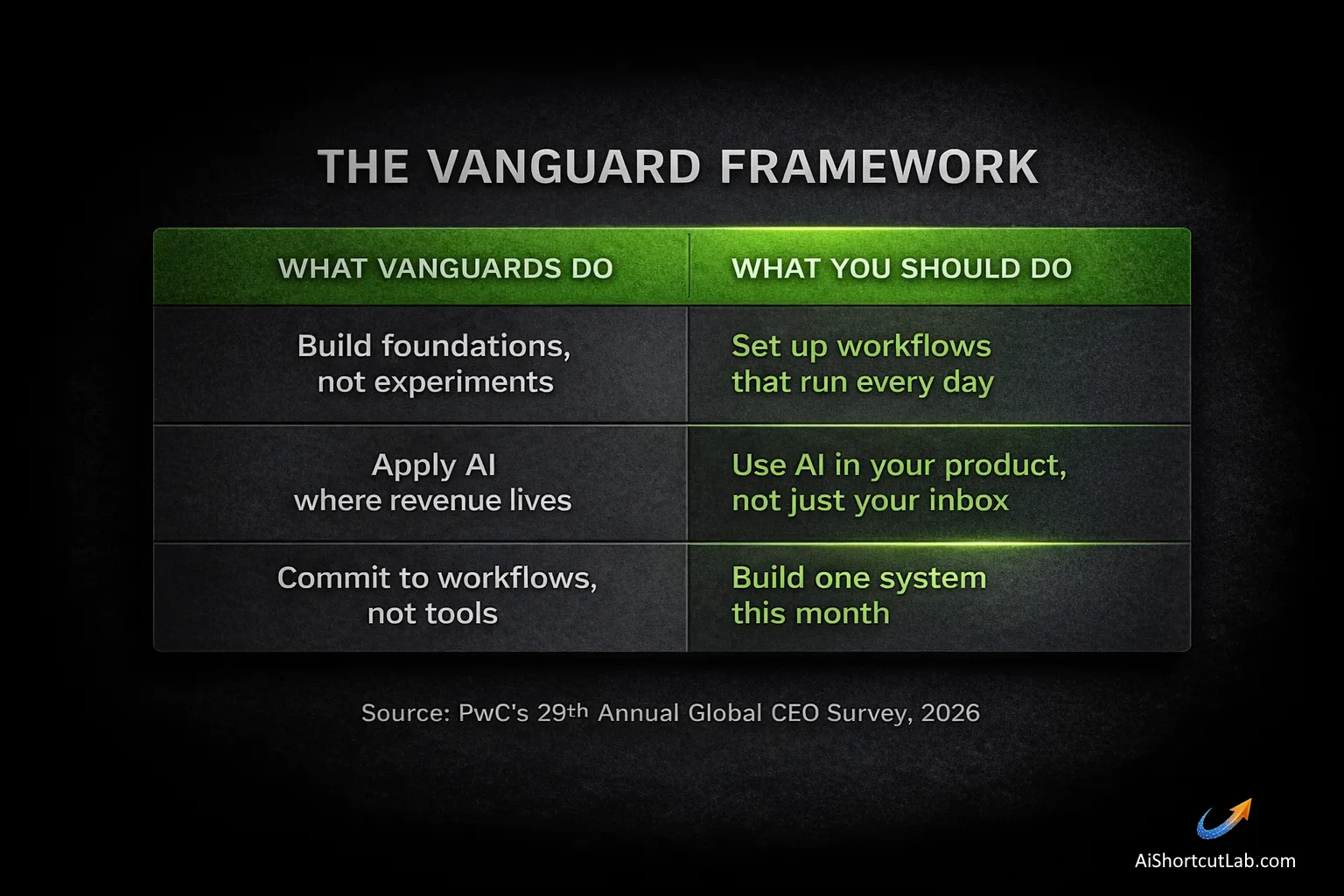
They build foundations, not experiments. They don't test AI on a one-off project and walk away when results are mixed. They build the infrastructure — the integrations, the workflows, the data pipelines — that makes AI useful across everything they do. For you, this means setting up systems that run continuously, not trying AI once for a specific task and concluding it "didn't work."
They apply AI where revenue lives. Vanguard companies put AI into their products and their customer acquisition, not just their back-office admin. For solo founders, this means using AI to make your core offering better or more scalable — to serve more clients at the same quality, or to charge more for a demonstrably superior result.
They commit to workflows, not tools. There's a meaningful difference between downloading an AI app and building an AI workflow. A tool does a task. A workflow replaces a process. The goal isn't to use ten AI tools occasionally. It's to have systems that run without you constantly making decisions — so your business keeps moving even when your attention is elsewhere.
Your 3-Step Roadmap to Join the 12%
The PwC report tells you what separates the winners from the rest. Here's how to apply it as a solo founder, starting this week.
Step 1: Automate the Grind (The Cost Side)
The 26% of companies seeing cost savings from AI aren't doing anything exotic. They're identifying the repetitive, time-consuming tasks that eat their hours — admin, scheduling, data entry, first-draft content, support triage — and replacing them with AI workflows.
Your version of this is straightforward: audit where your time goes for one week. Not where you think it goes — where it actually goes. Every task you do more than twice a week is a candidate for automation. Every task that requires gathering the same type of information repeatedly is a candidate for automation. Every task that produces a templated output is a candidate for automation.
The goal isn't to use AI for everything. It's to recover 10-15 hours a week so you can redirect them toward revenue-generating work.
→ AI Ops & Automation: Browse Implementation Guides
Step 2: Reinvent the Product (The Revenue Side)
This is where the 12% separate themselves. And it's where most solo founders are leaving money on the table.
Ask yourself: what does AI enable me to deliver that I couldn't deliver before, or couldn't deliver at this price point?
Can you deliver a service faster because AI handles the research and first-draft phase? Can you serve more clients simultaneously because AI handles onboarding and initial support? Can you offer a tier of your product that's AI-augmented and therefore higher-margin? Can you use AI to personalize your offering in a way that commands a premium?
The Vanguard answer this question and then build for it. They don't just use AI behind the scenes — they make it part of what they're selling.
→ AI Content Creation: Scale Your Output | AI Lead Gen & Outreach: Fill Your Pipeline
Step 3: Stop Experimenting. Start Committing.
This is the hardest one, because it requires a mindset shift rather than a tool change.
Pilot Purgatory isn't just a corporate disease. Solo founders fall into it too — trying an AI tool for two weeks, not seeing transformative results immediately, and moving on to the next one. The result is a collection of tools that don't talk to each other and workflows that are half-automated.
The shift is this: instead of asking "what can I try with AI this week?", ask "what system can I build this month that will still be running six months from now?"
That question points you toward workflows, not experiments. Toward integrations, not demos. Toward the 12% side of the chart.
→ The Solo Founder's Guide Library: Full Roadmap
The Bottom Line
PwC's 29th Global CEO Survey is nominally about large enterprises. But if you read between the lines, it tells you something specific and actionable about where the real opportunity is.
The world's biggest companies are in meetings right now trying to figure out AI governance, pilot approval processes, and enterprise-wide alignment frameworks. They'll be in those meetings for most of 2026.
You don't have to wait for anyone's approval. You don't need a committee to sign off. You don't need a multi-quarter rollout plan.
The AI Execution Gap is wide open. And unlike the CEOs in PwC's survey, you can start closing it today.
Source: PwC's 29th Annual Global CEO Survey, 2026. Survey conducted 30 September – 10 November 2025 across 4,454 CEOs in 95 countries.
All statistics cited directly from the published report. Key figures: 56% of CEOs report no revenue or cost benefit from AI; 12% report both; 44% of "Vanguard" companies apply AI to products and services vs. 17% of other companies.





Comments (0)
Leave a Comment