

Adoption rates · ROI · Productivity gains · Workforce shifts · What the data means for your competitive strategy
Last Updated: February 2026 | Sources: McKinsey, Wharton, Gallup, PwC, WEF, Federal Reserve, Stanford HAI, OECD
The AI revolution is no longer on the horizon — it is already reshaping how organizations compete, hire, and deliver value. Whether you lead a 10-person startup or a 10,000-person enterprise, the decisions you make about AI in the next 12 months will determine your competitive position for the next decade.
We compiled 140+ verified AI statistics from the world's leading research institutions and organized them by category so you can find what matters most — fast. Use these to benchmark your strategy, build internal business cases, and make better decisions.
1. AI Adoption Statistics
Enterprise Adoption
Artificial intelligence has crossed from experiment to infrastructure. The numbers below reflect where organizations actually stand — not where they aspire to be.
Statistic | Data Point | Source |
|---|---|---|
Organizations using AI in at least one business function | 88% | |
Increase in AI usage at organizations from 2023 to 2024 | +33 percentage points | |
U.S. adults ages 18–64 using generative AI (Aug 2025) | 54.6% (up from 44.6% in Aug 2024) | |
Business leaders using Gen AI daily | 46% (up 17pp year-over-year) | |
Business leaders tracking structured ROI metrics for AI | 72% | |
Enterprises with a Chief AI Officer (CAIO) role | 61% |
Generative AI Specifically
Statistic | Data Point | Source |
|---|---|---|
Employees whose organization has implemented AI for productivity | 37% | |
Employees who used AI at work at least a few times in Q3 2025 | 45% | |
Large enterprises with implemented AI solutions | 87% | |
Business leaders expecting major/revolutionary AI impact on their industry | 70% | |
Organizations scaling agentic AI in their enterprise | 23% | |
Organizations experimenting with AI agents | 39% |
⚡ Leader Takeaway: Adoption is mainstream. If you are still in "wait and see" mode, you are already behind roughly 88% of your industry peers. The competitive gap is no longer about whether to adopt AI — it is about how fast you can scale it.
2. AI Market Size & Investment Statistics
Understanding where capital is flowing reveals where competitive pressure will intensify — and where the greatest opportunities lie.
Statistic | Data Point | Source |
|---|---|---|
Projected global AI market size in 2025 | $244.22 billion | Various analyst sources |
U.S. companies' investment in AI in 2024 | $109.1 billion (~12× China's $9.3B) | |
Private investment in generative AI worldwide in 2024 | $33.9 billion (+19% from 2023) | |
Microsoft's planned investment in AI-enabled data centers (FY2025) | $80 billion | Microsoft, Jan 2025 |
Potential annual economic value AI could add globally | $2.6T–$4.4T | |
Total potential annual benefit including AI embedded in software | $6.1T–$7.9T | |
Projected GDP boost from AI over the next decade | +15% | Goldman Sachs |
Expected AI boost to labor productivity in the U.S. by 2035 | 35% |
⚡ Leader Takeaway: Capital allocation in AI is accelerating exponentially. Leaders who treat AI purely as a cost center — rather than a growth and productivity lever — are misreading the moment. Budget discipline is required; budget timidity is not.
3. AI Productivity Statistics
Output & Efficiency Gains
Productivity numbers from controlled studies and real-world deployments are now converging. The signal is clear: AI dramatically accelerates individual and team output.
Statistic | Data Point | Source |
|---|---|---|
Average productivity boost reported by employees using AI tools | 40% | |
Faster at writing or summarizing text for workers using Gen AI | 40% | |
Higher quality of work (evaluator-rated) for AI-assisted writers | 18% | |
Daily task throughput increase using AI | 66% | Multiple studies aggregated |
More productive for developers using AI coding tools | 88% | |
Sales professionals using AI saving 12 hours per week | 47% more productive | Fullview.io analysis, 2025 |
C-suite leaders confirming productivity gains from AI | 77% | |
Sales teams with AI that saw revenue growth in 2024 | 83% (vs. 66% without AI) | Fullview.io, 2025 |
Work hours saved weekly by frequent AI users | 5.4% avg; 27% save 9+ hours | |
Customer service agents resolving more issues per hour | +14.8% per hour; -9% handling time | Brynjolfsson, Li & Raymond — Generative AI at Work, QJE 2025 |
Companies reporting measurable productivity increases after AI implementation | 57% | Industry survey, 2025 |
Industry-Specific Productivity
Statistic | Data Point | Source |
|---|---|---|
Productivity growth at AI-adopting manufacturing firms vs. peers | 4.8× | |
Higher revenue growth per worker in AI-exposed sectors | 3× vs. low-adoption sectors | |
Faster new product launches at companies with dedicated AI teams | 30% | |
Efficiency gains in supply chain and document processing from AI | 20–40% | |
Manufacturers that have implemented AI (up from 70% in 2023) | 77% | 2025 State of AI in Manufacturing Survey |
⚡ Leader Takeaway: The productivity case for AI is no longer theoretical. The organizations pulling ahead are those that have moved beyond individual tool adoption to systematically redesigning workflows around AI assistance. The question is not "does AI improve productivity?" — the data is definitive. The question is "how fast can we build the operating model to capture that value?"
4. AI ROI Statistics
Return on AI investment is materializing — but the gap between high performers and laggards is growing rapidly.
Statistic | Data Point | Source |
|---|---|---|
Average ROI per dollar invested in generative AI | $3.70 | |
ROI achieved by the top generative AI adopters | 10.3× | Various sources |
Enterprises seeing 5%+ EBIT impact from AI ("AI high performers") | 6% | |
More likely to have senior leaders driving AI adoption (high performers vs. peers) | 3× | |
Typical ROI realization timeline for AI investments | 12–24 months | Industry research |
AI initiatives failing to meet expected outcomes | 70–85% | MIT; RAND Corporation |
Companies that abandoned most AI initiatives in 2025 | 42% (up sharply from 17% in 2024) | Fullview.io, 2025 |
AI spending going to people and process at top-performing orgs | 70% | Industry benchmarks |
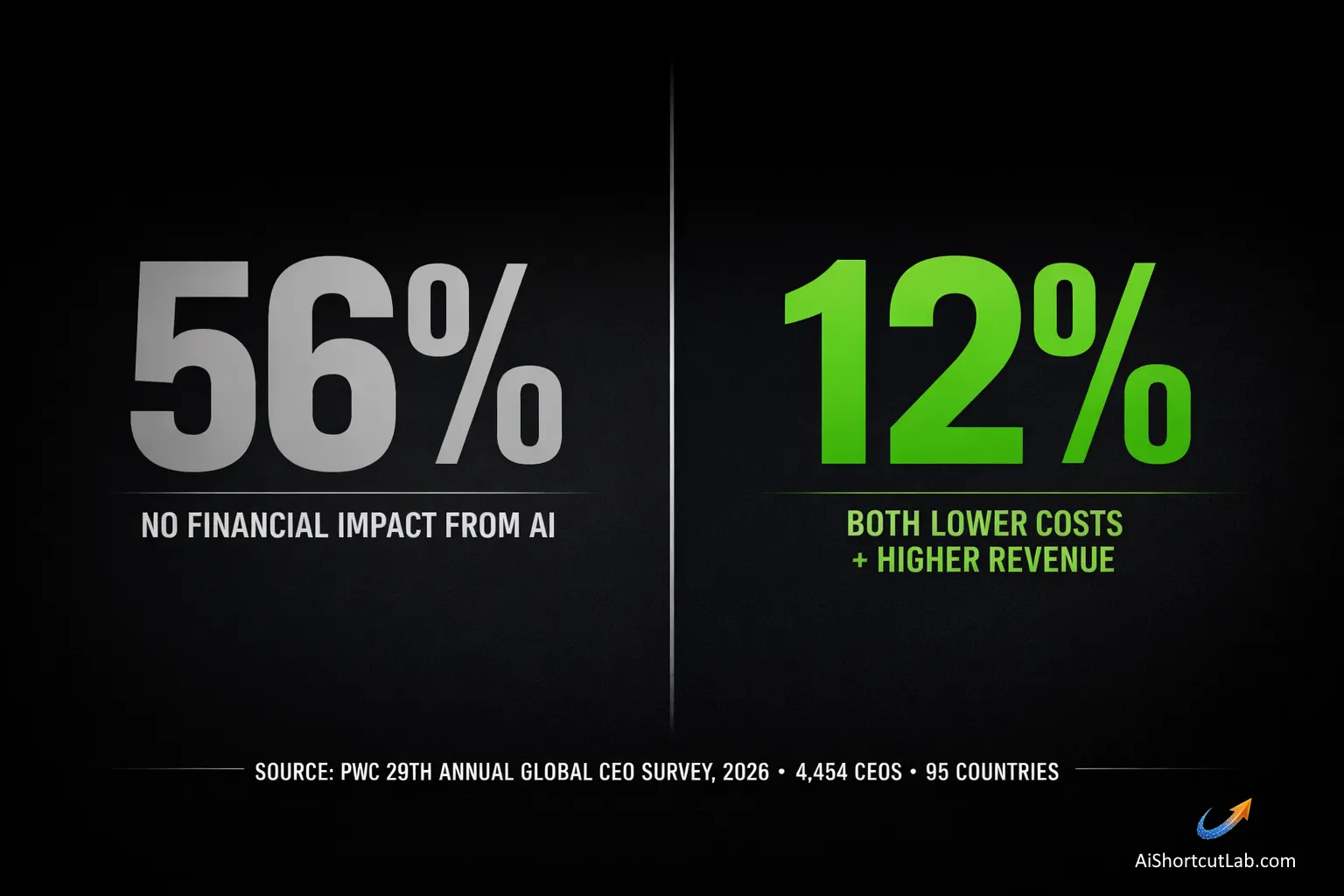
Gen AI pilots at enterprises that failed to deliver measurable ROI | 95% |
⚡ Leader Takeaway: The 6% of organizations achieving 5%+ EBIT impact from AI share a pattern: bold transformation ambitions, redesigned workflows, faster scaling, and invested leadership. The 95% failing in pilots share a different pattern: isolated experiments, technology-first thinking, and weak change management. AI ROI is a leadership and operating model challenge as much as a technology challenge.
5. AI Workforce & Jobs Statistics
Job Creation vs. Displacement
The jobs narrative around AI is more nuanced than headlines suggest. Displacement is real and accelerating — but so is creation.
Statistic | Data Point | Source |
|---|---|---|
New jobs projected to emerge globally by 2030 from AI | 170 million | |
Jobs projected to be displaced by 2030 | 92 million | |
Net new positions expected by 2030 | +78 million | |
Employers intending to reduce workforce due to AI automation (within 5 years) | 41% | |
Companies expecting AI to reduce workforce by 3%+ within the next year | 32% | |
Workforce that will experience disruption in the next 2–5 years | 39% | |
Key job skills that will change by 2030 | 39% | |
Jobs in advanced economies that could be impacted by AI | 60% | Multiple sources |
Skills & Compensation
Statistic | Data Point | Source |
|---|---|---|
Global AI talent demand-to-supply ratio (1.6M open roles; 518K qualified candidates) | 3.2:1 | Industry research, 2025 |
Higher salaries for AI roles vs. traditional software positions | 67% | Industry research, 2025 |
Wage premium for workers with AI skills vs. same role without | 56% | |
Employers struggling to find candidates with advanced AI skills | ~50% | Burning Glass Institute, 2024 |
Industries increasing AI usage (including mining and agriculture) | 100% | |
Faster skill change in AI-exposed jobs year-over-year | 25% | |
Prompt Engineer job growth year-over-year (fastest-growing AI role) | +135.8% | Industry data, 2025 |
Worker Attitudes
Statistic | Data Point | Source |
|---|---|---|
Americans believing AI will reduce total U.S. jobs over 10 years | 75% | Multiple surveys, 2025 |
Employees feeling AI improves their work efficiency | 89% | |
Gen Z job seekers believing AI reduced the value of their college education | 49% | National University survey, 2025 |
Employees who don't know whether their org has an AI strategy | 23% |
⚡ Leader Takeaway: The AI talent shortage is one of the most acute skills gaps in modern history. Leaders who treat upskilling as optional are setting up their organizations to fail. Simultaneously, the organizations winning the talent war are paying the premium — AI-skilled workers command 56–67% higher compensation, and that gap is widening, not narrowing.
6. AI in Business Functions
Marketing & Sales
Statistic | Data Point | Source |
|---|---|---|
Business function most commonly reporting revenue increases from AI | #1: Marketing & Sales | |
Shorter deal cycles for sales professionals using AI weekly | 78% | Fullview.io, 2025 |
Sales teams with AI that saw revenue growth in 2024 | 83% | Fullview.io, 2025 |
More productive for sales professionals using AI tools | 47% | Fullview.io, 2025 |
Customer Service
Statistic | Data Point | Source |
|---|---|---|
Human-serviced contacts in banking/telecom/utilities that could be replaced by AI | 50% | |
Improvement in customer experience reported by small businesses using AI | 53% | Aristek Systems, 2025 |
AI's total business value currently generated by customer support functions | 38% | |
Faster inquiry resolution with AI-powered chatbots vs. traditional methods | 80% | Various sources |
Software Development
Statistic | Data Point | Source |
|---|---|---|
Software development professionals now using AI tools | 90% (up 14% from 2023) | Multiple sources, 2025 |
Productivity increase for AI-powered developers in controlled studies | 126% | Research compilation |
More productive for developers using GitHub Copilot | 55% | |
Higher pull request merge rate with AI tools | 15% |
Legal & Finance
Statistic | Data Point | Source |
|---|---|---|
Legal professionals using generative AI at work | 31% (up from 27% in 2024) | Multiple surveys, 2025 |
Lawyers using AI for drafting correspondence | 54% | Legal industry survey, 2025 |
Hedge funds employing AI for market analysis and trading | 68% | Financial sector data, 2025 |
Highest-gaining sectors from AI (Legal +24pp, Customer Service +16pp, Procurement +15pp) | Top sectors |
⚡ Leader Takeaway: The highest-impact AI deployments are concentrated in customer service, marketing and sales, and software development. If your organization has not yet systematically embedded AI into at least these three functions, you are leaving measurable competitive advantage on the table.
7. AI Implementation Challenges & Risks
The failure rate of AI projects is a signal, not a surprise. Understanding why projects fail is as valuable as knowing what succeeds.
Statistic | Data Point | Source |
|---|---|---|
Businesses expressing concern about AI hallucinations | 77% | Fullview.io, 2025 |
Enterprise AI users making a major decision based on hallucinated content in 2024 | 47% | Fullview.io, 2025 |
Enterprises using human-in-the-loop processes to catch AI errors | 76% | Fullview.io, 2025 |
AI projects failing to meet expected outcomes | 70–85% | MIT; RAND Corporation |
Organizations with adequate data governance frameworks for AI | ~30% | Industry benchmarks |
Organizations integrating workforce planning into AI roadmaps | 46% | |
CEOs citing skill shortages as a top risk in AI-enabled workforce transformation | 94% | |
Organizations planning to invest adequately in AI upskilling (despite 48% of employees demanding it) | 28% | Multiple sources, 2025 |
Gen AI pilots that succeed but still fail to scale | Most |
⚡ Leader Takeaway: The most common reasons AI initiatives fail: lack of clear objectives, insufficient data infrastructure, weak change management, and treating AI as a technology problem rather than a business transformation. The winners invest 70% of their AI resources in people and process — not just tools.
8. AI Adoption by Industry
Healthcare
Statistic | Data Point | Source |
|---|---|---|
CAGR of AI adoption in healthcare — fastest of any sector | 36.8% | Industry research, 2025 |
Global healthcare worker shortage expected by 2030 | 11 million |
Financial Services
Statistic | Data Point | Source |
|---|---|---|
Annual spending by financial services on AI technologies | $20B+ | Industry research, 2025 |
Hedge funds using AI for market analysis and trading | 68% | Financial sector data |
Assets managed by AI-powered robo-advisors globally | $1.2 trillion | Industry research, 2025 |
Retail & E-commerce
Statistic | Data Point | Source |
|---|---|---|
Projected value of AI in retail by 2032 (up from $9.36B in 2024) | $85.07 billion | Aristek Systems, 2025 |
Projected CAGR for AI in retail through 2032 | ~32% | Market research, 2025 |
Manufacturing
Statistic | Data Point | Source |
|---|---|---|
Manufacturers that have implemented AI (up from 70% in 2023) | 77% | 2025 State of AI in Manufacturing Survey |
Additional GVA projected for manufacturing from AI by 2035 | $3.8 trillion |
⚡ Leader Takeaway: Healthcare, financial services, and manufacturing are pulling away from the pack. But PwC's 2025 Global AI Jobs Barometer found that 100% of industries — including traditionally slow adopters — are now increasing AI usage. There is no longer a safe industry to hide in.
9. AI Leadership & Strategy Statistics
The data increasingly shows that AI success is a C-suite mandate, not a department-level initiative.
Statistic | Data Point | Source |
|---|---|---|
Enterprises with a Chief AI Officer role in 2025 | 61% (up 16pp year-over-year) | |
Increase in executive leadership involvement in Gen AI adoption | +16pp year-over-year | |
Companies that prioritize AI in their business plans | 83% | Various sources |
Tech leaders who say AI is fully part of company strategy | 49% | Survey, 2025 |
Leaders preferring to hire AI-ready talent vs. retrain existing workforce | 3.1× more likely | |
Organizations with AI fully embedded in products and services | 33% | Survey, 2025 |
Organizations that have formally redesigned workflows due to Gen AI | ~33% | |
Leaders prioritizing job redesign as top workforce priority | 52% | |
Amazon employees retrained into tech roles via Upskilling 2025 program | 50,000+ | Amazon, 2025 |
⚡ Leader Takeaway: The correlation between C-suite ownership and AI success is unambiguous. Leaders who champion AI — not just approve budgets for it — are three times more likely to achieve significant business impact. The CAIO role is not a trend; it is a structural signal that AI governance belongs at the top table.
10. AI Future Outlook Statistics
Where is this all heading? These projections come from some of the most rigorous economic modeling available.
Statistic | Data Point | Source |
|---|---|---|
Potential annual labor productivity growth from Gen AI through 2040 | 0.1–0.6% | |
Combined AI and automation potential annual productivity growth | 0.5–3.4% | |
Gen AI companies that will launch agentic AI pilots by end of 2025 | 1 in 4 | |
Agentic AI adoption rate projected by 2027 | 50% | |
Jump in AI benchmark performance scores in a single year | +19–67 points | |
Potential productivity boost to labor in developed economies by 2035 | 40%+ | |
Gen AI adoption among U.S. adults vs. PC adoption at same 3-year milestone | 3× faster | |
Most routine cognitive tasks expected to be AI-assisted or AI-generated by | 2027–2028 |
⚡ Leader Takeaway: Generative AI is adopting faster than any technology in history — outpacing the internet and the personal computer at the same milestone. Leaders who think they have 3–5 years before they need to commit are misreading the pace of change. The organizations building AI capabilities now are not just early movers — they are building structural competitive advantages that compound every quarter.
How to Use This Data
Statistics are only as valuable as the decisions they inform. Here is how high-performing organizations are using data like this:
Benchmark against peers. Use the adoption rates in Sections 1 and 8 to identify where your organization sits relative to your industry. If 88% of organizations are using AI in at least one function and you are not, that is the starting line, not a differentiator.
Build the business case. The productivity and ROI figures in Sections 3 and 4 are your ammunition for executive buy-in and budget conversations. A $3.70 return on every dollar invested is hard to argue with.
Prioritize where to start. The business function data in Section 6 shows where AI delivers the fastest and most measurable returns — marketing and sales, customer service, and software development. Start there.
Prepare your workforce. The jobs and skills statistics in Section 5 underscore the urgency of upskilling. The global AI talent demand-to-supply ratio is 3.2:1. If you are not building AI capability internally, you will pay a steep premium to hire it externally — or go without.
Anticipate the failure points. The challenges in Section 7 are predictable — and therefore avoidable. Build your implementation strategy around what actually causes AI projects to fail: vague objectives, poor data foundations, and underinvestment in change management.
Primary Sources & References
All statistics in this article are drawn from primary research by the following institutions. We encourage you to read the original reports for full methodology and context.
McKinsey & Company — The State of AI: How Organizations Are Rewiring to Capture Value (March 2025)
McKinsey & Company — The State of AI: Agents, Innovation, and Transformation (November 2025)
Federal Reserve Bank of St. Louis — The State of Generative AI Adoption in 2025 (November 2025)
GitHub — Research: Quantifying GitHub Copilot's Impact on Developer Productivity
Accenture — AI Poised to Double Economic Growth Rates and Boost Labor Productivity
Brynjolfsson, Li & Raymond — Generative AI at Work, Quarterly Journal of Economics (2025)
Published by AI Shortcut Lab · Helping leaders harness AI without the hype.




Comments (0)
Leave a Comment