


As autonomous AI agents move from experimental prototypes to production-critical systems, monitoring their behavior has become essential for reliability, cost control, and compliance. Unlike traditional applications that throw predictable errors, AI agents can fail silently—hallucinating responses, skipping critical steps, or making costly API calls without triggering alerts.
This comprehensive guide explores the best AI agent monitoring tools across three key segments: enterprise-grade platforms for large organizations, SMB solutions for agile teams, and open-source tools for privacy-conscious developers. Whether you're tracking LLM observability, managing multi-agent workflows, or ensuring regulatory compliance, this guide will help you choose the right monitoring solution.
What Makes AI Agent Monitoring Different from Traditional Monitoring
AI agent monitoring goes far beyond checking if servers are up or APIs are responding. These autonomous systems require visibility into their reasoning processes, decision paths, and interactions with multiple tools and data sources.
Traditional application monitoring tracks uptime, response times, and error rates. AI agent observability must capture:
Reasoning chains: Every LLM call, prompt, and response in multi-step workflows
Tool invocations: Which external APIs, databases, or functions the agent accesses
Cost tracking: Token usage, API calls, and compute expenses per request
Quality metrics: Accuracy, hallucination detection, and output validation
Safety guardrails: Bias detection, content filtering, and compliance checks
The non-deterministic nature of LLMs means the same input can produce different outputs. Effective monitoring must trace these variations, identify drift, and help teams understand why an agent made specific decisions.
Enterprise-Grade AI Agent Monitoring Solutions
Large organizations need robust platforms that handle scale, meet strict compliance requirements, and integrate with existing infrastructure. Enterprise solutions prioritize security certifications (SOC2, HIPAA), explainability for audits, and comprehensive analytics.
Maxim AI: End-to-End Agent Lifecycle Management
Maxim AI provides a unified platform designed specifically for the complete agent lifecycle—from development to production deployment.
Key Capabilities:
Simulation environments: Test agents against thousands of scenarios before production
Distributed tracing: Track multi-step reasoning across complex agent chains
Automated evaluations: Continuous quality assessment using deterministic rules and LLM-as-judge frameworks
Safety monitoring: Built-in hallucination detection and prompt injection safeguards
Collaborative workflows: Product managers, engineers, and domain experts can review agent behavior together
Best For: Organizations requiring comprehensive testing, continuous evaluation, and cross-functional collaboration on agent quality.
Why It Matters: Maxim's simulation capability addresses one of the biggest challenges in agentic AI—validating behavior before real users are affected. The platform helps teams catch edge cases early and maintain quality standards as agents evolve.
Arize (Arize AX): Enterprise MLOps Meets Agentic AI
Arize brings proven MLOps expertise to the world of generative AI and autonomous agents. The platform specializes in drift detection and large-scale performance analytics.
Key Capabilities:
Unified monitoring: Track both traditional ML models and LLM-powered agents in one platform
Drift detection: Identify when model behavior or data distributions shift over time
Performance analytics: Comprehensive metrics across millions of agent interactions
Embedding visualization: Cluster analysis to surface anomalies and edge cases
OpenTelemetry integration: Standards-based instrumentation for flexibility
Best For: Enterprises running hybrid AI systems with both traditional ML pipelines and generative AI agents.
Why It Matters: Organizations with existing ML infrastructure can extend their observability practices to cover new agentic workflows without adopting entirely separate toolchains. Arize's Phoenix open-source variant also provides technical teams with flexibility for experimentation.
Datadog LLM Observability: Unified Infrastructure and Agent Monitoring
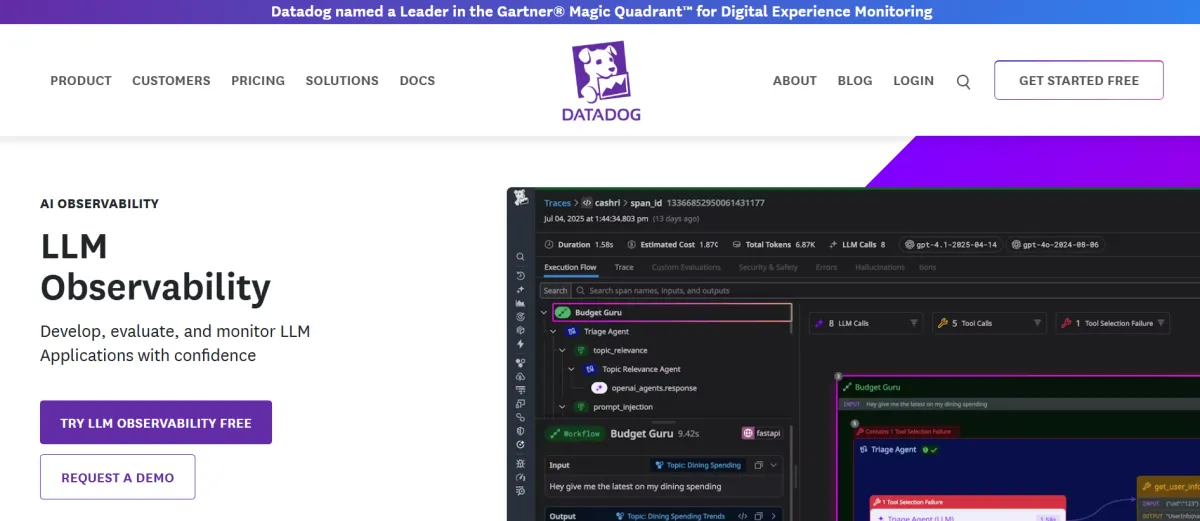
For enterprises already using Datadog for infrastructure monitoring, LLM Observability extends visibility into AI agent behavior within the same platform.
Key Capabilities:
Full-stack correlation: Connect agent reasoning failures to underlying infrastructure issues
End-to-end tracing: Track requests from user input through LLM calls to final output
Token and cost tracking: Monitor spending across all agent interactions
Integration with APM: Combine agent traces with application performance metrics
900+ integrations: Connect AI monitoring with existing tools and workflows
Best For: Enterprises seeking unified observability across infrastructure, applications, and AI agents in a single dashboard.
Why It Matters: When an agent fails, the cause might be a slow database, an overloaded API endpoint, or a prompt engineering issue. Datadog's unified platform helps teams quickly identify root causes by correlating signals across the entire stack.
Fiddler AI: Compliance-First Observability for Regulated Industries
Fiddler focuses on explainability, bias detection, and auditability—critical requirements for financial services, healthcare, and other regulated sectors.
Key Capabilities:
Explainable AI: Detailed reasoning traces for every autonomous decision
Bias detection: Automated checks for fairness issues across protected classes
Compliance dashboards: Pre-built templates for regulatory reporting
Model cards: Comprehensive documentation for audit trails
Real-time guardrails: Policy enforcement before outputs reach users
Best For: Organizations in regulated industries that need to justify AI decisions to auditors, regulators, or legal teams.
Why It Matters: When autonomous agents handle loan applications, medical recommendations, or legal document analysis, explainability isn't optional—it's legally required. Fiddler provides the documentation and controls necessary for high-stakes deployments.
SMB & Scale-Up AI Agent Monitoring Solutions
Startups and medium-sized teams need tools that deliver value quickly without requiring extensive infrastructure or large budgets. These solutions prioritize ease of setup, developer-friendly workflows, and cost efficiency.
LangSmith: Native Monitoring for LangChain Ecosystems
LangSmith is the official monitoring solution from LangChain, designed for teams building agents with LangChain or LangGraph frameworks.
Key Capabilities:
Seamless integration: Automatic instrumentation for LangChain applications
Trace visualization: Interactive UI for debugging multi-step agent chains
Prompt versioning: Track changes to prompts over time
Dataset creation: Convert production failures into test cases
Cost and latency tracking: Monitor per-request expenses and performance
Best For: Development teams already using LangChain who need fast setup and native framework support.
Why It Matters: LangSmith removes friction from monitoring setup. Teams can start tracing agent behavior with just a few lines of code, making it ideal for fast-moving startups that can't afford lengthy integration projects.
Braintrust: Evaluation-First Agent Observability
Braintrust takes an evaluation-centric approach, treating production monitoring and testing as a unified workflow.
Key Capabilities:
Trace-to-test conversion: Automatically turn production failures into regression tests
Automated scoring: Continuous evaluation using custom metrics and LLM-as-judge
Experiment tracking: Compare prompt variations, model choices, and configuration changes
Human feedback integration: Capture annotations from domain experts
Fast iteration cycles: Ship confidently with automated quality gates
Best For: Teams prioritizing rapid iteration and continuous improvement of agent quality.
Why It Matters: Traditional monitoring tells you when something breaks. Braintrust helps you prevent breaks by turning production data into safety nets—every failure becomes a test case that guards against regressions.
Helicone: Lightweight Observability Through Proxy
Helicone takes a unique approach by functioning as a transparent proxy between your application and LLM providers.
Key Capabilities:
One-line setup: Change your API base URL and start monitoring immediately
Zero code changes: No SDKs or instrumentation libraries required
Cost tracking: Detailed breakdown of spending by model, user, or feature
Latency monitoring: Track performance across different LLM providers
Prompt logging: Capture and replay all interactions for debugging
Best For: Small teams needing observability without engineering investment or infrastructure setup.
Why It Matters: Helicone proves that effective monitoring doesn't require complex integrations. By proxying API calls, it provides visibility with minimal disruption to existing codebases—ideal for teams with limited technical resources.
Open-Source & Self-Hosted AI Agent Monitoring Tools
Privacy-conscious organizations, technical teams wanting full control, and cost-sensitive projects benefit from open-source monitoring solutions. These tools provide transparency, community support, and deployment flexibility.
Langfuse: Community-Driven LLM Observability
Langfuse has emerged as the leading open-source platform for LLM application monitoring, backed by an active community and transparent development.
Key Capabilities:
MIT License: Truly open-source with no hidden restrictions
Complete tracing: Capture prompts, completions, and intermediate steps
Prompt management: Version control for prompts with A/B testing support
Cost analysis: Track token usage and expenses across all models
Self-hosting options: Deploy on your own infrastructure for data sovereignty
Best For: Teams requiring data privacy, full control over their monitoring stack, or avoiding vendor lock-in.
Why It Matters: Langfuse demonstrates that open-source tools can match commercial offerings in functionality while providing transparency that enterprises increasingly demand. The active community ensures rapid feature development and extensive integration options.
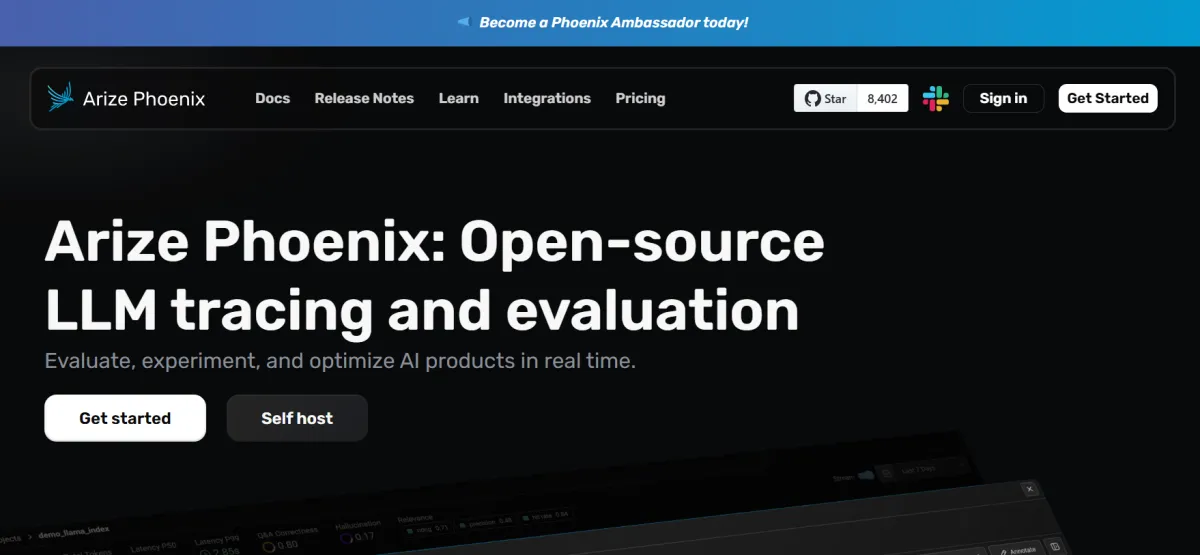
Arize Phoenix: Open-Source Variant of Enterprise Platform
Phoenix brings enterprise-grade observability capabilities to the open-source world, maintained by the team behind Arize's commercial platform.
Key Capabilities:
OpenTelemetry standards: Compatible with existing observability infrastructure
Embedding visualization: Cluster analysis for identifying patterns and anomalies
Notebook integration: Works seamlessly with Jupyter for experimentation
Local development: Run monitoring locally during development
Production ready: Scale from laptop to production without platform changes
Best For: Technical teams wanting enterprise features with open-source flexibility, especially those working with embeddings and vector databases.
Why It Matters: Phoenix provides a smooth transition path—start with open-source for development and testing, then upgrade to Arize's commercial platform when scaling to production requires additional support and features.
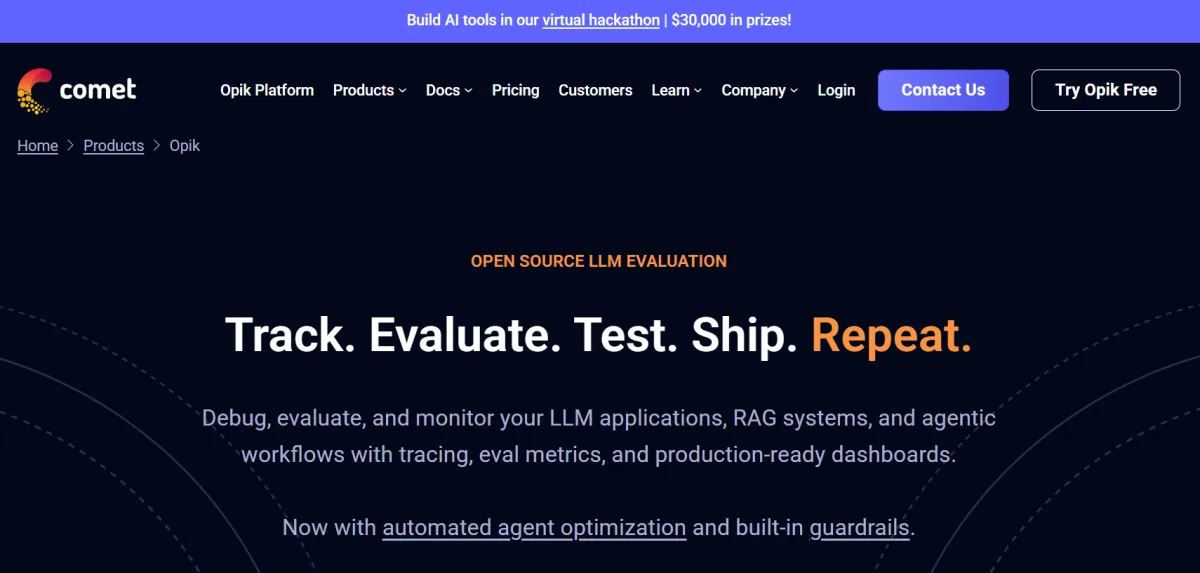
Opik: Modern Open-Source Observability by Comet
Opik is a newer entrant in the open-source space, offering enterprise-grade features under the permissive Apache 2.0 license.
Key Capabilities:
Apache 2.0 License: Maximum flexibility for commercial use
Experiment tracking: Compare different agent configurations systematically
Multi-modal support: Track text, image, and audio inputs/outputs
Dataset management: Curate evaluation datasets from production data
Comet integration: Optional connection to Comet's ML platform for additional capabilities
Best For: Teams wanting comprehensive features without compromising on open-source principles, especially those already using Comet for ML workflows.
Why It Matters: Opik demonstrates that open-source doesn't mean sacrificing advanced features. Its permissive license and modern architecture make it attractive for both startups and enterprises exploring self-hosted options.
Key Features to Evaluate in AI Agent Monitoring Tools
When selecting an AI agent monitoring platform, consider these critical capabilities:
Tracing and Observability
End-to-end visibility: Capture every step from user input to final output
Multi-agent support: Track interactions between multiple agents
Tool call tracking: Monitor external API and function invocations
Context preservation: Maintain full state across async operations
Evaluation and Quality
Automated scoring: LLM-as-judge, heuristics, and custom evaluators
Human feedback loops: Capture expert annotations efficiently
Regression detection: Alert when quality degrades over time
A/B testing support: Compare different configurations scientifically
Cost and Performance
Token usage tracking: Monitor spending by model, feature, or user
Latency analysis: Identify bottlenecks in agent workflows
Resource optimization: Recommendations for reducing costs without sacrificing quality
Budget alerts: Proactive notifications before overruns
Security and Compliance
Prompt injection detection: Identify adversarial inputs
Data lineage: Track information flow for audit trails
Access controls: Role-based permissions for sensitive data
Compliance dashboards: Pre-built reports for regulatory requirements
Integration and Deployment
Framework support: Native integrations with LangChain, LlamaIndex, etc.
Language SDKs: Python, JavaScript/TypeScript, and others
Cloud compatibility: Works across AWS, Azure, GCP
Self-hosting options: On-premises deployment when needed
How to Choose the Right AI Agent Monitoring Tool
Your ideal monitoring solution depends on several organizational factors:
By Company Size
Enterprise (1000+ employees):
Prioritize: Security certifications, scalability, support SLAs
Consider: Datadog, Fiddler, Maxim AI, Arize
Budget: $5,000-$50,000+ per month depending on usage
SMB/Scale-Up (50-1000 employees):
Prioritize: Quick setup, developer experience, cost efficiency
Consider: LangSmith, Braintrust, Helicone
Budget: $500-$5,000 per month
Startup (<50 employees):
Prioritize: Free tiers, minimal integration work, flexible pricing
Consider: Helicone, Langfuse, Opik, Phoenix
Budget: $0-$500 per month
By Technical Maturity
High technical sophistication:
Open-source tools provide maximum control
Self-hosting for data sovereignty
Custom instrumentation and evaluation frameworks
Moderate technical capability:
Commercial SMB solutions with good documentation
Managed services to reduce operational burden
Standard integrations with popular frameworks
Limited technical resources:
Proxy-based solutions requiring minimal code changes
Generous free tiers for experimentation
Strong support and onboarding assistance
By Compliance Requirements
Regulated industries (finance, healthcare, government):
SOC2, HIPAA, GDPR compliance essential
Explainability and audit trails mandatory
Consider: Fiddler, Datadog, Maxim AI with enterprise contracts
General business applications:
Basic security and privacy features sufficient
Focus on functionality and developer experience
Most commercial and open-source tools acceptable
Internal tools and experiments:
Minimal compliance requirements
Open-source tools for flexibility
Self-hosted options for maximum control
Comparison Table: AI Agent Monitoring Tools at a Glance
Tool | Category | Best For | Key Strength | Starting Price | Open Source |
|---|---|---|---|---|---|
Maxim AI | Enterprise | Simulation & testing | Comprehensive lifecycle | Custom | No |
Arize (AX) | Enterprise | MLOps teams | Drift detection | Custom | Partial (Phoenix) |
Datadog | Enterprise | Infrastructure teams | Unified monitoring | Custom | No |
Fiddler | Enterprise | Regulated industries | Explainability | Custom | No |
LangSmith | SMB | LangChain users | Native integration | $39/month | No |
Braintrust | SMB | Evaluation-focused | Trace-to-test | $50/month | No |
Helicone | SMB | Quick setup | Proxy approach | Free tier | No |
Langfuse | Open Source | Privacy-conscious | Community support | Free | Yes (MIT) |
Phoenix | Open Source | Technical teams | Standards-based | Free | Yes |
Opik | Open Source | Flexible deployment | Modern features | Free | Yes (Apache 2.0) |
Best Practices for AI Agent Monitoring
Regardless of which tool you choose, follow these practices for effective monitoring:
Instrument Comprehensively
Capture all prompts, responses, and intermediate steps
Log tool calls and external API interactions
Track user feedback and error reports
Maintain consistent schema across all agents
Sample Strategically
Monitor 100% of traffic initially to establish baselines
Move to sampling (10-30%) for cost efficiency at scale
Always log failures and edge cases completely
Increase sampling when investigating issues
Automate Evaluation
Combine deterministic checks with LLM-as-judge scoring
Run evaluations continuously, not just during releases
Create golden datasets from production failures
Track evaluation metrics alongside operational metrics
Monitor Safety Continuously
Implement real-time guardrails for harmful content
Detect prompt injection and adversarial inputs
Track bias metrics across demographic groups
Alert on unusual patterns or anomalies
Close the Feedback Loop
Convert monitoring insights into test cases
Feed production failures into simulation environments
Use real data to improve agent prompts and configurations
Share learnings across teams systematically
Future Trends in AI Agent Monitoring
The observability landscape for autonomous agents continues to evolve rapidly. Expect these developments in 2026 and beyond:
AI-Native Observability
LLM-native tracing built directly into model runtimes
Standardized instrumentation through OpenTelemetry GenAI conventions
Automatic anomaly detection using foundation models
Self-healing agents that adjust behavior based on monitoring feedback
Decision Path Analysis
Causal reasoning about why agents made specific choices
Counterfactual analysis (what would have happened if...)
Interactive debugging with natural language queries
Visual representations of agent decision trees
Multi-Agent Orchestration
Specialized tools for tracking agent-to-agent communication
Coordination analysis across autonomous systems
Distributed tracing for complex multi-agent workflows
Governance frameworks for agent hierarchies
Embedded Governance
Real-time compliance checking during agent execution
Automatic documentation generation for audits
Policy-as-code for safety constraints
Continuous certification for regulated deployments
Conclusion: Monitoring as a Foundation for Reliable Agentic AI
As AI agents take on increasingly critical roles—from customer support to infrastructure automation—monitoring transforms from optional to essential. The right observability platform helps teams move confidently from prototype to production while maintaining quality, controlling costs, and meeting compliance requirements.
Enterprise organizations should prioritize platforms offering security certifications, explainability for audits, and integration with existing infrastructure. Solutions like Maxim AI, Datadog, Arize, and Fiddler provide the robust capabilities large teams need.
SMBs and startups benefit from tools emphasizing quick setup, developer experience, and flexible pricing. LangSmith, Braintrust, and Helicone deliver powerful features without the complexity of enterprise platforms.
Technical teams and privacy-conscious organizations will find open-source solutions like Langfuse, Phoenix, and Opik provide transparency and control while matching commercial offerings in functionality.
Ultimately, the best AI agent monitoring tool aligns with your team size, technical capabilities, compliance requirements, and deployment preferences. Start with clear requirements, evaluate tools against real use cases, and choose a platform that grows with your agent capabilities.
The future of AI is autonomous. The future of autonomy is observable.
Frequently Asked Questions
What is AI agent monitoring?
AI agent monitoring is the continuous observation of autonomous AI systems to track their reasoning, decisions, tool usage, costs, and output quality. Unlike traditional application monitoring focused on uptime and performance, agent monitoring ensures LLM-powered systems behave correctly and safely.
Why can't I use traditional APM tools for AI agents?
Traditional application performance monitoring tools track servers, databases, and APIs but don't capture the non-deterministic behavior of LLMs. AI agents require specialized observability for prompts, reasoning chains, hallucinations, and token costs—signals that standard APM tools weren't designed to handle.
How much does AI agent monitoring cost?
Costs vary widely: open-source tools are free but require self-hosting, SMB solutions range from $50-$5,000/month depending on usage, and enterprise platforms typically require custom pricing starting at $5,000/month with volume-based scaling.
What's the difference between LLM observability and agent monitoring?
LLM observability focuses on monitoring language model calls, token usage, and latency. Agent monitoring extends this to track multi-step workflows, tool invocations, decision paths, and interactions between multiple agents—capturing the full autonomous system behavior.
Can I monitor agents built with different frameworks?
Most commercial platforms support multiple frameworks through SDKs or OpenTelemetry integration. Native tools like LangSmith work best with their specific frameworks, while platform-agnostic solutions like Helicone (proxy-based) and Phoenix (OTEL-based) work across any architecture.
How do I measure agent quality beyond traditional metrics?
Agent quality requires custom evaluations: accuracy on domain-specific tasks, hallucination rates, instruction following, reasoning coherence, and safety compliance. Modern monitoring tools support automated scoring through LLM-as-judge, heuristics, and human feedback loops.
Is self-hosting required for sensitive data?
Not necessarily. Many commercial platforms offer enterprise plans with data residency options, on-premises deployment, or hybrid architectures. However, regulated industries often prefer self-hosted open-source solutions like Langfuse or Phoenix for maximum control.
What security features should I look for?
Essential security features include prompt injection detection, PII filtering, access controls, audit trails, compliance dashboards (SOC2, HIPAA, GDPR), and real-time guardrails. Enterprise platforms typically include these by default; open-source tools may require additional configuration.





Comments (0)
Leave a Comment