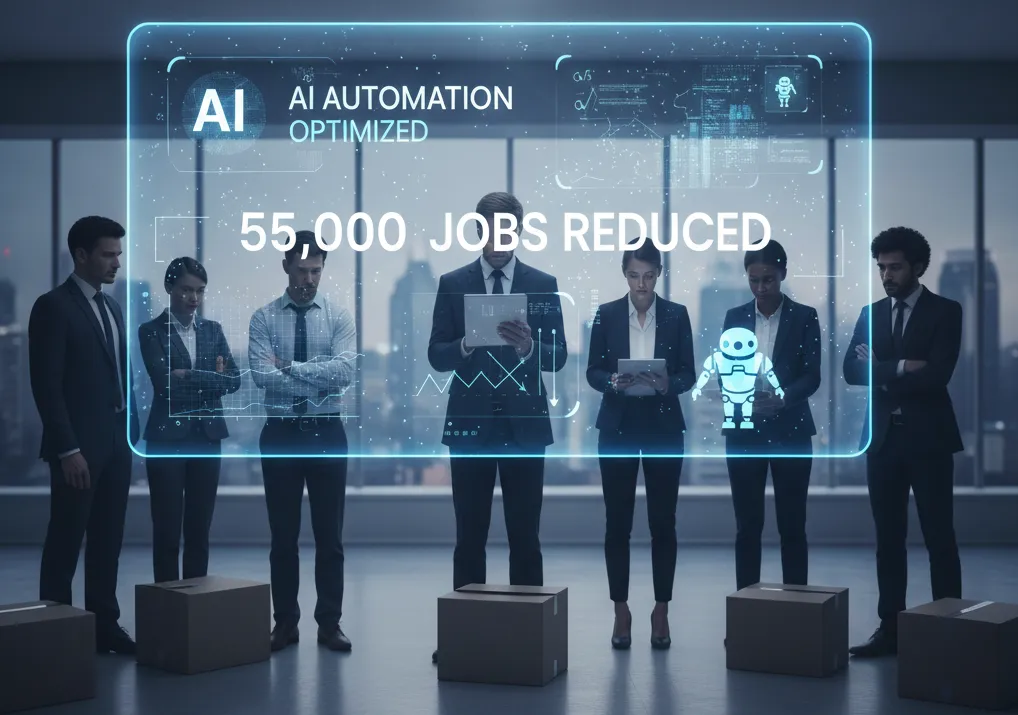
TL;DR: A new report indicates AI was cited as a primary reason for 55,000 US layoffs in 2025, primarily impacting administrative, tech, and creative roles. This marks a significant shift, as AI moves from a hypothetical job disruptor to a direct cause of workforce reduction.
In a stark revelation that brings the future of work into sharp focus, a recent analysis highlights AI as a direct factor in 55,000 US job layoffs during 2025. This isn't just about automation; it's about intelligent systems performing tasks once exclusive to human cognition, particularly in sectors prone to data processing and repetitive digital work.
Career Recalibration: This trend accelerates the demand for "AI literacy" and roles that complement AI, such as AI prompt engineering, data interpretation, and ethical AI oversight. For individuals in affected sectors, upskilling into these areas is no longer optional.
Sector-Specific Impact:
Administrative Support: Roles involving scheduling, data entry, and basic communication are being consolidated or automated by Large Language Models (LLMs) and AI agents.
Technology: Even within the tech industry, AI development is leading to fewer jobs in routine coding, testing, and IT support, as AI tools handle these functions.
Creative & Media: Content generation, basic design, and preliminary research tasks are increasingly being offloaded to AI, putting pressure on entry-level creative positions.
Economic Ripple Effect: While some argue AI creates new jobs, the immediate impact of these layoffs could strain local economies and require significant re-training initiatives from governments and corporations.
It's crucial to understand that "AI-driven layoffs" aren't solely about robots replacing people. Often, it's about "workflow optimization" where AI tools allow smaller teams to achieve previous output levels. This means companies aren't just cutting jobs; they're fundamentally redesigning their operational structures. There's also the challenge of measuring true AI impact, as companies may cite "restructuring" when AI is an underlying factor. The reported 55,000 figure represents instances where AI was explicitly mentioned in layoff notices or public statements, suggesting the actual number with AI as a contributing factor could be higher.
Industry analysts emphasize that this data underscores the need for proactive workforce planning. "Companies leveraging AI aren't just seeking efficiency; they're redefining human-machine collaboration," states one report. "The challenge now is to transition affected workers into roles that require uniquely human skills—critical thinking, empathy, and complex problem-solving—which AI cannot replicate."

AI Shortcut Lab Editorial Team
The AI Shortcut Lab Editorial Team ensures that every technical guide, automation workflow, and tool review published on our platform undergoes a multi-layer verification process. Our collective experience spans over 12 years in software engineering, digital transformation, and agentic AI systems. We focus on providing the "final state" for users—ready-to-deploy solutions that bypass the steep learning curve of emerging technologies.