

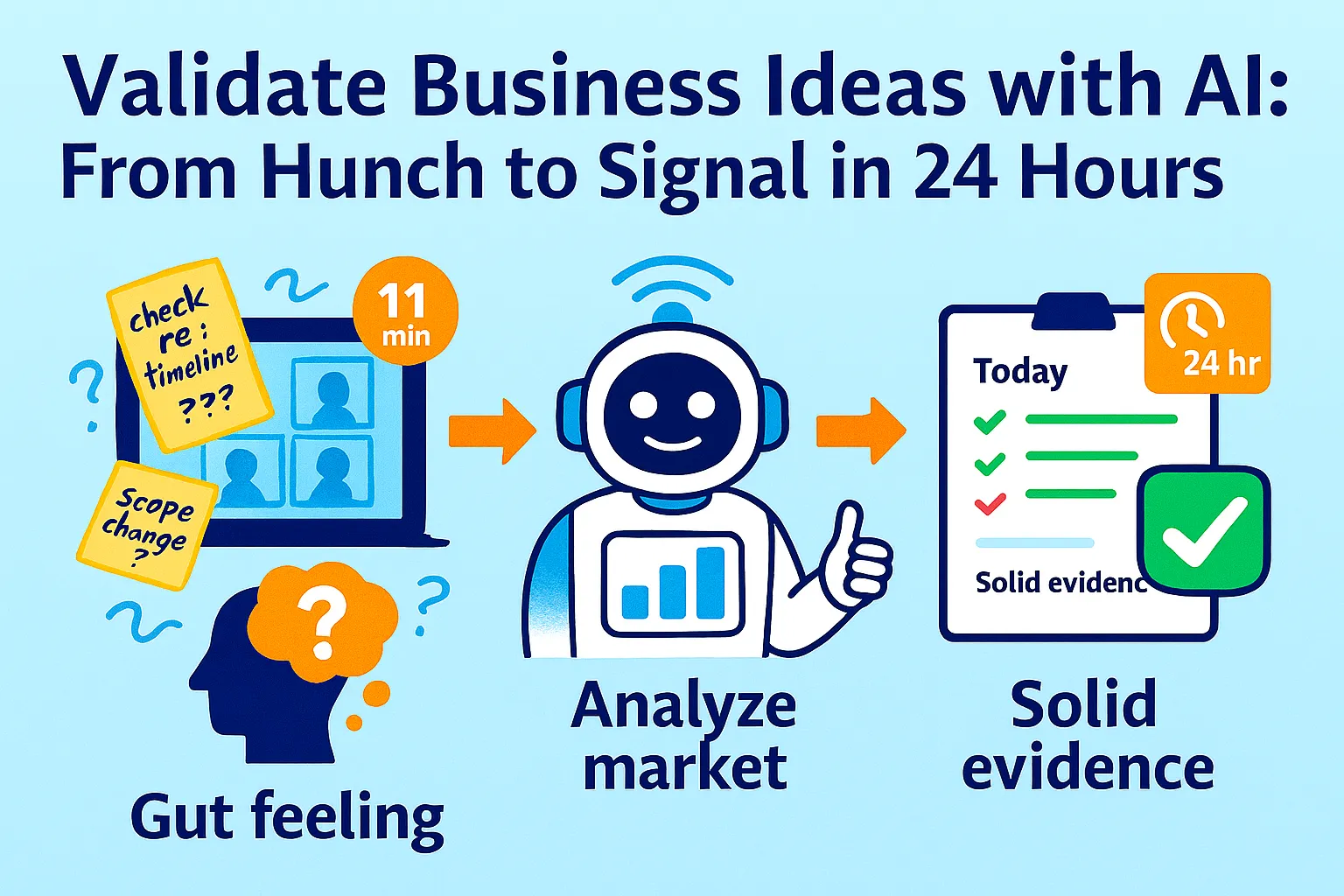
You have an idea. It came to you at 11 PM on a Tuesday.
It feels different from the last seven ideas. More specific. More urgent. You can picture the customer. You can see the problem clearly. You've already named it in your head.
By Thursday, one of two things happens: you've either talked yourself into it enough to start building, or the enthusiasm has faded and it joins the graveyard of Tuesday-night ideas you never pursued.
Neither outcome is validation.
Talking yourself into an idea is not validation. Losing enthusiasm is not invalidation. Yet most solo founders make their go/no-go decision on business ideas based entirely on one of these two things — internal conviction or internal doubt — with no external signal involved at all.
The result: 42% of startups fail because there was no real market need. Not because the founder wasn't smart, wasn't hardworking, or didn't believe in the idea. Because nobody checked.
The AI validation sprint changes this. In 24 hours, using freely available tools and a structured sequence of AI prompts, you can move from raw hunch to real signal — market size estimate, competitive landscape, demand evidence, monetization analysis, and a clear go/kill/pause recommendation — without spending a dollar on research or waiting three weeks for a consultant's report.
This is not a replacement for talking to customers. Nothing replaces talking to customers. But it's the work you do first — before you spend 20 hours building a landing page, before you pitch anyone, before you commit to an idea that might have a fatal flaw detectable in 25 minutes.
Here's the full 24-hour sprint.
What You're Actually Testing
Most founders think idea validation means "is this a good idea?" That's the wrong question. There is no universally good or bad idea — there are ideas that are good for specific markets at specific times with specific founder advantages.
You're testing five specific things:
1. Is there a real problem? Not "do people think this is interesting?" — but do they currently spend money, time, or headcount dealing with it? The key validation signal is not whether prospects say they would buy, but whether they are currently paying (in some form) for a solution to this problem. If nobody is paying for anything in this space — no tools, no consultants, no workarounds — the problem may not be painful enough.
2. Is the market large enough to matter to you? Not large enough for a venture fund — large enough for your goals. A market that supports $1M ARR is sufficient for a solo founder. A market that supports only $50K ARR is a freelance project, not a business.
3. Is competition a red flag or a green flag? No competition means no market. Too much well-funded competition in a commoditized space means you're too late. The sweet spot: established competition with identifiable gaps, complaints in communities, or customer segments that are systematically underserved.
4. Can this actually make money? Does a viable monetization model exist for this type of product in this type of market? Who pays, how much, and how often? Can you get to $5K MRR with fewer than 100 customers, or does this require thousands of users to generate meaningful revenue?
5. Do you have an unfair advantage here? The most overlooked validation question. Two founders with identical ideas and identical markets will have very different probabilities of success based on their specific background, network, and credibility. Your idea validated against your specific advantages is a much more reliable signal than a generic market assessment.
These five questions are what the 24-hour sprint answers. Not "is this a good idea" — but "is this a good idea for me, in this market, right now?"
Phase 1: The Stress-Test (Hours 1-4)
Before you look at a single external signal, put your idea through a structured adversarial prompt. This does two things: it surfaces weak points you haven't consciously acknowledged, and it forces you to articulate the idea with enough precision that external research becomes meaningful.
The Idea Stress-Test Prompt:
You are a brutally honest startup advisor with deep experience
watching solo founders succeed and fail. I'm going to describe
a business idea. Your job is not to be encouraging — it's to
find the real problems before I waste time building something
nobody wants.

MY IDEA:
[Describe your idea in 3-5 sentences:
- What the product does
- Who it's for (be specific — not "small businesses")
- What problem it solves
- How I think it makes money]

Stress-test this idea across these dimensions:

1. THE PROBLEM TEST
Is this a real, painful, recurring problem — or an interesting
problem that people tolerate without paying to fix?
What's the evidence that people currently spend money (directly
or indirectly) on this problem?
What's the strongest argument that this problem isn't
painful enough?

2. THE MARKET SIZE TEST
Give me a realistic TAM/SAM/SOM estimate — not optimistic,
not pessimistic, but grounded.
TAM: Total market if everyone who could use this did
SAM: Realistic serviceable market for this specific product
SOM: Realistic capture in years 1-3 for a solo founder

Flag if this looks like a <$1M ARR opportunity at realistic
capture rates.

3. THE COMPETITION TEST
Who are the 3-5 most likely direct competitors?
Who are the indirect competitors (including "do nothing"
and "hire someone")?
What is each competitor's biggest weakness?
What would it take to be meaningfully better or different?

4. THE MONETIZATION TEST
What are the 3 most plausible monetization models for this idea?
For each: who pays, how much, how often, and what's the realistic
path to $5K MRR?
Which model has the highest probability of working for a solo
founder with no sales team?

5. THE FOUNDER FIT TEST
What type of founder background gives this idea the highest
chance of success?
What distribution advantage does the ideal founder have?
What would make this idea very hard for a solo founder specifically?

6. THE KILL SHOTS
List the 3 most likely reasons this idea fails — not generic
startup failure reasons, but specific to this idea and market.
For each kill shot: what evidence would tell me this risk
is real vs. manageable?

7. THE TIMING TEST
Why now? What has changed in the last 2-3 years that makes
this idea more viable today than it was before?
What macro or technology trend is this riding — or is it
fighting against?

Output each section clearly. Be direct. I'd rather hear hard
truths now than after I've built something.
How to use the output:
Read it fully before defending any point. Your first instinct will be to dispute the parts that feel wrong. Don't — sit with them for an hour. The sections that make you most uncomfortable are the ones worth investigating.
Flag the two or three kill shots that feel most real. These are your research targets for Phase 2.
What this prompt does that generic idea feedback doesn't:
Generic feedback says "the market is competitive." The stress-test says "Competitor X charges $299/month and has 200 reviews — mostly complaining about the lack of API access. That gap is real, but closing it requires significant technical depth." Specific. Actionable. Testable.
Phase 2: Demand Signals (Hours 4-12)
The stress-test gives you a framework. Phase 2 gives you external signals — evidence from the real world that the problem exists and people are actively looking for solutions.
Four demand channels, all free, all completable in a few hours.
Channel 1: Search Trend Analysis
Search volume is one of the most honest demand signals that exists. People don't search for things they don't care about.
Google Trends (free):
Go to trends.google.com
Search your core problem keyword (not your solution — the problem)
Set to 5-year view
Look for: Is interest growing, flat, or declining? Any seasonal patterns? Regional concentration?
What you're looking for:
Upward trend over 3-5 years = growing market
Stable high volume = established market with consistent demand
Declining trend = market shrinking or problem being solved elsewhere
Flat low volume = either niche (good) or nobody cares (bad — needs further research)
The competitor comparison trick:
Enter 3-4 competitor names in Google Trends. See relative search volume. If competitors have growing search interest, the market is expanding. If their search volume is flat or declining, you're entering a saturated or shrinking space.
Then run this prompt with your Trends data:
Interpret these Google Trends findings for my business idea.

My idea: [one sentence]
Core problem keyword: [keyword you searched]
Trend pattern: [growing / flat / declining / seasonal]
Trend period: [5 years — note any inflection points]
Competitor search comparison: [what you found]

Based on this:
1. What does this trend pattern tell me about market demand?
2. Is the timing good, neutral, or concerning?
3. What follow-up search queries should I check to
   understand demand more precisely?
4. What's the most important thing this data doesn't tell me?
Channel 2: Community Demand Scan
If the problem is real, people are complaining about it somewhere — Reddit, Indie Hackers, specific Discord communities, LinkedIn, Twitter/X, or niche forums. Community demand is qualitative signal that search trends can't provide: the exact language people use to describe the problem, how frequently it comes up, and whether people are actively looking for solutions or just venting.
The Community Research Prompt:
I'm validating a business idea and need to find community
signals for a specific problem.

MY IDEA: [one sentence]
TARGET CUSTOMER: [specific description]
CORE PROBLEM: [the pain point, in plain language]

Tell me:
1. Which subreddits, Discord servers, Slack communities,
   or forums are most likely to contain my target customers?
   List 8-10 specific communities with brief reasoning.

2. What exact search queries should I use on Reddit to find
   people discussing this problem?
   Give me 10 specific search strings.

3. What phrases or keywords would my target customer use when
   describing this problem — NOT the solution language I would use?
   (e.g., I might say "workflow automation" — they might say
   "I spend hours every week manually copying data")

4. What competing products or workarounds are most likely
   to appear in these communities?

5. What would a post from someone with this exact problem
   look like? Write a sample Reddit post title that would
   organically surface my target customer.
Then actually go search.
Spend 30-45 minutes on Reddit, Indie Hackers, and the most relevant community from the AI's list. Search the phrases it gave you. Look for:
Posts asking for tool recommendations in your space (demand signal)
Complaints about existing tools (gap signal)
"I've been doing this manually for years" comments (willingness-to-pay signal)
"I wish someone would build X" threads (explicit demand signal)
Run this AI synthesis on what you find:
I searched these communities and found the following posts
and comments relevant to my business idea.

[Paste 5-10 relevant posts/comments you found]

Analyze these for:
1. PAIN INTENSITY: How painful does this problem actually sound?
   (1-10 scale with reasoning)
2. SOLUTION AWARENESS: Are people aware that tools exist to
   solve this, or are they solving it manually?
3. WILLINGNESS TO PAY: Any signals about budget or what
   they currently spend on related tools?
4. EXACT LANGUAGE: What specific words and phrases do they
   use to describe the problem?
5. UNDERSERVED SEGMENTS: Does any specific customer sub-segment
   appear more frustrated than others?
6. RED FLAGS: Anything in these conversations that concerns you
   about this idea?
The exact language extraction is valuable beyond validation — it's the copy you'll use on your landing page if you proceed.
Channel 3: Competitor Autopsy
If competitors exist — and they should, as no competition means no market — you need to understand them precisely, not superficially.
"There are a few competitors but we're different" is not competitive analysis. This is competitive analysis:
Step 1: Identify the full competitive landscape
Map the complete competitive landscape for this business idea.

MY IDEA: [one sentence]
TARGET CUSTOMER: [specific]

List:
1. DIRECT COMPETITORS: Products that solve the same problem
   for the same customer
   For each: name, approximate price, founding year,
   estimated size (team/funding/reviews), primary positioning

2. INDIRECT COMPETITORS: Different solutions to the same problem
   Include: manual processes, spreadsheets, hiring someone,
   adjacent tools used as workarounds

3. SUBSTITUTES: Things customers do instead of buying
   any solution at all

4. EMERGING COMPETITORS: Startups that launched in
   the last 18 months in this space

For each direct competitor, note: What customer segment
do they serve best? What customer segment do they
systematically underserve?
Step 2: Mine competitor reviews
Go to G2, Capterra, or Product Hunt for your top 2-3 competitors. Filter reviews by 1-3 stars. Paste 10-15 negative reviews into this prompt:
These are 1-3 star reviews of [Competitor Name], which competes
in the space I'm entering.

[Paste reviews]

Extract:
1. TOP 5 COMPLAINTS: Most frequently mentioned problems
   (count mentions)
2. CUSTOMER SEGMENTS FRUSTRATED: Which type of customer
   wrote these reviews? Any pattern?
3. FEATURE GAPS: Specific features repeatedly requested
   or missing
4. SWITCHING SIGNALS: Are reviewers saying they're leaving
   for another tool? Which one?
5. MY OPPORTUNITY: Based on these complaints, what is the
   clearest gap I could position against?
6. COPYCAT RISK: Is any complaint easily fixable by the
   incumbent in the next 6-12 months?
This is how you find real differentiation — not by imagining what's missing, but by reading what paying customers are already frustrated about.
Step 3: Pricing intelligence
Based on the competitor landscape for [idea], analyze pricing:

1. What's the pricing range in this market?
   (Low / Mid / High tiers with approximate prices)
2. What pricing model dominates?
   (Per seat / Usage-based / Flat monthly / One-time)
3. What does the pricing signal about customer willingness to pay?
4. Where is the pricing gap — is there an underserved price point?
5. What price would a solo founder realistically need to charge
   to reach $5K MRR?
   How many customers does that require?
Channel 4: The "Spending Money" Test
The most reliable demand signal is simple: are people currently paying for something in this space?
Not paying for your product — paying for anything related to the problem. Job postings for roles that do this work manually. Consultants charging for this service. Adjacent tools people jury-rig into solving this problem.
For this business idea, find evidence that people are currently
spending money on this problem:

MY IDEA: [one sentence]
PROBLEM: [the pain point]

Search for and analyze:
1. JOB POSTINGS: What job titles on LinkedIn or Indeed
   would be hired to do this work manually?
   (If companies hire people for this, AI can replace them —
   that's validated demand)

2. CONSULTANT MARKET: Are there freelancers or agencies
   charging for this service on Upwork, Fiverr, or LinkedIn?
   Approximate rates?

3. WORKAROUND TOOLS: What tools are people currently
   combining to solve this problem imperfectly?
   (Zapier + Google Sheets + manual = clear automation opportunity)

4. ADJACENT PURCHASES: What tools do target customers
   already pay for that are adjacent to this problem?
   (Signals they have budget and are actively managing this area)

Synthesize: Is there evidence of current spending in this space?
High / Medium / Low — with reasoning.
Phase 3: The Monetization Deep-Dive (Hours 12-18)
Most ideas with real demand still die on monetization. The problem exists. People care. Nobody wants to pay what you need to charge, or the sales cycle is 9 months, or the unit economics never work for a solo founder.
Run this before the decision prompt.
The Monetization Viability Prompt:
Analyze monetization viability for this solo founder business idea.

MY IDEA: [description]
TARGET CUSTOMER: [specific]
EVIDENCE OF DEMAND SO FAR: [1-2 sentences from your research]

Evaluate three monetization models:

MODEL 1: SaaS Subscription
- Who is the buyer? (individual / team / company)
- Realistic price range (monthly) based on the market
- Typical sales cycle length for this buyer
- Estimated churn rate for this category
- Path to $5K MRR: how many customers, at what price?
- Solo founder viability: can I close these deals alone?
  What's the typical acquisition channel?

MODEL 2: One-Time / Project-Based
- Is there a productized service or one-time purchase model?
- Realistic price for a one-time transaction
- Repeat purchase likelihood
- Path to $5K monthly revenue: volume required?

MODEL 3: Usage-Based / Consumption
- Does this lend itself to pay-per-use pricing?
- What's the unit of consumption?
- Minimum viable usage to generate meaningful revenue
- Risk: does usage-based create unpredictable revenue
  for a solo founder?

VERDICT FOR EACH MODEL:
- Viable for solo founder: Yes / Conditional / No
- Fastest to first dollar: ranking
- Highest ceiling: ranking
- Recommended model and why

FATAL MONETIZATION RISKS:
What would make this fundamentally hard to monetize
regardless of model chosen?
The unit economics check:
After the monetization prompt, run one more calculation:
Given this monetization model for [idea]:

Assumptions:
- Target price: $[X]/month
- Estimated CAC (cost to acquire one customer): $[Y]
  (Use: $0 if purely content/SEO, $50-200 if community-driven,
   $500+ if outbound sales)
- Estimated monthly churn: [Z]%
  (Use 2-3% for sticky B2B tools, 5-8% for less sticky products)
- My time cost per customer per month: [hours × hourly rate]

Calculate:
1. LTV (lifetime value) = Average revenue per month ÷ churn rate
2. LTV:CAC ratio (should be >3x to be viable)
3. Months to recover CAC
4. Revenue at 100 customers / 500 customers / 1000 customers
5. At what customer count does this become a real business
   ($10K MRR) vs. a side project ($1-2K MRR)?
6. Is this fundamentally a high-volume / low-price or
   low-volume / high-price business?

Flag if the unit economics look fundamentally broken at
realistic assumptions.
If LTV:CAC is below 3x at realistic assumptions, the business model needs rethinking before you go further — not after you've built an MVP.
Phase 4: The Go/Kill/Pause Decision (Hours 18-24)
You now have: a stress-tested idea, four demand signal sources, a competitive map with real gaps identified, and a monetization analysis with unit economics.
Run the decision prompt.
The Go/Kill/Pause Framework Prompt:
I've completed a 24-hour validation sprint on a business idea.
Help me make a clear go/kill/pause decision.

MY IDEA: [description]
TARGET CUSTOMER: [specific]
PROPOSED PRICE: [model and amount]

VALIDATION FINDINGS:

Search Trends: [What you found — growing/flat/declining,
key observations]

Community Signals: [What you found — pain intensity score,
key quotes, underserved segments]

Competition: [Top 3 competitors, their gaps, your positioning angle]

Demand Evidence: [Is money currently being spent in this space?
Evidence found]

Monetization: [Which model you're pursuing, path to $5K MRR,
unit economics summary]

Founder Fit: [Your relevant background, existing network,
distribution advantage if any]

DECISION FRAMEWORK:

Score each dimension 1-5:

1. PROBLEM REALITY (1=questionable, 5=undeniable pain with
   current spending)
2. MARKET SIZE (1=<$500K opportunity, 5=>$10M realistic SAM)
3. COMPETITIVE POSITION (1=commoditized/dominated,
   5=clear gap with defensible angle)
4. MONETIZATION CLARITY (1=unclear how this makes money,
   5=obvious model with precedent)
5. FOUNDER FIT (1=no advantage here, 5=unfair distribution
   or credibility advantage)
6. TIMING (1=too early/too late, 5=clear tailwind right now)
7. VALIDATION QUALITY (1=all assumption, 5=strong external signals)

Total score / 35

DECISION THRESHOLDS:
28-35: GO — Start building an MVP or landing page this week
20-27: CONDITIONAL GO — Proceed with one specific
        condition that must be met first
14-19: PAUSE — One or two critical gaps need closing
        before committing
Below 14: KILL — Fundamental problem with idea as conceived;
          pivot significantly or move on

Output:
1. Scores for each dimension with one-sentence reasoning
2. Total score and decision
3. If GO: What's the first thing to build?
4. If CONDITIONAL GO: What's the one condition to meet?
5. If PAUSE: What specifically needs to be resolved
   and how?
6. If KILL: What's the most valuable insight from
   this validation to carry into the next idea?
The decision is a recommendation, not a verdict.
A score of 32/35 doesn't mean the business will succeed. A score of 18/35 doesn't mean the idea is worthless. The framework surfaces where your evidence is weak and your assumptions are strongest — which is exactly what you need to know before committing time and money.
The founder override rule:
One dimension can legitimately override the score: Founder Fit. A founder with deep industry expertise, an existing audience of the target customer, or a unique distribution advantage can viably pursue a 22/35 idea that a founder without those advantages should kill. Score it honestly — but weight your own unfair advantages carefully.
The 24-Hour Sprint Schedule
Hour 0-1: Write your idea description. Be specific enough that the prompts can work. Vague input = vague output.
Hours 1-4: Run the Idea Stress-Test Prompt. Read the full output. Sit with the kill shots. Note your top 3 research targets.
Hours 4-6: Google Trends — search your problem keyword and 3-4 competitor names. Run the Trends Interpretation Prompt.
Hours 6-9: Community research. Run the Community Research Prompt, get the list of communities and search strings. Spend 45-60 minutes actually searching. Paste your best finds into the Community Synthesis Prompt.
Hours 9-12: Competitor research. Run the Competitor Landscape Prompt. Find G2/Capterra reviews for top 2 competitors. Run the Review Mining Prompt on their negative reviews. Run the Pricing Intelligence Prompt.
Hours 12-15: Run the "Spending Money" Test. Check job postings, Upwork, workaround patterns.
Hours 15-18: Run the Monetization Viability Prompt and unit economics check.
Hours 18-24: Compile everything. Run the Go/Kill/Pause Framework Prompt. Make your decision.
Total active time: 6-8 hours of focused work across 24 hours. The rest is thinking time, letting findings settle before the decision.
What To Do With Each Decision
GO:
Don't build the full product. Build the smallest possible thing that tests the riskiest assumption. If the biggest unknown is whether people will pay — build a landing page with pricing before writing code. If the biggest unknown is whether you can deliver the core value — build one instance manually for one customer before automating. The validation sprint de-risks the idea. An MVP de-risks the execution.
CONDITIONAL GO:
Do the one thing. Not ten things — the one specific condition your decision prompt identified. If the condition is "talk to 5 target customers before building anything" — do that this week, not in a month. Conditional goes become kills when founders ignore the condition.
PAUSE:
Set a 30-day timer. Identify the two specific things that need to be resolved. Do only those two things. At 30 days, re-run the relevant sections of the validation sprint with new information. Pause is not "keep thinking about it" — it's "resolve these specific gaps by this specific date."
KILL:
Write one paragraph capturing the most valuable insight from the validation. What did you learn about the market, the customer, or the problem that you'll carry into the next idea? The graveyard isn't failure — it's a research database.
What This System Is Not
AI validation has real limits. The prompts in this guide are analytical. They stress-test assumptions, find external signals, and structure decisions. They do not replace the two things that only real conversations provide:
Customer language you can't anticipate. Reddit posts and community searches give you proxies. Actual conversations with target customers give you the specific framing, the specific frustration, the specific vocabulary that makes or breaks positioning. If this is a GO, talk to 10 target customers before you write a word of code.
Willingness to pay at your specific price point. Community signals tell you people are spending money in this space. They don't tell you whether your specific price will work with your specific positioning. Pre-sales — asking real prospects to pay before you've built anything — is the only reliable test.
The 24-hour sprint gets you from hunch to informed hypothesis. Customer conversations get you from hypothesis to conviction. Build nothing of substance until you have both.
Common Validation Mistakes
1. Validating the solution instead of the problem
"Would you use an AI tool that automatically summarizes your meetings?" is not a validation question — it's a leading question that people answer yes to because it sounds useful. "How do you currently handle meeting notes and action items?" is a validation question. Validate the problem. The solution can be changed. The problem must be real.
2. Counting positive reactions as demand
"That's a great idea!" is not demand. "I would pay $X/month for that" is weak demand. "Here's my credit card, can I get early access?" is demand. Social validation from friends, colleagues, or Twitter followers is the most dangerous form of false signal — it feels like market feedback and contains none.
3. Ignoring the kill shots
The stress-test produces three kill shots. Most founders read them, feel briefly uncomfortable, and then proceed as if they weren't there. The kill shots are the research agenda. They are not obstacles to being dismissed — they are hypotheses to be tested.
4. Validating in the wrong community
You post in an entrepreneur community full of people who are themselves validating ideas. They engage with your post because engaging is what that community does — not because they're your target customer. Validate where your customer is, not where other founders are.
5. Stopping at "the market exists"
A market exists for almost every idea. The question is whether it exists at sufficient size, at sufficient pain, with sufficient willingness to pay, in a competitive landscape you can actually navigate. Market existence is the beginning of validation, not the end.
6. Over-indexing on competition as a kill signal
"There are already 5 competitors" is not a reason to kill an idea. It's a reason to understand each competitor deeply and identify who they're failing. Every successful new product launched into a market with competition. The question is not whether competition exists — it's whether you have a clear, defensible position that a specific customer segment will prefer.
Tools and Cost
Free (covers 90% of the sprint):
ChatGPT free or Claude free: All prompts
Google Trends: Search demand analysis
Reddit (browser): Community demand scan
G2/Capterra (browser): Competitor review mining
Product Hunt (browser): Competitor and market pulse
LinkedIn Jobs (free): Job posting demand signal
Upwork (browser): Consultant market check
Total: $0
Recommended ($20/month):
ChatGPT Plus or Claude Pro ($20/month): Better reasoning on complex prompts, faster output, higher quality monetization and competitive analysis
Total: $20/month
Optional research boosters:
Ahrefs Webmaster Tools (free): Keyword volume for demand validation
SparkToro ($50/month): Where your target audience actually spends time online — worth it if community research keeps returning shallow results
Semrush free tier: Competitor traffic estimates
The Real Talk on Idea Validation
Most founders resist validation for one of two reasons.
The first is fear. If you validate and the signal is weak, you have to kill the idea. As long as you haven't validated, hope remains. This is precisely backwards — killing a bad idea in 24 hours is infinitely better than killing it after 6 months of building.
The second is impatience. Validation feels like delay. You want to build. Spending a day on research when you could be writing code feels like the opposite of momentum.
Here's the reframe: validation is the fastest path to building. Not because it removes risk — it doesn't, entirely — but because it tells you where the riskiest assumptions are so you can build the smallest thing that tests them, rather than building everything and discovering the fatal flaw at launch.
AI has made this faster than it's ever been. The stress-test prompt takes 10 minutes to run. The community research guide takes 30 minutes. The competitive analysis takes an hour. The full sprint — 8 hours of real work — previously required a market research team and a week.
You have a Tuesday-night idea. Give it 24 hours before you give it 6 months.
That's it.



Comments (0)
Leave a Comment