

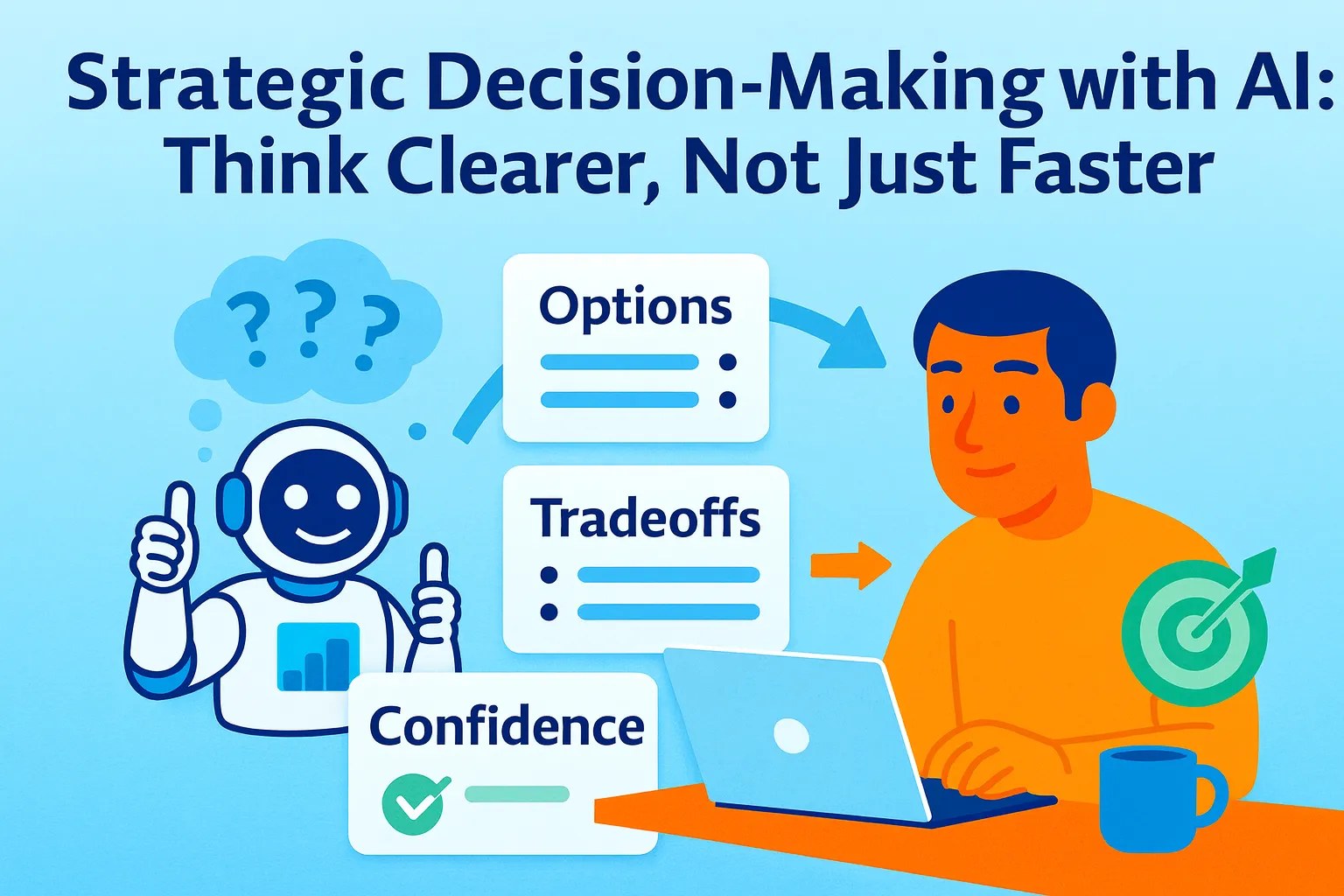
Every article in this series made you faster.
Faster at onboarding clients. Faster at processing meetings. Faster at producing content. Faster at documenting processes. Faster at validating ideas and researching markets.
This article does something different. It makes you clearer.
Speed without clarity is how founders move quickly in the wrong direction — shipping features nobody asked for, raising prices at the wrong moment, pursuing a partnership that sounds strategic but isn't, pivoting away from something that needed more patience. The decisions that damage businesses most aren't made slowly. They're made confidently, at speed, on incomplete reasoning.
Solo founders face a specific version of this problem. You don't have a co-founder to push back. You don't have a board to stress-test your reasoning. You don't have a management team to surface the concerns they see from where they sit. You have your own thinking, your own experience, and your own cognitive biases — which, like everyone's, are largely invisible to you while you're inside them.
The "bias blind spot" is the most fundamental challenge in decision-making: individuals recognize cognitive distortions in others while remaining oblivious to identical patterns in their own thinking. You can name confirmation bias fluently and still only research the evidence that confirms what you already believe. You can critique sunk cost reasoning in others and still defend a failing product because you've spent eight months on it.
AI doesn't make you immune to these biases. But used correctly — not as a yes-machine that validates whatever you're already leaning toward, but as a structured adversary that forces your reasoning into the open — it becomes the closest thing to a thinking partner that a solo founder can access.
This article is about using AI to think, not to execute. The prompts that follow are for your biggest calls: product direction, pricing, strategic focus, and partnerships. And the decision log at the end is the system that makes your decision-making compound — turning every big call into future intelligence.
The Fundamental Mistake: Using AI to Confirm, Not to Challenge
Before any prompt, one framing that determines whether AI helps or hurts your decision-making.
The natural way to use AI on a hard decision: you've already formed a view, you describe the situation, and you ask "what do you think?" AI, being cooperative by default, tends to validate the frame you've presented and find supporting arguments. You leave the conversation feeling more confident. Your original view is unchanged. Nothing was actually tested.
This is AI as confirmation machine. It's worse than not using AI at all, because it adds false confidence to an untested position.
The productive way: you describe the situation and explicitly instruct AI to challenge your position, steelman the opposite view, identify what you might be missing, and name the cognitive biases most likely to be distorting your thinking. You leave the conversation with the same or updated view — but one that has been stress-tested against counterarguments you didn't generate yourself.
Research shows that aggregating evaluations across multiple AI prompts and roles tends to resemble the quality of expert human judgment — while single AI evaluations are often inconsistent or biased. The practical implication: never run one prompt on a big decision. Run three different framings — from different adversarial angles — and see where they converge.
The meta-prompt to use before every decision prompt:
Before I describe my decision, I want you to commit
to a specific role for this conversation.

Your role: Thinking partner, not yes-machine.

Your job is to:
1. Ask the question I'm not asking
2. Steelman the position I'm arguing against
3. Identify the cognitive bias most likely
   distorting my thinking right now
4. Tell me what I need to know that I
   haven't asked about
5. Give me your honest assessment,
   not a diplomatic hedge

You are not here to validate my thinking.
You are here to pressure-test it.
If my reasoning is sound, tell me why.
If it has gaps, show me where they are.

Commit to this role before I describe the decision.
This single meta-prompt changes the entire quality of the AI interaction. Most founders skip it. Don't.
The Five Cognitive Biases Most Dangerous for Solo Founders
These are the biases most likely to be active when you're making big decisions alone. Name them before running any decision prompt — AI is better at catching them when you've made them visible.
1. Confirmation bias Seeking information that supports what you already believe, filtering out what contradicts it. Most likely to appear when: you've already emotionally committed to a direction and you're "researching" it.
2. Sunk cost fallacy Continuing to invest in something because of past investment rather than future expected value. Most likely to appear when: you've built something for 6+ months and it isn't working, but pivoting means admitting the time was wasted.
3. Overconfidence bias Overestimating your abilities and underestimating risks — resulting in unrealistic timelines and excessive risk-taking. Most likely to appear when: things have been going well and you're planning the next move.
4. Recency bias Overweighting recent events (a big win, a notable churn, a competitor's launch) when making predictions about the future. Most likely to appear when: something notable just happened and you're making a decision in its emotional wake.
5. Availability heuristic Making judgments based on examples that come easily to mind rather than representative data. Most likely to appear when: you recently heard about a founder succeeding with an approach you're evaluating.
Add to every decision prompt:
Before giving your assessment, tell me which of
these five biases is most likely active in
my reasoning right now, and why:
1. Confirmation bias
2. Sunk cost fallacy
3. Overconfidence bias
4. Recency bias
5. Availability heuristic

Name the most likely one. Give a specific reason
based on what I've described. Don't name all five.
The Standard Decision Prompts
Four decisions that every solo founder faces repeatedly. Each one has a standard prompt architecture designed to force clear thinking rather than fast answers.
Decision Type 1: Product Direction
The product decision is where sunk cost and confirmation bias combine most dangerously. You've built something. You believe in it. Someone questioned it. Or it's not growing. Or a competitor just launched something adjacent. Now you're deciding: stay the course, pivot, or kill.
The Product Direction Prompt:
I'm facing a product direction decision.
Help me think through it clearly.

THE CURRENT SITUATION:
Product: [What it does, who it's for]
Stage: [Pre-launch / Early / Growing / Plateaued]
Evidence for the current direction:
  [What data or signal supports continuing]
Evidence against:
  [What data or signal suggests this isn't working]
What I'm leaning toward: [Stay / Pivot / Kill]
Why I'm leaning that way: [Honest reasoning]

Run this through four lenses:

LENS 1 — THE EVIDENCE TEST:
What does the actual data say, separated from
how I feel about it?
What's the minimum evidence I'd need to
definitively confirm this is/isn't working?
Do I have that evidence yet, or am I deciding
before the evidence exists?

LENS 2 — THE SUNK COST TEST:
If I had built nothing yet, and I was
evaluating this opportunity fresh today,
would I start building it?
If yes: sunk cost isn't distorting this decision.
If no or uncertain: sunk cost may be driving
the "stay" position.

LENS 3 — THE STEELMAN TEST:
Make the strongest possible argument for the
position I'm arguing against.
What would a smart founder who took the
opposite view know that I might be missing?

LENS 4 — THE REGRET TEST:
In 24 months, which decision am I more likely
to regret — staying too long, or quitting
too early?
What does the answer reveal about my
actual risk tolerance vs. stated risk tolerance?

BIAS CHECK:
Which of the five biases named above is
most likely active in my thinking right now?

SYNTHESIS:
Given all four lenses, what is the clearest
reading of this situation?
What decision would a rational outside
observer make with this information?
What would you do?
Decision Type 2: Pricing
Pricing decisions are where overconfidence and availability bias combine most dangerously. You see a competitor charge $X and assume you should charge the same. Or you just closed a deal at a price that felt high and assume that's the ceiling. Or you're afraid to raise prices because you remember the one customer who complained.
The Pricing Decision Prompt:
I'm facing a pricing decision.

MY CURRENT SITUATION:
Current price: $[X]/month
What I'm considering: [Raise / Lower / Add tier /
  Change model / Launch at new price]
My reasoning: [Why I'm considering this]
Evidence I have: [Customer data, conversion rates,
  competitor prices, any pricing research]
What I'm afraid of: [The specific risk I'm trying to avoid]

Run this through four lenses:

LENS 1 — THE VALUE ALIGNMENT TEST:
Does my current or proposed price reflect
the actual value customers receive, or is it
anchored to competitor prices or my own
cost structure?
What would "pricing to value" look like here?

LENS 2 — THE FEAR AUDIT:
I said I'm afraid of [X]. Is this fear
based on data or assumption?
What's the actual probability of the bad
outcome I'm fearing?
Have I conflated "one customer complained"
with "the market won't bear this price"?

LENS 3 — THE EXPERIMENT TEST:
What's the smallest test that would give me
real signal on this pricing decision
before fully committing?
How long would it take to get a reliable answer?
What result would tell me I'm right?
What result would tell me I'm wrong?

LENS 4 — THE REVENUE MODEL TEST:
At the proposed price, what does the path
to $5K / $10K / $20K MRR look like in
terms of customer count?
Is that customer count realistic given my
current acquisition rate?
Does changing the price change the acquisition
economics in a way I haven't accounted for?

BIAS CHECK: Which bias is most likely active here?

SYNTHESIS:
What does a clear-eyed reading of this
pricing situation suggest?
What should I do, and what should I test first?
Decision Type 3: Strategic Focus
The focus decision is where availability bias and FOMO combine. You hear about another founder succeeding with a different approach. You see a competitor moving into adjacent territory. You have three things that are all "working" at 30% capacity and you're trying to do all of them. You're deciding: concentrate or diversify.
The Strategic Focus Prompt:
I'm facing a strategic focus decision.

MY CURRENT SITUATION:
What I'm currently doing: [List your current
  strategic initiatives / channels / bets]
What's working: [With evidence — metrics, not feelings]
What's not working: [With evidence]
What I'm considering doing differently:
  [The new direction, channel, or bet]
Why I'm considering it: [Honest reasoning —
  include if you heard about another founder
  doing this successfully]

Run this through four lenses:

LENS 1 — THE CONCENTRATION TEST:
If I took everything I'm currently spreading
across [N initiatives] and put it entirely
into the single best-performing one,
what would the likely result be?
Why am I not doing that?

LENS 2 — THE SIGNAL VS. NOISE TEST:
For each current initiative: what's the
actual signal strength? (Leading indicators
of future success, not activity metrics)
Which one has the clearest signal?
Which one am I continuing out of hope
rather than evidence?

LENS 3 — THE OPPORTUNITY COST TEST:
For the new direction I'm considering:
what do I stop doing to make room for it?
Is what I'm stopping more or less likely
to produce results than what I'm adding?
If I can't name what I'm stopping,
I'm adding without deciding.

LENS 4 — THE FOUNDER FIT TEST:
Which of my current options do I have
an unfair advantage in?
(Distribution, expertise, network,
 credibility, or prior relationships)
Am I currently leaning toward an option
where I have less advantage because it
looks more interesting?

BIAS CHECK: Which bias is most active here?
(Specifically: is this an availability bias
situation — did I hear about another founder's
success and it's distorting my assessment?)

SYNTHESIS:
What does the evidence say I should concentrate on?
What am I most likely to regret if I don't stop?
What's the decision?
Decision Type 4: Partnership and Collaboration
Partnership decisions are where optimism bias and the desire for external validation combine. A potential partner appears. They have something you want (distribution, credibility, access). The conversation goes well. You're excited. You're deciding how much to invest in this relationship.
The Partnership Decision Prompt:
I'm evaluating a potential partnership or
collaboration.

THE SITUATION:
Who: [Who this person or company is]
What they're proposing: [The specific arrangement]
What I'd get: [Distribution / Revenue /
  Credibility / Access / Technology / Other]
What they'd get: [My product / Audience /
  Technology / Revenue share / Other]
Why I'm excited: [Honest — include the
  emotional appeal, not just the rational case]
What gives me pause: [The reservations
  I'm not sure are valid]

Run this through four lenses:

LENS 1 — THE INCENTIVE ALIGNMENT TEST:
Do we want exactly the same thing from this
partnership, or do we want compatible things?
Where might our interests diverge over
the next 12 months?
Who benefits more if this succeeds?
Who loses more if it fails?

LENS 2 — THE EXCLUSION TEST:
Does this partnership close off options?
(Exclusivity clauses, reputational associations,
 technical dependencies, time commitments)
If this partnership ends badly in 12 months,
what am I left without?

LENS 3 — THE SMALL BET TEST:
What's the smallest possible version of
this partnership — a 30-day test, one project,
one channel — that would tell me whether
the full version is worth pursuing?
Is the partner willing to start small?
(Unwillingness to start small is a signal.)

LENS 4 — THE DISTRACTION TEST:
How many hours per week will this partnership
require to do well?
Is that time coming from something more
important to my core business?
Am I pursuing this partnership partly because
it's more exciting than the hard work I know
I need to do?

BIAS CHECK: Which bias is most active here?
(Specifically: am I overweighting the upside
because the conversation went well —
availability bias from recent positive
interaction?)

SYNTHESIS:
What does a clear-eyed reading of this
partnership suggest?
Start full / Start small / Pass /
  Ask these specific questions first?
The Pre-Mortem: One More Check Before Any Big Decision
Before committing to any major decision — one that's hard to reverse, costs significant time or money, or affects a key relationship — run a pre-mortem.
The pre-mortem is the most consistently underused decision tool in solo founder practice. It asks one question from an unusual vantage point: assume the decision you're about to make turned out badly. Not "could it go wrong" but "it went wrong — what happened?"
Run a pre-mortem on this decision.

THE DECISION I'M ABOUT TO MAKE:
[Describe the decision clearly]

Assume it's 18 months from now.
The decision I made was wrong.
The outcome was significantly worse
than I expected.

Work backward:
1. What specifically went wrong?
   (Give me 3-5 plausible failure scenarios,
   not generic "execution was poor")

2. Which failure scenario is most likely
   given what I know now?

3. What early warning signal would have
   told me, 3-6 months in, that this was
   going wrong?

4. Is there anything I could do before
   committing that would reduce the
   probability of the most likely
   failure scenario?

5. Is this decision reversible if it goes wrong?
   What's the exit path and what does
   it cost to take it?

The pre-mortem doesn't mean don't decide.
It means decide with eyes open.
The value of the pre-mortem isn't that it predicts what will go wrong. It's that it makes you articulate the failure scenarios — which most founders deliberately avoid thinking about when they're excited about a decision. The scenarios you generate will be uncomfortable. That discomfort is the tool working.
The Decision Log: Learning From Every Call
A decision log is the compounding mechanism that turns individual decisions into a learning system.
Most founders make decisions and move on. When the decision produces a good outcome, they credit their judgment. When it produces a bad outcome, they attribute it to bad luck or external factors. Neither assessment is systematically examined. The next similar decision is made from the same starting point.
The decision log breaks this pattern. It captures the reasoning at decision time — not reconstructed after the outcome is known — so you can compare what you thought would happen against what actually happened. Over time, the log reveals systematic patterns: the types of decisions you consistently get right, the cognitive biases that reliably distort your thinking, the situations where your intuition leads you astray.
The decision log structure (one Notion page per significant decision):
DECISION LOG ENTRY

Date: [Date of decision]
Decision: [What you decided — one clear sentence]
Options considered: [What alternatives you evaluated]
Why you chose this option: [Your reasoning at decision time]
Evidence you had: [What you knew when you decided]
Evidence you didn't have but wish you did:
  [What was missing from your analysis]
Cognitive bias most likely present:
  [From your pre-decision AI analysis]
Expected outcome: [What you thought would happen]
Risk you were most concerned about:
  [Your top worry at decision time]
Reversibility: [Easy / Moderate / Hard to reverse]

---

[30 DAYS LATER]
Early signal: [What's happening so far]
Tracking as expected? [Yes / No / Too early to tell]

---

[90 DAYS LATER]
Outcome: [What actually happened]
Versus expectation: [Better / As expected / Worse —
  with specifics]
Was your main risk realized? [Yes / No / Differently]
What you would do differently: [Honest one paragraph]
Lesson: [One sentence — the reusable insight]
The quarterly decision review prompt:
Review my decision log for the last quarter.

[Paste all decision log entries from past 90 days]

Analyze:

1. PATTERN RECOGNITION:
   What types of decisions am I making well
   (expected vs actual outcome positive)?
   What types am I consistently getting wrong?

2. BIAS PATTERNS:
   Which cognitive bias appeared most frequently
   in my pre-decision analysis?
   Did the bias I identified actually distort
   the outcome in the cases where it was present?

3. CALIBRATION:
   When I expected a positive outcome,
   how often did I get one?
   When I expected a negative risk to materialize,
   how often did it?
   Am I overconfident or appropriately calibrated?

4. REVERSIBILITY LESSONS:
   For decisions I got wrong:
   Were they reversible?
   Did the reversibility (or lack of it) matter?
   Am I taking appropriately sized risks
   given my stage?

5. ONE CHANGE:
   Based on this quarter's decisions,
   what one change to my decision-making
   process would most improve future outcomes?

Output: 2-3 paragraph synthesis + one specific
process change for next quarter.
The quarterly review is where the compounding happens. After two or three quarters, you have enough data to see the actual shape of your judgment — where it's sharp, where it's systematically distorted. That self-knowledge is more valuable than any framework.
When to Decide Quickly and When to Deliberate
Not every decision deserves the full framework. Applying pre-mortems and four-lens analysis to "what should I call this blog post?" is over-engineering clarity.
The decision framework is for:
Decisions that are hard or impossible to reverse
Decisions with significant resource commitment (3+ months of time or $5K+ of money)
Decisions affecting key relationships (clients, partners, contractors)
Decisions where you notice yourself feeling emotionally committed before you've analyzed
The decision framework is not for:
Tactical daily choices
Low-stakes experiments with clear exit criteria
Decisions you've made many times before with consistent results
Decisions where the cost of deliberation exceeds the cost of being wrong
A simple filter:
I'm trying to decide whether to deliberate
carefully or just decide quickly on this.

DECISION: [Describe it]

Tell me:
1. How reversible is this?
   (1 = very hard to undo, 5 = trivially reversible)
2. How large is the commitment?
   (1 = minor, 5 = major resource or relationship stake)
3. How emotionally activated am I about this?
   (1 = neutral, 5 = strongly attached to one outcome)

If the average score is 3 or above:
use the full decision framework.
If below 3: decide quickly, log the outcome,
move on.
The Real Talk on AI and Judgment
There's a version of AI-assisted decision-making that feels like progress but isn't: using AI to generate reasons for the decision you've already made, until you have enough reasons to feel confident.
That's not thinking clearly. That's thinking faster toward a predetermined conclusion.
The prompts in this article are designed to make that harder. The meta-prompt commits AI to the adversarial role before you describe the situation. The four lenses include at least one that explicitly argues against your position. The pre-mortem forces you to inhabit the failure scenario. The bias check names the specific distortion most likely to be active.
Used honestly, this framework doesn't produce better decisions by making you smarter. It produces better decisions by making your reasoning visible — to you, and to the AI that's stress-testing it. Most decision errors aren't errors of intelligence. They're errors of structured thinking — the failure to employ frameworks that overcome cognitive biases before proposing a decision that could yield significant consequences.
The log is what turns one good decision into a decision-making system. Six months of entries, honestly completed, will show you more about how your judgment actually works than any book on decision-making ever could.
Your judgment is the asset. The prompts protect it.
That's it.



Comments (0)
Leave a Comment