

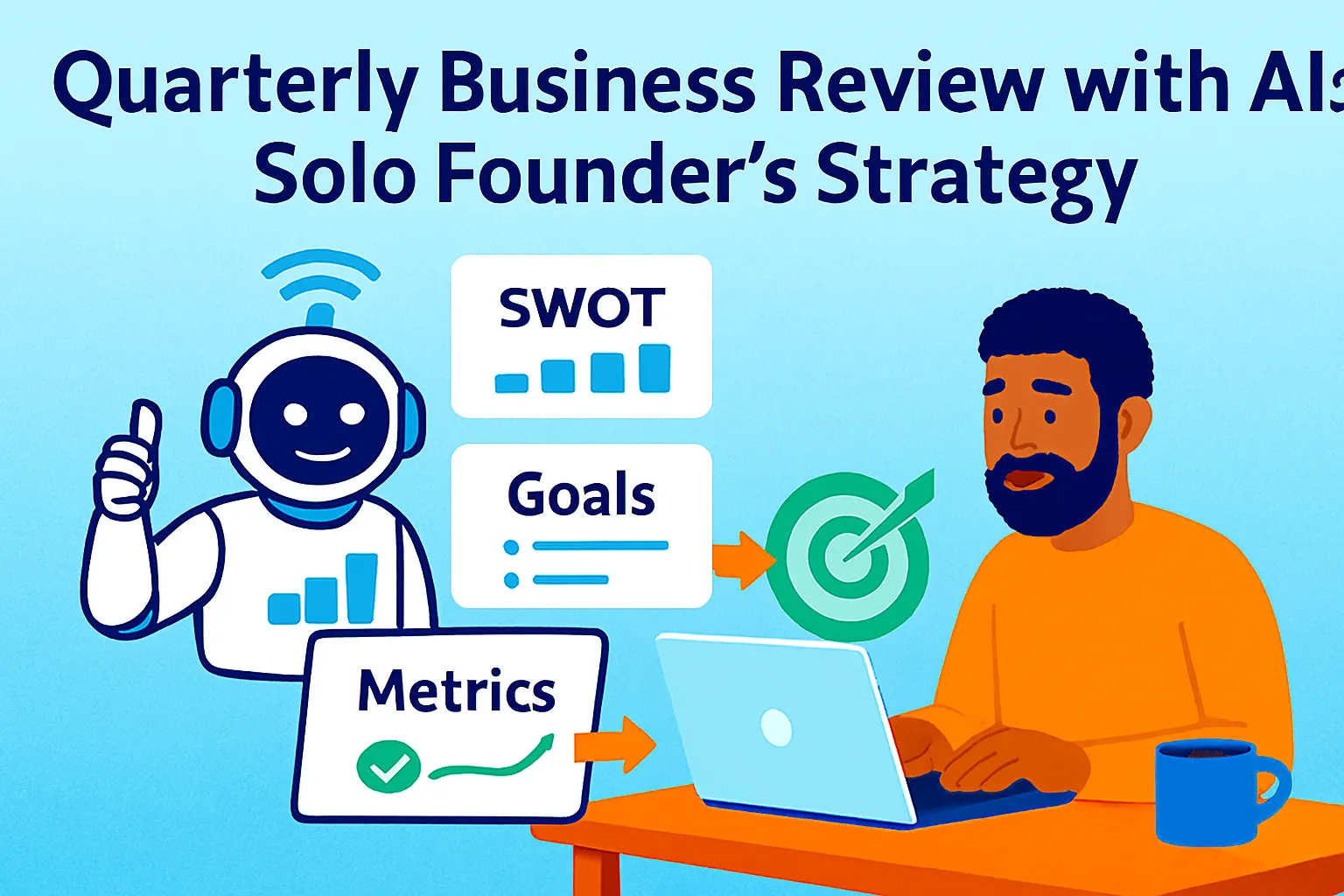
Most solo founders don't do quarterly reviews.
They have a vague sense of how the quarter went. They know the big wins and the things that didn't work. They feel busier than they were three months ago, or less busy, or about the same. Come January, they set some goals. Come April, they can't quite remember what those goals were.
This is not a time management problem. It's a ritual problem. The quarterly review isn't something most solo founders were taught to do — it belongs to the vocabulary of corporate teams with executive sponsors and slide deck templates. For a solo founder, the idea of a formal quarterly review can feel bureaucratic, even absurd. A meeting with yourself, reviewing your own work, producing a document no one will read.
Karen Peacock, former CEO of Intercom, captured the corporate version of this problem precisely: a quarterly business review done badly is a relic of slower-moving time — a ceremonial data scramble where people cherry-pick metrics that make them look good, confirm the strategy everyone already agreed on, and leave without changing anything.
The solo founder version of the QBR is not that. It's something more valuable and more honest: a structured 2-hour conversation between you and your business, mediated by AI, that produces a clear verdict on what actually happened, why it happened, and what the next 90 days should look like because of it.
Without this ritual, you are always inside the quarter. The weekly metrics briefing tells you what happened this week. The monthly review tells you what happened this month. Neither gives you the altitude to see whether the strategy you're executing is actually the right strategy, whether the bets you made 90 days ago were correct, and whether the things consuming your time are the things most likely to build the business.
The quarterly review is the moment you step outside the quarter and look at it whole.
This article is that ritual: what data to collect, how AI synthesizes it into a verdict, how to identify what to stop, start, and double down on, and how to translate the review into a focused action plan and calendar that governs the next 90 days.
Two hours. Four times a year. Here's how.
Why 2 Hours Is Enough
The longest quarterly reviews are not the most useful ones. They're the most anxious ones — founders who feel guilty about not having reviewed sooner, overcorrect by scheduling three hours of introspection, and leave more confused than when they started.
Two hours works because the review is not an analysis sprint. The analysis happened weekly, throughout the quarter, via the metrics briefings and OKR check-ins described elsewhere in this series. The quarterly review is a synthesis — pulling the quarter's worth of signals into a single coherent picture, drawing the strategic conclusions, and deciding what changes.
The 2-hour structure:
30 minutes: Data collection and paste
45 minutes: AI synthesis and interpretation
30 minutes: Stop/start/double-down decisions
15 minutes: Next quarter plan and calendar
That's it. The time constraint is a feature. It forces prioritization — you can't spend 45 minutes agonizing over one metric when you have 25 others to cover. The constraint produces the directness the review needs.
Step 1: Data Collection (30 Minutes Before You Write a Word)
The quality of the AI synthesis is entirely determined by the quality of the data you bring to it. Vague inputs produce vague outputs. The data collection step is not analysis — it's assembly. Pull numbers, paste them, move on.
Your quarterly data set:
Open a blank document. Paste in:
Revenue metrics (from Stripe or your payment processor):
MRR at start and end of quarter
Net new MRR (new customers this quarter)
Churned MRR (lost customers this quarter)
Expansion MRR (existing customers upgrading or paying more)
Number of active customers, start vs. end
Average revenue per customer
Traffic and acquisition (from Plausible, GA, or your analytics tool):
Monthly sessions: each of the three months
Top 3 traffic sources by volume
Top 3 traffic sources by conversion rate (if tracked)
Email list size: start vs. end of quarter
Email open rate average across quarter
Product and engagement (from PostHog or your product analytics):
Active users: monthly average
Key feature adoption rate (the feature that defines activation)
Support ticket volume: monthly average
Churn reasons this quarter (top 3)
Time and effort (from your weekly review logs or task management):
How many hours per week, roughly, on: product / marketing / sales / operations / admin
Top 3 projects completed this quarter
Top 3 projects started but not completed
Weeks where you felt most productive and why
Weeks where you felt least productive and why
OKR results (from your quarterly OKR tracker):
Each key result: final metric vs. target
Grade: Achieved (>90%) / Mostly (70-89%) / Partial (40-69%) / Missed (<40%)
One honest sentence per KR on why
Qualitative signals:
Best customer conversation this quarter (what they said)
Worst customer conversation this quarter (what happened)
One thing you learned about your ICP that you didn't know 90 days ago
One thing you tried that didn't work and why
One external change (competitor, market, macro) that affected the quarter
This data set takes 20-30 minutes to assemble if you've been tracking metrics weekly. If you haven't been tracking weekly, this step takes longer — which is itself a signal to act on.
The data collection prompt (runs first):
I'm preparing for my quarterly business review.
Before I paste in my data, help me identify
any gaps.

MY BUSINESS: [Description]
STAGE: [Pre-revenue / $0-5K MRR / $5-20K MRR / Growing]
DATA I HAVE: [List what you have]
DATA I DON'T HAVE: [List what's missing]

Tell me:
1. Which missing data points matter most
   for a useful quarterly review?
2. Which can I approximate or estimate
   if I don't have the exact number?
3. Which are genuinely not worth tracking
   at my stage and can be skipped?

Output: Prioritized list of what to find
before proceeding.
This prompt prevents the most common QBR failure: the founder who spends 90 minutes trying to find a number that doesn't matter at their stage, then runs out of time for the actual synthesis.
Step 2: The AI Synthesis (45 Minutes)
Paste everything you collected into one long prompt. Don't clean it up. Don't pre-analyze it. Raw data produces more honest synthesis than polished data — the AI will catch inconsistencies you smoothed over.
The Master QBR Synthesis Prompt:
Run a quarterly business review for my business.
I'm a solo founder. Be direct. Don't hedge.
Tell me what the data actually says.

QUARTER: [Q1/Q2/Q3/Q4 YEAR]
BUSINESS: [Description]
MY NORTH STAR FOR THIS YEAR: [From annual plan]

--- REVENUE ---
[Paste all revenue metrics]

--- TRAFFIC AND ACQUISITION ---
[Paste all traffic metrics]

--- PRODUCT AND ENGAGEMENT ---
[Paste product and support metrics]

--- TIME AND EFFORT ---
[Paste time allocation and project summary]

--- OKR RESULTS ---
[Paste each KR with grade and reasoning]

--- QUALITATIVE SIGNALS ---
[Paste customer conversations, lessons, changes]

Produce a complete quarterly review across
these sections:

SECTION 1: THE HEADLINE (2-3 sentences)
If this quarter were a chapter in a book,
what would the chapter title be?
What is the single most important thing
that happened — positive or negative?
Don't average everything into "it was okay."
Find the signal.

SECTION 2: WHAT THE NUMBERS ACTUALLY SAY
Not a list of metrics — an interpretation.
What story do these numbers tell together?
Where are the numbers contradicting each other?
(e.g., traffic up but conversion down — what does that mean?)
What number is most alarming?
What number is most encouraging?
What number am I probably underweighting?

SECTION 3: OKR VERDICT
For each OKR: Achieved / Mostly / Partial / Missed
Were the OKRs the right ones?
(Would hitting them at 100% have actually
moved the business?)
Were any OKRs too easy? Too ambitious?
Were there things that moved the business
that weren't in the OKRs at all?
What does the OKR scorecard reveal about
my ability to predict what matters?

SECTION 4: TIME AUDIT VERDICT
Based on how I described my time allocation:
What percentage of my time went to
revenue-generating vs. non-revenue activities?
Where did I spend time that produced
disproportionate results?
Where did I spend time that produced
disproportionate nothing?
If I could reallocate 5 hours per week next
quarter, where should those hours go?

SECTION 5: WHAT WORKED AND WHY
Not "what I'm proud of" — what actually worked?
What specific action or decision produced
the best measurable outcome this quarter?
Why did it work — what made it repeatable?

SECTION 6: WHAT DIDN'T WORK AND WHY
Not "what I'm disappointed in" —
what failed to produce results despite effort?
Was the failure a bad bet, bad execution,
or insufficient time?
What's the honest verdict on each?

SECTION 7: THE SURPRISES
What happened that you didn't expect
(positive or negative)?
What does each surprise reveal about
an assumption you were making that was wrong?

Output: A clear, honest quarterly narrative.
Not a bulleted list of observations.
A verdict.
The "not a bulleted list — a verdict" instruction is critical. Generic QBR outputs are long lists of observations with no synthesis. A verdict requires the AI to take a position — this quarter was a growth quarter / a consolidation quarter / a warning quarter — and defend it with the data. That position is what the stop/start/double-down decisions flow from.
Step 3: The Stop/Start/Double-Down Decisions (30 Minutes)
The synthesis tells you what happened. This step tells you what to do about it. Three questions, answered with the synthesis in front of you.
The decision prompt:
Based on this quarterly review, help me make
the three decisions that will shape next quarter.

QUARTERLY REVIEW SYNTHESIS: [Paste output from Step 2]
MY ANNUAL PLAN AND BETS: [Paste from one-page plan]
CONSTRAINTS NEXT QUARTER:
  Hours available: [X/week]
  Budget: $[X]
  Major known commitments: [List anything fixed]

DECISION 1: WHAT TO STOP

What am I currently doing that I should stop
doing next quarter?

Candidates for stopping:
- Activities that consumed significant time
  with weak results
- Channels that produced traffic but not customers
- Features being built for the wrong segment
- Meetings, commitments, or relationships that
  cost more than they return
- Anything I continued out of sunk cost
  rather than evidence

For each candidate:
Name it specifically.
Estimate hours per week recovered if stopped.
Note the risk of stopping
(is there a dependency or relationship cost?).

Recommended stops: [Rank by impact]

DECISION 2: WHAT TO START

What should I add next quarter that
isn't currently in my system?

Criteria for starting something new:
- There's evidence it would work
  (signal, not just hypothesis)
- I have the capacity without adding stops
- It addresses a gap the quarterly data revealed
- It's the most direct path to the
  next revenue milestone

For each candidate:
Name it specifically.
What evidence supports starting this?
Hours per week required to do it properly.
What would success look like in 90 days?

Recommended starts: Maximum two.
(More than two is not a decision —
it's wishful thinking.)

DECISION 3: WHAT TO DOUBLE DOWN ON

What worked this quarter that deserves
more resources, not the same resources?

Doubling down is different from continuing.
Continuing means the same effort, same output.
Doubling down means: this thing works,
and more of it would produce more results,
so I'm consciously shifting resources toward it.

For each candidate:
What evidence shows this has leverage?
What would doubling down actually look like
in practice — specifically, not abstractly?
What stops to make room for this?

Recommended double-downs: One or two maximum.
The John Doerr rule applied to this step:
OKRs should be set so that 60-70% achievement represents strong execution — "70 percent is the new 100 percent." Apply the same logic to stop/start/double-down: if you can stop two things, start one, and double down on one — that's a strong quarter's worth of strategic change. Attempting to stop seven things, start four, and double down on three is not strategy. It's a new to-do list.
Force the constraint: maximum two stops, one start, one double-down. Make the hard choices at the decision step so you don't have to make them later.
Step 4: The Next Quarter Plan (15 Minutes)
With the decisions made, the quarterly plan writes itself. This isn't a blank-page planning exercise — it's a translation of the synthesis and decisions into a concrete operating document for the next 90 days.
The quarterly plan prompt:
Turn my QBR decisions into a focused
quarterly action plan.

MY DECISIONS:
STOP: [List your decided stops]
START: [List your decided starts]
DOUBLE DOWN: [List your decided double-downs]

MY ANNUAL NORTH STAR: [From one-page plan]
CURRENT MRR: $[X]
TARGET MRR END OF NEXT QUARTER: $[X]
HOURS AVAILABLE PER WEEK: [X]

Generate:

QUARTERLY THEME (one sentence):
What is this quarter fundamentally about?
Not a list of goals — one sentence that
captures the strategic intent.
(e.g., "The distribution quarter" /
"The product-quality quarter" /
"The channel-validation quarter")

QUARTERLY OKRs:
Maximum two objectives.
Two to three key results per objective.
Each KR: specific metric, baseline, target.
Apply the 70% rule: targets should be
achievable with strong execution but
not guaranteed with normal effort.

WEEKLY TIME BUDGET:
Based on stops and double-downs,
how should I allocate my hours per week?
[Hours on: product / marketing / sales /
 operations / admin]
What does this allocation protect
compared to last quarter?

THE 30-60-90 DAY MILESTONES:
30 days: What specific things should be
  done or measurably underway?
60 days: What should be true by mid-quarter?
90 days: What does success look like at
  the end of the quarter?

NOT THIS QUARTER (protection list):
Three to five things explicitly deferred
to prevent scope creep.
These should hurt slightly —
real things you want to do but won't.

Output: A one-page quarterly plan I can
save in Notion and reference weekly.
The calendar translation:
A plan without dates is a wish list. The final step is blocking the quarterly plan into a real calendar.
Turn my quarterly plan into a calendar
I can actually follow.

MY QUARTERLY PLAN: [Paste]
MY WEEKLY STRUCTURE: [Describe your typical week —
  deep work days, shallow work days,
  fixed commitments]

Produce:

WEEKLY RECURRING BLOCKS:
Based on my new time budget, what recurring
blocks should I add to or remove from
my calendar?
For each block: day, duration, what happens in it.

KEY DATES THIS QUARTER:
30-day milestone check: [Date]
60-day milestone check: [Date]
Next QBR: [Date — last week of quarter]
Any known deadlines or events: [From your plan]

WEEK 1 PRIORITY:
What are the three most important things
to accomplish in the first week of next quarter?
(Starting strong matters —
the first week sets the quarter's momentum)

Output: A list I can block into my calendar
in 15 minutes.
The Pre-QBR Prep Ritual (The Week Before)
The QBR itself takes two hours. The week before, two small rituals make those two hours significantly better.
The data audit (Monday of QBR week, 30 minutes):
Open your weekly metrics dashboard and ensure the last 13 weeks of data is accurate and accessible. Nothing kills a QBR faster than discovering mid-synthesis that three months of data is missing or wrong. Check each data source: Stripe, Plausible, PostHog, your task management tool. Resolve any gaps before the review day.
The unfiltered brain dump (Friday before QBR, 20 minutes):
Before the data shapes your narrative, write what you actually think happened — without looking at a single number.
Before I look at any data, help me capture
my unfiltered read on the quarter.

I'm going to answer these questions from
memory and instinct:

1. One word that describes this quarter
2. The decision I'm most proud of
3. The decision I most regret
4. The thing I kept avoiding that I should
   have done
5. The thing I did that felt important
   but probably wasn't
6. How close to burnout was I?
   (1-10, honest)
7. One customer interaction that
   changed how I think
8. What I would tell a version of myself
   from 90 days ago

Don't analyze my answers. Just record them.
I'll compare these to the data synthesis
next week and see where instinct and
numbers agree or diverge.
Where instinct and data agree, you have high-confidence conclusions. Where they diverge — where you felt great about something the data doesn't support, or felt terrible about something the data suggests was fine — those divergences are the most interesting strategic signals you'll encounter.
The Annual Meta-Review (Once a Year, 1 Hour)
After four quarterly reviews, run one meta-review: the review of the reviews.
I've completed four quarterly reviews this year.
Here is what each one said.

Q1 REVIEW SUMMARY: [Paste]
Q2 REVIEW SUMMARY: [Paste]
Q3 REVIEW SUMMARY: [Paste]
Q4 REVIEW SUMMARY: [Paste]

Run an annual meta-review:

1. THEME OF THE YEAR:
   What was this year actually about —
   not what the plan said,
   but what the four quarters reveal?

2. PATTERN RECOGNITION:
   What problems appeared in multiple quarters?
   What problems were predicted in Q1
   and ignored until Q3?
   What kept appearing in "stop" decisions
   but never actually got stopped?

3. STRATEGIC ACCURACY:
   How well did my annual plan predict
   what would actually matter?
   Which annual bets paid off?
   Which were wrong and how quickly did
   I acknowledge that?

4. PERSONAL PATTERNS:
   In which quarter was I most effective?
   What conditions produced that effectiveness?
   In which quarter was I least effective?
   What was different?

5. WHAT NEXT YEAR NEEDS:
   Based on the full year's arc,
   what is the most important thing
   next year's plan must account for
   that this year's plan didn't?

Output: One paragraph per section.
Honest. Unsentimental. The synthesis I need
to plan next year from reality, not aspiration.
This annual meta-review is where the compounding value of the quarterly review system becomes visible. Four quarters of data, synthesized together, reveal patterns that no single quarter can show: the recurring bottleneck that never got fixed, the strategic bet that consistently underperformed, the strength that was consistently underutilized. These patterns are the most valuable strategic inputs available to a solo founder — and they're entirely invisible without the review system that surfaces them.
What Good QBR Output Looks Like
The quality test for a quarterly review: does the output change your behavior next quarter?
A review that produces "keep doing what you're doing, some things worked better than others" is a reassurance ritual, not a strategic review. The output should produce at least one genuine decision — something you're stopping that you were still doing, something you're starting that you weren't, something you're investing more heavily in because the data is clear.
If you complete the two hours and your next quarter looks essentially identical to the last one — same channels, same time allocation, same projects — one of two things is true: either the strategy is working well and the right answer genuinely is to continue, or you ran a confirmation review instead of a real one. The way to tell the difference: run the synthesis prompt and commit to its verdict, even when the verdict is uncomfortable.
The QBR is the moment where intellectual honesty earns its return. Founders who do it clearly, act on it fully, and build next quarter's calendar from its conclusions compound strategy over time. Founders who use it to confirm what they already believed treat it as a ceremony with no stakes.
One ritual, four times per year.
That's it.



Comments (0)
Leave a Comment