

Most solo founders do market research once — right before they launch — and never again.
They write "small business owners" in a deck, pick three competitors they found in 20 minutes of Googling, and file the whole thing under "done." Then they spend the next year marketing to everyone and converting almost nobody, wondering why growth feels like pushing uphill.
The problem isn't that they didn't do market research. It's that market research, as most founders understand it, is a one-time activity that produces a static artifact. You write it, you file it, you refer to it occasionally, it gets stale, you stop referring to it.
Real market intelligence is a living system. Your ICP sharpens as you learn who actually pays and stays. Your competitive map shifts as new entrants appear and incumbents add features. Your audience's language evolves — the phrases they use to describe the problem, the solutions they're comparing you to, the objections they raise — all of it changes faster than a quarterly research sprint can track.
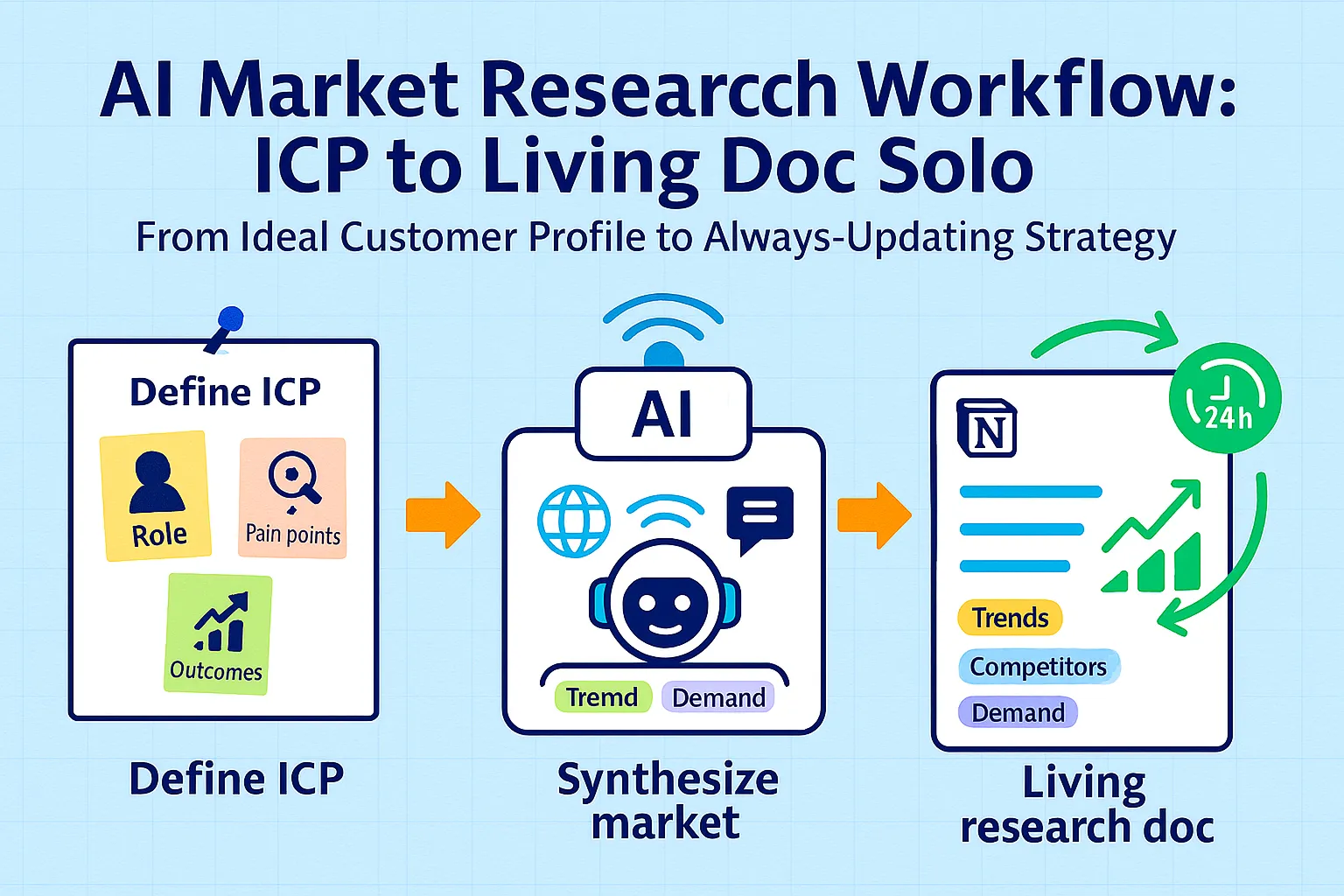
The AI market research workflow replaces the one-time research project with a system that builds precise intelligence continuously and keeps it fresh with a monthly 90-minute refresh. It produces three things most founders don't have: an ICP sharp enough to guide every positioning and messaging decision, a competitive intelligence snapshot sourced from real customer conversations rather than company marketing pages, and a living research document that never goes stale.
Here's how to build it.
Why "Small Business Owners" Is Not an ICP
Before the workflow, one reframe that changes everything: the difference between a target audience and an ICP.
A target audience is who could theoretically use your product. An ICP is who gets the most value from it, pays reliably, churns the least, and refers others. These are not the same group.
"Small business owners" is a target audience. It covers 33 million entities in the US alone, ranging from a solo freelance designer to a 50-person manufacturing company. They have almost nothing in common — different tools, different budgets, different problems, different decision processes.
A good ICP is not about who you could serve, but who you serve best. The customers who get real business value from your product and stick around. That distinction changes everything downstream: your positioning, your content, your channel strategy, your pricing, your product roadmap.
The test of a good ICP is simple: does it tell you who to say no to? If your ICP is so broad that every lead technically qualifies, it's doing nothing for you. A useful ICP eliminates as many prospects as it includes.
What a complete ICP actually contains:
Beyond job title and company size — the surface level most founders stop at — a complete ICP contains four layers:
Layer 1: Firmographic/Demographic Who they are on paper. For B2B: industry, company size, revenue range, tech stack, geography, growth stage. For B2C: age, income range, life situation, platforms they use.
Layer 2: Behavioral What they do that signals fit. For B2B: hiring for specific roles, using specific tools, growing headcount, raising a funding round. For B2C: searching specific terms, active in specific communities, recently triggered by a life event.
Layer 3: Psychographic How they think. Goals, anxieties, identity, status signals. What does success look like to them? What do they fear failing at? What do they read, follow, aspire to?
Layer 4: Situational What has to be true for them to need you right now. Not just who they are, but what circumstance creates urgency. "Series A SaaS founder with a growing sales team who just moved off spreadsheets" is a situation. "B2B founder" is not.
The workflow below builds all four layers — not from assumption but from signals in the market.
Phase 1: The ICP Foundation Prompt
Start here if you have any existing customers or users. If you're pre-revenue, use your best hypothesis and label it clearly as assumption.
Step 1: Feed your known customer data
Before running any prompts, collect what you actually know. Export from your CRM or pull manually:
Your 10 best customers (high LTV, low support, expanded or referred)
Your 5 worst fits (churned early, high support cost, complained a lot)
Any patterns you've noticed anecdotally ("our happiest customers always seem to be...")
Then run this:
You are helping me build a precise Ideal Customer Profile (ICP)
for my business.

MY BUSINESS: [One sentence — what you do and for whom]
MY PRODUCT: [What it does specifically]
CURRENT PRICE: [Monthly or one-time]

BEST CUSTOMERS (high value, low friction, stayed or expanded):
[List 5-10 with: industry, company size, role of buyer,
how they found you, what they mainly use your product for]

WORST FIT CUSTOMERS (churned early, high support, complained):
[List 3-5 with same attributes]

PATTERNS I'VE NOTICED:
[Any observations about what your best customers have in common]

Build my ICP across four layers:

LAYER 1 — FIRMOGRAPHIC/DEMOGRAPHIC
[For B2B: industry, company size, revenue, tech stack, stage]
[For B2C: age range, income, life stage, location]
Be specific. Include ranges. Note what to EXCLUDE.

LAYER 2 — BEHAVIORAL SIGNALS
What behaviors, actions, or events signal this is an ideal
customer right now?
Include: tools they use, roles they're hiring for,
actions they've recently taken, events that create urgency.
"Better if" signals: secondary traits that make a
good account great.

LAYER 3 — PSYCHOGRAPHIC
Goals: What are they trying to achieve in the next 12 months?
Anxieties: What keeps them up at night professionally?
Identity: How do they see themselves? What do they aspire to?
Status signals: What tools, events, affiliations signal
they're the right person?

LAYER 4 — SITUATIONAL TRIGGER
Complete this sentence: "This person needs us RIGHT NOW because..."
What specific situation creates urgency?
What has to have happened in the last 90 days for this
to be the right moment?

NEGATIVE ICP (who to exclude):
[3-5 specific characteristics of customers you should
proactively disqualify]

OUTPUT FORMAT:
Write this as a usable reference document, not a bulleted list
of guesses. Be direct and specific. Flag any section
where you're inferring vs. where the data clearly supports
the conclusion.
If pre-revenue (hypothesis mode):
Replace the customer data section with:
I don't have customers yet. I'm building this ICP from
first principles and market signals.

MY HYPOTHESIS CUSTOMER: [Describe who you think it is
and why — be honest about what's assumption]

Build the ICP with the same four-layer structure, but:
- Label each section: HYPOTHESIS or MARKET-SUPPORTED
- Flag the 3 assumptions most likely to be wrong
- Tell me what evidence would confirm or refute
  each assumption
- Suggest 3 questions to ask in customer interviews
  that would sharpen each layer
Pre-revenue ICPs are hypotheses. The workflow below generates market evidence to test them.
Phase 2: The Forum and Community Intelligence Layer
Forums and communities are the most underused market research source for solo founders. Reddit, Indie Hackers, specific Slack communities, niche Discord servers, LinkedIn groups — these are where your target customers talk to each other without trying to impress anyone. No marketing language. No optimism bias. Just what they actually think.
Reddit hosts millions of authentic consumer discussions — for market research, this represents unfiltered insight into what people actually think about products and services — authenticity that surveys and focus groups often miss.
Step 1: Community mapping
Map the communities where my ICP spends time online.

MY ICP: [paste your ICP from Phase 1 — the 2-3 sentence
summary version]
MY PRODUCT CATEGORY: [e.g., "project management for agencies"]

List:
1. TOP SUBREDDITS: 8-10 specific subreddits where this
   person is active, with brief reasoning and estimated
   community size

2. OTHER PLATFORMS: Indie Hackers, Hacker News, specific
   Slack/Discord communities, LinkedIn groups, Twitter/X
   hashtags, niche forums

3. WATERING HOLES: Newsletters, podcasts, YouTube channels,
   and blogs they consume regularly

4. SEARCH STRINGS: 15 specific search queries to use on
   Reddit to find my ICP discussing the problem I solve
   Format: "exact phrase" OR related terms
   Include: problem language (not solution language),
   competitor mentions, workaround descriptions

5. COMPETITOR COMMUNITIES: Any Reddit threads, Slack
   groups, or communities built around my competitors
Step 2: The manual research session (60 minutes)
Take the community map and search strings. Spend 60 minutes across 3-4 of the highest-value communities. You're looking for four signal types:
Signal A — Pain articulation Posts where people describe the problem in their own words. Copy the exact language — not what you'd call it, what they call it.
Signal B — Solution hunting Posts where people ask "what tool do you use for X?" or "has anyone solved Y?" These show active demand and reveal which alternatives you're competing against.
Signal C — Competitor complaints Negative posts about your competitors. What's broken? What's missing? Who's leaving and why?
Signal D — Workaround descriptions Posts where people describe what they do instead of buying a solution. "I just use a Google Sheet," "I hired a VA to handle this," "I built a Zapier workflow to..." These reveal both the problem's reality and the bar you need to clear.
Step 3: The community synthesis prompt
After your research session, paste your best finds:
I spent 60 minutes researching my target market in online
communities. Here are the most relevant posts and comments
I found. Synthesize these into market intelligence.

MY ICP HYPOTHESIS: [2-3 sentence summary]
MY PRODUCT CATEGORY: [category]

COMMUNITY FINDINGS:
[Paste 10-20 posts/comments — include the source (subreddit/forum),
upvote count if significant, and post date]

Synthesize into:

1. EXACT CUSTOMER LANGUAGE
The specific words and phrases they use to describe
the problem (not my solution language). These should
be direct quotes or close paraphrases.
These are the words that should appear in my marketing.

2. PAIN HIERARCHY
Rank the pains from most to least intense based on
frequency, emotional language, and upvote signals.
For each pain: Is it a MUST SOLVE (blocking) or
NICE TO SOLVE (friction)?

3. SOLUTION AWARENESS MAP
What solutions are they aware of? What are they
currently using? What have they tried and abandoned?
Are they solution-aware or still in problem-aware stage?

4. COMPETITOR PERCEPTION
What do they think of each competitor?
Specific complaints (not generic).
What's the #1 thing each competitor does wrong in
customers' eyes?

5. JOBS TO BE DONE
What are they actually trying to accomplish?
Not the feature they want — the underlying job.
"When I [situation], I want to [motivation],
so I can [expected outcome]."

6. ICP REFINEMENT SIGNALS
Does anything here challenge or sharpen the ICP hypothesis?
Any segments appearing more frustrated than others?
Any signals about company size, role, or situation
that sharpen who this is most for?

7. CONTENT ANGLES
Based on these conversations, what 5 content topics
would most resonate with this audience? (For blog posts,
LinkedIn, or ad copy — framed around their language)
This synthesis is the richest output in the entire workflow. It gives you their exact words, their actual hierarchy of pain, and the competitive landscape as they perceive it — not as competitors describe themselves.
Phase 3: The Competitor Intelligence Layer
Competitor marketing pages are useless for market research. They tell you what competitors want prospects to believe. You need to know what customers actually experience.
Three sources that tell the truth: review platforms, job postings, and pricing pages.
Source 1: Review platform mining
For each of your top 3 competitors, find their profile on G2, Capterra, Trustpilot, or App Store/Play Store. Filter to 1-3 star reviews. Paste 10-15 into this prompt:
These are 1-3 star customer reviews of [Competitor Name].
I'm a competing solo founder trying to understand
real gaps in this market.

[Paste reviews — include date and reviewer role/company
size if available]

Extract:

1. TOP COMPLAINTS (ranked by frequency)
For each: complaint description, how many reviews mention it,
exact quote from most vivid example

2. CUSTOMER SEGMENTS COMPLAINING
Who is writing these reviews? Any pattern in company size,
role, or use case? Which segment is most underserved?

3. FEATURE GAPS
Specific capabilities repeatedly missing or broken.
Flag: Is this something they're unlikely to fix
(architectural limitation) vs. just haven't prioritized?

4. SWITCHING SIGNALS
Are reviewers saying they left for another tool? Which one?
Are they going back to manual processes?

5. THE POSITIONING OPPORTUNITY
Based on these complaints, write a one-sentence positioning
statement that directly addresses the most painful gap:
"Unlike [Competitor], [My Product] [does specific thing]
so [ICP] can [outcome] without [the specific pain]."

6. RED FLAGS FOR ME
Is any complaint easily fixable by this competitor
in the next 6-12 months? What would neutralize
this gap if they prioritized it?
Source 2: Job posting intelligence
Competitors' job postings reveal strategy before it's public. Hiring a Head of Enterprise Sales signals upmarket move. Hiring ML engineers signals product direction. Hiring in a new geography signals expansion.
I found these recent job postings from my top competitors.
Analyze what they reveal about strategic direction.

COMPETITOR 1: [Name]
Recent job postings: [List titles + brief description]

COMPETITOR 2: [Name]
Recent job postings: [List titles + brief description]

Analyze:
1. What product investments are signaled by their hiring?
2. What customer segment are they moving toward?
3. What are they de-prioritizing? (Roles they're NOT hiring)
4. Any geographic or market expansion signals?
5. What should I do differently, double down on,
   or move on before they get there?
Source 3: Pricing page intelligence
Analyze these competitor pricing pages and extract
market intelligence.

[Paste text from 2-3 competitor pricing pages,
or describe their pricing structure]

Extract:
1. PRICING MODEL: What model dominates? (Per seat /
   usage / flat / freemium)
2. PRICE ANCHORING: How do they frame value?
   (Cost saving / ROI / features / users)
3. TIER LOGIC: What's in each tier and what does
   the tier structure reveal about their ICP?
   (Free = acquisition, Pro = SMB, Business = mid-market?)
4. WHAT THEY HIDE: What's absent from the pricing page
   that customers typically care about?
   (Setup fees, contract length, support tier)
5. PRICING GAP: Is there an underserved price point?
   A tier that's clearly overpriced vs. value delivered?
6. MY PRICING IMPLICATION: Given their pricing,
   what price point and model should I test first?
Phase 4: Building the Living Research Document
All of the above produces raw intelligence. The living research document structures it into something you can use daily — and refresh monthly without starting over.
The Notion structure:
Create a Notion page: "Market Intelligence — [Product Name]"
It has five sections. Each section has a "Last Updated" date and a "Confidence Level" (High / Medium / Hypothesis).
Section 1: ICP — Current Best Understanding
Last Updated: [date]
Confidence: [High / Medium / Hypothesis]
Next Review: [first Monday of next month]

PRIMARY ICP: [2-3 sentence description — specific enough
to disqualify]

THE FOUR LAYERS:
[Paste structured ICP from Phase 1 — condensed]

THE NEGATIVE ICP:
[3-5 bullet points — who to say no to]

OPEN QUESTIONS:
[What do we not yet know about our ICP that matters?]

EVIDENCE BASE:
[What this is based on: X customers analyzed,
Y community posts reviewed, Z interviews conducted]
Section 2: Customer Language Glossary
This is the section most founders don't build and then wonder why their copy doesn't convert.
Last Updated: [date]

HOW THEY DESCRIBE THE PROBLEM:
[Exact phrases from community research — direct quotes]

HOW THEY DESCRIBE SUCCESS:
[What "solved" looks like in their own words]

WORDS THEY DON'T USE:
[Your solution language that doesn't appear in their vocabulary]

EMOTIONAL TRIGGERS:
[The specific anxieties and aspirations that came up repeatedly]

COMPARISON LANGUAGE:
[How they compare alternatives — what criteria they use]
This glossary is your copywriting bible. Every landing page headline, every email subject line, every ad should draw from it. Customer language converts. Founder language doesn't.
Section 3: Competitive Landscape
Last Updated: [date]

COMPETITIVE MAP:
[Table: Competitor | Strengths | Weaknesses | ICP they serve best |
ICP they underserve | Price range | Notable recent moves]

OUR POSITIONING ANGLE:
[The specific gap we're positioned against]

WATCH LIST:
[New entrants or adjacent competitors to monitor]

COMPETITOR MOVES THIS MONTH:
[Any pricing changes, feature launches, funding, pivots]
Section 4: Market Signals
Last Updated: [date]

SEARCH TRENDS: [Growing / Flat / Declining — brief note]
COMMUNITY ACTIVITY: [Increasing / Stable / Declining —
which communities are most active?]
HIRING SIGNALS: [What target companies are hiring for
that relates to our space]
MACRO TAILWINDS: [Any regulatory, economic, or tech
trends accelerating demand]
MACRO HEADWINDS: [Anything working against us]
Section 5: Monthly Refresh Log
[Month Year]: What changed. What was confirmed.
What was wrong. What we adjusted.
[Month Year]: ...
This log is underrated. Over six months it becomes a strategic record of how your understanding of the market evolved — invaluable when making pricing, positioning, or product decisions.
The Monthly 90-Minute Refresh
The living document stays fresh through a monthly refresh ritual. Not a full rebuild — a targeted update of what's most likely to have changed.
Every first Monday of the month (90 minutes):
Minutes 0-20: New customer data
Pull any new customer data from the past month:
Any new customers worth adding to the ICP pattern?
Any churned customers whose reasons revealed something?
Any support conversations that surfaced new pain language?
Run the ICP prompt update:
Here's my current ICP. Here's what I learned from new
customers this month. Update only what the new evidence
supports changing.

CURRENT ICP: [paste]
NEW EVIDENCE THIS MONTH: [paste customer notes/churn reasons]

Output: Updated ICP with only changed sections highlighted.
Flag: What did this month's data confirm? What did it challenge?
Minutes 20-45: Community re-scan
Return to your top 2-3 communities. Search for posts from the last 30 days. You're looking for:
Any new complaints about competitors (new openings?)
Any new tools being recommended (new competition?)
Any shift in the language used to describe the problem
Any new sub-problem emerging that's getting traction
Run the community synthesis prompt on your new finds. Compare output to last month's language glossary — anything new?
Minutes 45-65: Competitor moves
Check each competitor's:
Product changelog or update emails (sign up for their newsletter)
Pricing page (has it changed?)
Job postings (any new signals?)
G2/Capterra: any new reviews with notable complaints?
Run the competitor update prompt:
Here are new developments from my competitors this month.
My current competitive positioning: [paste Section 3 summary]

NEW DEVELOPMENTS:
[Bullet list of any changes you found]

Tell me:
1. Does anything here threaten my current positioning angle?
2. Does anything here open a new gap to position against?
3. Any moves I should respond to this month?
4. Update my competitive section with what's changed.
Minutes 65-90: Synthesize and update the doc
Run the monthly synthesis:
Here is my market research document from last month and
the new intelligence I've gathered this month.

LAST MONTH'S DOC: [paste current document]
NEW FINDINGS: [paste outputs from today's refresh]

Produce:
1. WHAT CHANGED: Top 3 things that shifted this month
2. WHAT WAS CONFIRMED: Assumptions this month's data supported
3. WHAT WAS WRONG: Anything previous research got wrong
4. ICP DELTA: Any updates to the ICP worth making
5. POSITIONING IMPLICATION: Should anything change in how
   I describe or sell my product this month?
6. ONE THING TO DO: The single highest-value action
   suggested by this month's research

Then output an updated version of each section that changed.
Update the Notion document. Add to the monthly log. Done.
Total time investment:
Initial setup (Phase 1-4): 4-6 hours
Monthly refresh: 90 minutes
Annual cost: ~22 hours total for continuously current market intelligence
Compare that to hiring a market research agency (weeks, thousands of dollars), conducting customer interviews (30+ hours per quarter), or relying on stale initial research (free, and costs you precision on every decision you make).
Using the Research Doc Daily
The living research document only delivers value if it actively informs decisions. Here's how to reference it:
When writing any marketing copy: Open Section 2 (Customer Language Glossary) first. Use their words, not yours. Every headline, subject line, and CTA should contain at least one phrase from the glossary.
When positioning against a competitor: Open Section 3. Use the specific gap identified in the review mining — not generic "we're simpler" claims. "Unlike [Competitor], we don't [specific complaint from their 2-star reviews]" is more credible than any marketing claim you could write.
When evaluating a product feature request: Check Section 1 (ICP). Does this request come from an ICP-fit customer or a bad-fit customer? Feature requests from churned bad-fit customers are not your roadmap.
When writing content: The content angles from the community synthesis (Section 2) tell you exactly what topics your ICP is searching for and discussing. Write those articles.
When making a pricing decision: Section 3's pricing intelligence tells you where the gaps are and what the market will bear. Your ICP's psychographic layer tells you whether they're price-sensitive or outcome-sensitive.
Every strategic decision is faster and more confident with this document open.
Tools and Cost
Free tier ($0/month):
ChatGPT free or Claude free: All prompts
Reddit (browser): Community research
G2/Capterra (browser): Review mining
LinkedIn Jobs (browser): Competitor hiring signals
Notion free: Living research document
Google Trends (free): Search signal validation
Total: $0/month — works completely
Recommended tier ($20/month):
ChatGPT Plus or Claude Pro ($20/month): Better synthesis on complex prompts, more reliable ICP layer construction, faster monthly refresh
Total: $20/month
Accelerated tier ($50-100/month):
SparkToro ($50/month): Shows exactly where your ICP audience spends time online — Reddit communities, newsletters, podcasts, YouTube channels — based on real behavioral data. Replaces the community mapping prompt for higher accuracy.
Similarweb free tier: Competitor traffic estimates and top pages
Total: $50-70/month
When to upgrade to SparkToro: If community research keeps returning shallow results or you're selling to a niche where Reddit isn't active, SparkToro's behavioral audience mapping is worth the $50/month. It shows you where an audience actually spends time, not where you'd guess they'd be.
Common Mistakes Solo Founders Make
1. Building an ICP from who you wish your customer was
The ICP should describe who currently gets the most value and pays most reliably — not who you'd most like to serve. Aspirational ICPs produce misaligned marketing and bad churn. If your best current customers are small agencies and you keep trying to market to enterprise, you're fighting the evidence.
2. Updating the ICP without evidence
"I feel like our customer is changing" is not a reason to update your ICP. New customer patterns, churn data, or community signals are. The monthly refresh cycle exists to bring discipline to what gets changed and what evidence triggers the change.
3. Using competitor marketing pages as research
Competitor positioning pages show you what they want to be perceived as, not what customers actually experience. The research that matters is in their review sections. Always source competitive intelligence from customer-written content.
4. One ICP for B2B and B2C signals mixed
If you sell B2B, your ICP describes a company type and a buyer role within it. If you sell B2C, it describes a person in a specific life situation. Never mix them. A B2B ICP that includes "psychographics like anxiety about work-life balance" is describing a person, not an organization. Keep the layers clean.
5. Ignoring the negative ICP
Knowing who to say no to is as valuable as knowing who to pursue. Without a clearly articulated negative ICP, every lead looks like a potential customer and you waste time on bad fits. The negative ICP is what makes your sales process efficient.
6. Treating language glossary as optional
The customer language section is the highest-ROI output of the entire workflow. Founders who skip it and write copy in their own voice consistently underperform on conversion. Their product could be better. Their copy just doesn't resonate because it uses words their customers don't use.
When You've Outgrown This System
You're running paid acquisition at scale. When you're spending $5K+/month on ads, the ICP precision this system provides is necessary but not sufficient. You need audience testing in the channel itself — testing creative, copy, and targeting variations against real conversion data. The ICP informs the hypothesis; paid testing confirms it.
You want primary research at scale. Qualitative community research and review mining give you themes. Survey tools like Typeform ($29/month) or Wynter ($300/month for message testing) give you quantitative validation at volume. Worth adding once your ICP is stable and you're optimizing messaging.
You need behavioral ICP enrichment. Clay ($149/month) enriches contact records with firmographic, technographic, and hiring signals that let you score leads against ICP criteria automatically. When you're running outbound sales and want to filter hundreds of leads against your ICP instantly, Clay is the upgrade.
Your market is moving fast. For categories where competitive dynamics shift monthly (AI tooling, for example), the 90-minute monthly refresh may not be enough. Consider bi-weekly competitor monitoring using an automated n8n or Zapier workflow that scrapes Reddit and community mentions weekly and emails you a digest.
The Real Talk on Market Research
Most solo founders avoid deep market research for the same reason they avoid documentation: it feels like overhead, and the payoff is invisible until the decisions it would have improved are already made.
Here's the reframe: every positioning decision, every content topic, every pricing tier, every feature priority is easier and faster with a precise ICP and current competitive intelligence. The research doesn't add work — it removes the second-guessing that makes every decision take longer than it should.
The founder with a sharp ICP writes better copy in 30 minutes than the founder without one writes in 3 hours, because they know exactly whose language to use and whose problem to address. The founder with current competitive intelligence positions confidently instead of hedging, because they know the specific gap they own.
Successful businesses view their ICP as a dynamic document, updating it regularly based on data, feedback, and market shifts. Not a slide in a deck. Not a one-time research exercise. A living system that gets sharper every month.
Build it once. Refresh it monthly. Use it daily.
That's it.



Comments (0)
Leave a Comment