

Nobody reads the 40-page business plan.
Not you, after you write it. Not investors, past page four. Not the contractors you hire. Not your future self, six months later, trying to remember why you made the decisions you made.
The 40-page plan is an artifact of a different era — when banks required it for loans, when VCs expected it before meetings, when "having a business plan" was a proxy for being serious. That era is mostly over. The founders moving fastest today don't write plans to prove seriousness. They write plans to think.
The distinction matters. A plan written to impress someone else optimizes for comprehensiveness. A plan written to think optimizes for clarity. Comprehensive plans are long, hedged, and full of market size statistics that justify the idea. Clear plans are short, honest, and force you to articulate the three things every business requires: who has the problem, how you solve it, and how you make money.
Everything else is detail work. Important detail work, eventually — but not before you have the one-page foundation right.
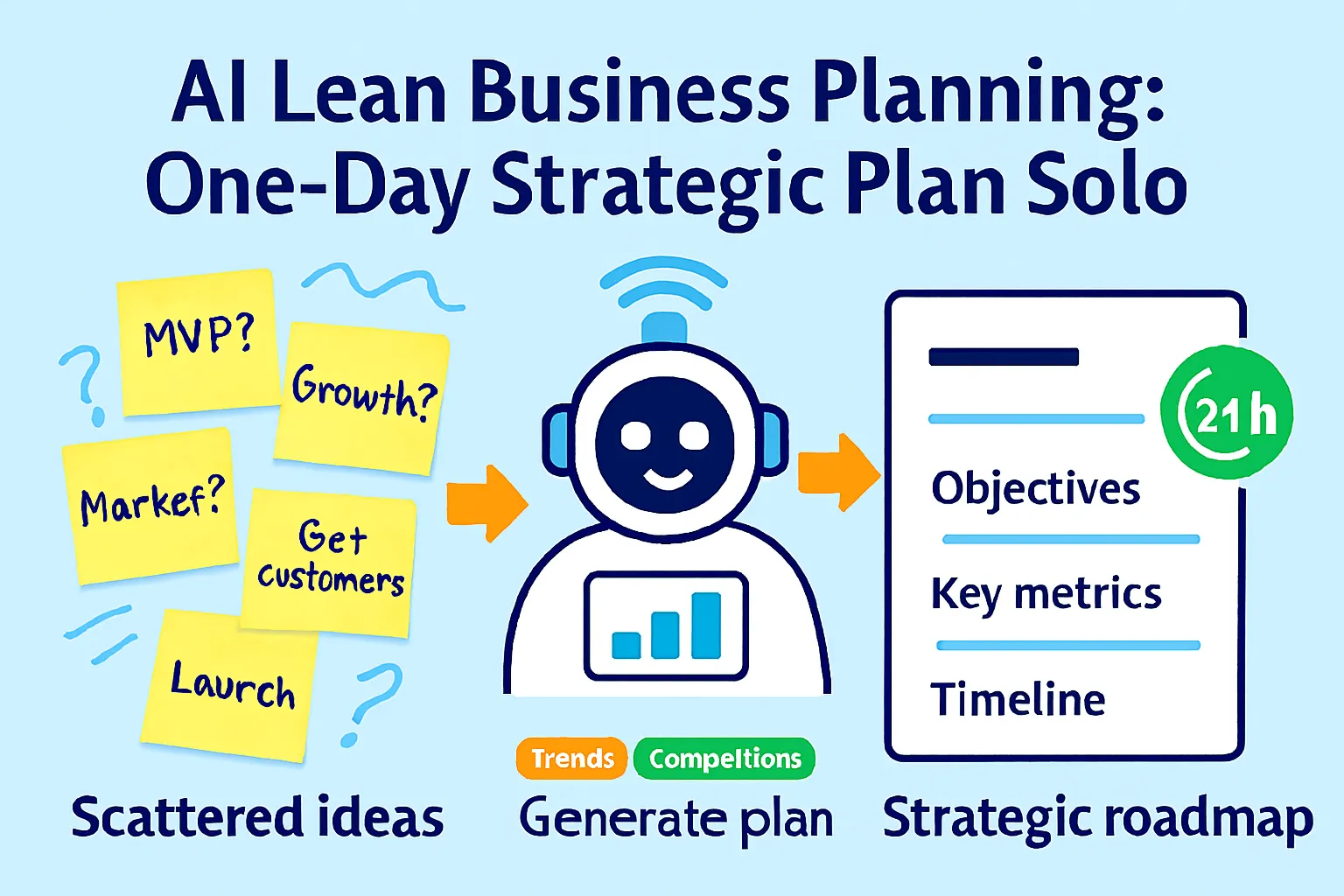
The AI-assisted lean planning sprint produces that foundation in one day. Not a deck, not a document for investors, not a 5-year forecast. A single living page that maps your business model with enough precision to guide every decision for the next 90 days, plus a set of quarterly OKRs that translate the strategy into measurable work.
Here's how to build it.
Why Most Solo Founder Planning Fails
Before the system, name the failure modes. They're different from what you'd expect.
Failure 1: Planning as procrastination
The most common use of business planning for solo founders is to feel productive while avoiding the harder work of building and selling. Writing the plan is comfortable. It's a controlled environment where everything can be made to sound good. Shipping, selling, and hearing "no" from real customers is not.
The lean plan is designed to be completed in one day specifically to prevent this. If it takes you three weeks, you're using planning as a substitute for action.
Failure 2: Overplanning the knowable, underplanning the unknown
A 40-page plan has 35 pages of background research on market size, competitive landscape, and industry trends — all things that can be researched — and four paragraphs on how the business actually makes money and grows. It spends disproportionate time on what's knowable and almost no time on the hardest questions: what's the riskiest assumption, what has to be true for this to work, and what's the first test that validates or kills it.
The lean plan inverts this. It spends most of its length on assumptions and hypotheses, not established facts.
Failure 3: Plan-then-execute instead of plan-test-revise
A 40-page plan assumes the strategy is correct and execution is the variable. Lean planning assumes the strategy is a hypothesis and treats every quarter as a test of that hypothesis. The plan is not a commitment — it's a current best guess, updated quarterly as you learn.
This is the mental model shift the entire workflow depends on.
The Lean Canvas: The One-Page Business Model
The foundation of the lean planning sprint is the Lean Canvas — a one-page business model framework created by Ash Maurya, used by over a million entrepreneurs worldwide. It strips a business down to nine blocks, each answering one critical question:
Problem: What are the top 3 problems you're solving?
Customer Segments: Who specifically has these problems?
Unique Value Proposition: Why should they choose you, in one sentence?
Solution: How does your product solve the problems?
Channels: How do you reach customers?
Revenue Streams: How do you make money?
Cost Structure: What are your major costs?
Key Metrics: What numbers tell you if this is working?
Unfair Advantage: What do you have that can't be easily copied?
The canvas is not a complete business plan. It's a hypothesis map — nine boxes of assumptions, some better-supported than others, all subject to revision as you learn. 42% of startups fail because there's no market need — most of them had a plan that sounded reasonable but was never stress-tested against reality.
The Lean Canvas forces honesty. Boxes that should be easy (Unique Value Proposition) reveal how vague most founders' thinking actually is. Boxes that seem trivial (Unfair Advantage) reveal fatal weaknesses early enough to address them.
Phase 1: Building the Canvas with AI (Hours 1-3)
Don't fill out the canvas alone. Fill it out in conversation with AI — which will challenge your answers, identify gaps, and push you past surface-level responses.
The Canvas Generation Prompt:
You are helping me build a Lean Canvas for my business.
Ask me about each of the nine sections, one at a time.
For each section:
1. Ask me the relevant question
2. Accept my first answer
3. Push back with one honest challenge
   ("Are you sure? What about X?" or
   "That's broad — can you be more specific?")
4. Help me refine the answer until it's specific
   enough to be actionable

After all nine sections, output the complete canvas
as a formatted one-page document.

The nine sections are:
1. Problem (top 3 problems — be specific)
2. Customer Segments (who specifically —
   not "small businesses")
3. Unique Value Proposition (one sentence,
   why you over alternatives)
4. Solution (how each problem is solved —
   minimum features only)
5. Channels (how you reach customers —
   be specific about first channel)
6. Revenue Streams (how you make money —
   model, price, path to $5K MRR)
7. Cost Structure (3-5 major cost items
   and monthly estimates)
8. Key Metrics (3-5 numbers that prove
   the business is working)
9. Unfair Advantage (what you have that
   a well-funded competitor cannot easily copy)

Start with section 1: Problem.
Run this as a full conversation. Don't rush through it. The push-back on each answer is where the value is.
What good answers look like vs. bad ones:
The difference between a useful canvas and a vague one is specificity. Here's what that looks like in practice across three critical sections:
Problem — Bad: "Businesses struggle with productivity." Problem — Good: "Freelance designers spend 4-6 hours per week chasing late invoice payments, creating awkward client conversations that damage relationships they depend on."
Unique Value Proposition — Bad: "The easiest invoicing tool for creatives." Unique Value Proposition — Good: "Automatically follow up on late invoices so you never have to ask for money again — handles the awkward conversation you've been avoiding."
Unfair Advantage — Bad: "Our team has 10 years of experience." Unfair Advantage — Good: "Founder has a 40,000-subscriber newsletter to the exact ICP, giving us a zero-cost acquisition channel competitors cannot replicate."
The push-back step in the prompt is designed to catch the first version and force the second.
The canvas stress-test (run after the first draft):
Here is my completed Lean Canvas.
Stress-test each section.

[Paste your canvas]

For each section, tell me:
1. Is this specific enough to guide decisions?
2. What's the weakest assumption in this section?
3. What would a skeptical investor challenge here?
4. What's the ONE thing to fix before moving forward?

Then give me:
OVERALL ASSESSMENT:
- What is the single riskiest assumption
  across the entire canvas?
- What is the single strongest element?
- What would need to be true for this business
  to work that you haven't stated explicitly?
The riskiest assumption output from this prompt becomes your primary focus for the next 90 days. You're not trying to validate everything — you're trying to validate the one thing that kills the business if it's wrong.
Phase 2: The One-Page Strategic Plan (Hours 3-5)
The canvas maps your business model. The one-page strategic plan maps your strategy — the specific choices about where to focus, which bets to make, and what to say no to for the next 12 months.
The difference: the canvas describes the business. The plan describes how you'll build it.
A good strategic plan for a solo founder has five components, all on one page:
Component 1: The North Star (one sentence) The outcome that would make this year a success. Not a revenue number — an outcome. "100 paying customers who renewed at least once" is an outcome. "$50K ARR" is a metric that follows from outcomes. The North Star should describe the state of the business you're building toward, not just the financial result.
Component 2: The Three Annual Bets What are the three strategic investments — in product, distribution, or positioning — that you're making this year? These are not tasks. They're choices. "Build content-led distribution" is a bet. "Write 2 blog posts per week" is a task that follows from it. Annual bets define where your energy and money go at the strategic level.
Component 3: The Riskiest Assumption and This Year's Test From the canvas stress-test: what's the one assumption that kills the business if it's wrong? What's the test you'll run this year to resolve it? This is the most important section of the plan — and the one most founders skip.
Component 4: What You're Not Doing Explicit decisions about what you're saying no to. Without a "not doing" list, every new idea, every competitor's feature, every customer request competes for attention. "We are not building a mobile app this year." "We are not targeting enterprise until we have 50 SMB customers." These constraints protect focus.
Component 5: The 12-Month Revenue Path Not a spreadsheet — a narrative. "To reach $5K MRR by December, we need 50 customers at $99/month. Our acquisition assumption is 10 customers/month from content + community. We need to validate this assumption by month 2." One paragraph, honest about the assumptions it contains.
The One-Page Plan Prompt:
Help me write a one-page strategic plan for my business.

MY LEAN CANVAS: [paste canvas]
MY SITUATION: [Stage: pre-launch / post-launch /
growing / stuck]
MY CONSTRAINTS: [Solo founder, hours per week
available, any funding]
BIGGEST UNKNOWN: [What you identified as riskiest
assumption from the stress-test]

Build a one-page strategic plan with these five sections:

1. NORTH STAR (one sentence)
The outcome that would make this year a complete success.
Not a revenue number — a business state.
Challenge: Is this specific enough that in 12 months
I could definitively say yes or no?

2. THREE ANNUAL BETS
The three strategic choices where I'm concentrating
energy this year.
For each: Name the bet, explain the hypothesis behind
it ("we're betting that X will Y because Z"),
note what would tell me this bet was wrong.

3. RISKIEST ASSUMPTION AND THE TEST
Name the single assumption most likely to be wrong.
Describe the simplest possible test to resolve it
in 90 days or less.
What result confirms it? What result kills it?

4. WHAT I'M NOT DOING (3-5 items)
Explicit constraints I'm placing on scope this year.
Each item should be something I might otherwise be
tempted to pursue.

5. 12-MONTH REVENUE PATH (one paragraph)
Narrative description of how I get from current
state to North Star.
Include the acquisition assumption, the retention
assumption, and the major uncertainty.
Be honest about what's assumption vs. known.

Format: Clean, readable prose for each section.
No bullet soup. One page total.
The "say no to" exercise:
The fourth component — what you're not doing — is harder than it sounds, because you have to actually mean it. Run this prompt to sharpen it:
Based on my business, ICP, and annual bets,
generate a list of 10 things I should explicitly
NOT do this year.

Include things that:
- Sound reasonable but dilute focus
- Belong in a later stage of the business
- Serve the wrong customer segment
- Require capabilities I don't have and
  shouldn't build yet
- Would distract from the riskiest assumption test

For each: Why this should wait. When it becomes worth doing.
The best output is three or four things on this list that sting a little — ideas you were genuinely considering. That sting means you made a real strategic choice.
Phase 3: Quarterly OKRs (Hours 5-7)
The canvas maps the model. The one-page plan maps the year. OKRs map the next 90 days.
Vision tells you where you're going. Strategy tells you how you'll get there. OKRs tell you what you'll accomplish this quarter to make progress. The three layers connect: your North Star informs your annual bets, your annual bets inform your quarterly objectives, your quarterly objectives inform your weekly work.
Without OKRs, a one-page strategic plan is an aspiration. With OKRs, it becomes a schedule.
OKR fundamentals for solo founders:
The standard OKR rule: maximum three objectives per quarter, two to four key results per objective. For a solo founder, the ceiling is lower — two objectives, three key results each. You are one person. Overloading your OKRs doesn't make you ambitious; it makes your OKRs meaningless.
The format:
Objective: Qualitative, inspiring, directional. "Establish content-led distribution" not "write blog posts."
Key Result: Specific, measurable, has a baseline and a target. "Grow organic traffic from 200 to 800 monthly sessions" not "increase traffic."
The test of a good key result: if you can check a box without achieving the underlying outcome, it's a task, not a key result. "Publish 4 blog posts" is a task. "Generate 400 sessions from organic search" is a key result — it can only be achieved if the posts were good enough to rank and attract clicks.
The OKR Generation Prompt:
Generate quarterly OKRs for a solo founder based on
their one-page strategic plan.

ONE-PAGE PLAN: [paste your plan]
QUARTER: [Q1/Q2/Q3/Q4 YEAR]
CURRENT STATE:
- MRR: $[X]
- Customers: [N]
- Primary channel: [Channel]
- Biggest bottleneck right now: [What's stuck]

CONSTRAINTS:
- Solo founder
- [X] hours/week available for focused work
- [Any budget constraints]

Generate:

QUARTERLY FOCUS THEME (one sentence):
What this quarter is fundamentally about.
Not a list of things — a singular focus.

OBJECTIVE 1: [First most important goal]
  KR 1.1: [Specific, measurable, baseline → target]
  KR 1.2: [Specific, measurable, baseline → target]
  KR 1.3: [Specific, measurable, baseline → target]

OBJECTIVE 2: [Second most important goal]
  KR 2.1: [Specific, measurable, baseline → target]
  KR 2.2: [Specific, measurable, baseline → target]
  KR 2.3: [Specific, measurable, baseline → target]

For each objective, also provide:
- WHY THIS QUARTER: Why now, not next quarter?
- INITIATIVE (the primary project/activity that drives it)
- KILL SIGNAL: What would tell me in week 4 that
  this objective needs to be abandoned or pivoted?

WHAT'S NOT IN THESE OKRs:
List 3-5 things excluded from this quarter's OKRs
that might seem important but would dilute focus.

DEPENDENCY CHECK:
Are there any dependencies between objectives
that could cause problems?
(e.g., Objective 2 requires Objective 1 to be
partially complete first)
The "key result quality check" prompt:
After generating OKRs, run each key result through this:
Check the quality of these key results for a solo founder.

[List your key results]

For each KR, flag:
OUTCOME-BASED: Does achieving this require actual
  business progress, or can you game it with activity?
MEASURABLE: Is there a clear baseline, target,
  and measurement method?
ACHIEVABLE: For a solo founder with [X hours/week],
  is this realistic in 13 weeks?
CONNECTED: Does this clearly connect to the objective?

Rewrite any KR that fails these tests.
This check catches the most common OKR mistake: activity-based key results that get achieved without the underlying objective being met. "Publish 8 blog posts" as a key result can be achieved even if none of the posts rank, drive traffic, or convert readers. "Generate 500 organic search sessions" cannot.
Phase 4: The Living Plan System
The worst outcome of today's planning work is a document you file and never open again. The living plan system prevents this by treating the plan as an operating document — updated quarterly, referenced weekly, integrated into your daily command center.
The Notion structure:
Create a top-level page: "Strategy — [Business Name]"
Three sub-pages:
Page 1: The Canvas (current version) Your Lean Canvas, with a "Last Updated" date and a "Confidence" rating (1-5) for each section. Sections marked 1-2 are hypothesis, 4-5 are validated. This visual confidence map tells you at a glance where your business model is solid and where you're still guessing.
Page 2: The One-Page Plan (current year) Your five-section plan. Updated once annually, or when a major strategic pivot occurs. Every update gets a version number and a one-line note: "v1.2 — updated after Q1 review showed content channel underperforming; switched Annual Bet 2 from content to community."
Page 3: OKRs (rolling 4 quarters) Four sections, one per quarter. Current quarter at top. Each OKR has:
Status: On Track 🟢 / At Risk 🟡 / Off Track 🔴
Progress: current metric against target
Notes: what's working, what's stuck
The weekly 10-minute OKR check-in:
Every Monday, open Page 3. For each key result:
Update the current metric
Change status if needed
Add one line if anything has changed
That's it. Ten minutes. This is not a reflection session — just a data update. The reflection happens at the end of each month.
The monthly 30-minute review prompt:
Here are my OKRs for this quarter and my current progress.

[Paste OKRs with current metrics]

WEEK [N] of 13.

Analyze:
1. TRAJECTORY: At current pace, which KRs will I hit?
   Which will I miss? Which are unclear?

2. ATTENTION NEEDED: Which KR needs the most focus
   this month? Why?

3. KILL OR PIVOT SIGNALS: Any KR where the approach
   is clearly not working and needs to change?

4. RESOURCE ALLOCATION: Given these results,
   should I shift time from one objective to another?

5. NEXT 4 WEEKS: What are the three most important
   things to accomplish in the next 4 weeks to
   get back on track or maintain momentum?

Be honest. Don't tell me I'm on track if the
numbers say otherwise.
The quarterly review and refresh (90 minutes, last week of each quarter):
Here are my completed OKRs for [Quarter] and
my results.

[Paste OKRs with final metrics]

Run the quarterly review:

1. SCORECARD (for each KR):
   - Final metric vs. target
   - Grade: Achieved (>90%) / Mostly (70-90%) /
     Partial (40-70%) / Missed (<40%)
   - One sentence on why

2. LEARNING EXTRACTION:
   What did this quarter teach you about:
   - Your ICP (any surprises about who converted
     or churned?)
   - Your channel (what worked, what didn't?)
   - Your product (what feature drove the most
     value or complaints?)
   - Your own capacity (what was over-planned?)

3. CANVAS UPDATES:
   Based on this quarter's learnings, what should
   change in the Lean Canvas?
   Which sections increased in confidence?
   Which decreased?

4. PLAN UPDATES:
   Does anything in the annual plan need to change?
   Any annual bet that's no longer valid?
   Any new bet that should be added?

5. NEXT QUARTER'S DRAFT OKRs:
   Based on results, learnings, and remaining
   annual bets, draft OKRs for [Next Quarter].
   Adjust ambition level based on what you
   now know about capacity.

Output: Updated canvas confidence ratings,
any plan changes, and draft Q[N+1] OKRs.
The compounding effect of this system: after four quarters, your canvas has moved from hypothesis to evidence. Your plan has been updated based on reality, not speculation. Your OKRs in Q4 are materially better than Q1 because they're built on what you actually learned — not what you assumed in January.
The Full One-Day Schedule
This is the sprint in practice. Clear your calendar. One day.
Morning (Hours 1-3): The Canvas
Hour 1: Run the Canvas Generation Prompt as a full conversation. Answer all nine sections.
Hour 2: Review the output. Refine the three weakest sections.
Hour 3: Run the Canvas Stress-Test Prompt. Note the riskiest assumption.
Midday (Hours 3-5): The One-Page Plan
Hour 3-4: Run the One-Page Plan Prompt. Review the output, push back on anything that feels safe or vague.
Hour 4-5: Run the "Say No To" prompt. Pick three things from the list that sting.
Afternoon (Hours 5-7): Quarterly OKRs
Hour 5-6: Run the OKR Generation Prompt for the current quarter.
Hour 6: Run the Key Result Quality Check on every KR.
Hour 7: Set up the Notion living plan structure. Load all outputs in.
End of Day: One additional prompt
Here is everything I built today:
- Lean Canvas: [paste]
- One-Page Plan: [paste]
- Q[N] OKRs: [paste]

Give me:
1. The single most important thing I need to
   do in the next 7 days to move this forward
2. The assumption I should validate first
   before doing anything else
3. One thing about today's plan that is
   probably wrong and why
4. The moment I should stop and reassess
   (what specific signal would tell me the
   strategy needs rethinking?)
Print the answer to question 3. Tape it somewhere visible. It's the thing you'll want to ignore — which is exactly why it matters.
The Specific OKR Mistake Solo Founders Make
OKRs were designed for teams. Applied to solo founders without modification, they produce a common failure: all objectives are "do more things" instead of "achieve specific outcomes."
Team OKR thinking (wrong for solo founders):
"Objective: Build distribution. KR1: Publish 12 blog posts. KR2: Post on LinkedIn 20 times. KR3: Send 8 cold emails per week."
These are a task list wearing OKR clothes. They measure output, not outcome. You can achieve all three and have zero new customers.
Solo founder OKR thinking (right):
"Objective: Establish a repeatable inbound channel. KR1: Generate 1,000 organic monthly sessions by end of quarter (from 150 baseline). KR2: Convert at least 30 sessions to email subscribers (3% conversion rate). KR3: Close 3 customers who found us through content."
These require actual outcomes. The tasks (writing posts, engaging on LinkedIn) are the work that drives the KRs — but they're not the KRs themselves.
The test: if a KR can be achieved by doing busy work without business impact, rewrite it.
The solo founder OKR rule: maximum two objectives per quarter. One focused on revenue/growth, one focused on the riskiest assumption. Everything else is tasks that serve those two objectives.
Common Planning Mistakes
1. Building consensus instead of making decisions
Some founders run planning workshops with their contractors, advisors, or partners. The output is a plan everyone can live with — which means every hard choice was avoided. Strategy is the art of saying no. A plan that doesn't exclude anything isn't a strategy.
2. Copying OKR formats from enterprise companies
Google's OKRs have 40 people's work cascading from one objective. Yours has you and maybe two contractors. Three objectives for a solo founder is too many. Two is often too many. Pick the most important thing and make it the whole quarter.
3. Setting 100% achievable KRs
If you always hit 100% of your KRs, they're too easy. OKRs should be ambitious enough that 70% achievement represents strong progress. A KR you hit with normal effort is a task, not a goal. Stretch targets force prioritization — you can't be lazy and still hit them.
4. Treating the plan as a commitment
The lean plan is a hypothesis, not a promise. Updating it quarterly when you learn something isn't failure — it's the system working. The trap is treating an update as an admission that you planned badly. You didn't plan badly; you learned something.
5. Planning without constraints
"This is what I'd do with infinite time" plans are useless. Every prompt in this workflow includes your actual constraints: hours per week, budget, current MRR. A plan that requires 80 hours per week from a founder who has 30 isn't strategic — it's a wish list.
6. Skipping the "riskiest assumption" section
This is the most skipped section and the most important. If you don't name the riskiest assumption explicitly, you will unconsciously avoid testing it — because testing it might kill the plan. Naming it forces you to either test it early (smart) or acknowledge you're building on an untested foundation (honest).
When You've Outgrown This System
You're raising a seed round. Investors want more than a one-page canvas — they want a narrative memo, a market sizing analysis, and a financial model. The lean plan is the thinking work that makes those documents faster to produce, but the documents themselves are different artifacts for a different audience.
You have a team. OKRs for a team of three need proper tooling — Notion or Linear for tracking, weekly team syncs for alignment, clear ownership per KR. The solo version of this system doesn't scale to team use without modification.
Your planning horizon extends beyond a year. Once you're at $500K+ ARR, quarterly OKRs need to connect to a 3-year vision, not just a 12-month plan. The lean canvas remains useful at every stage; the planning framework around it needs to grow.
You want financial modeling. The one-page plan contains a revenue narrative. It is not a financial model. When you need a model — for fundraising, for hiring decisions, for pricing strategy — build one in a spreadsheet. The plan tells you what bets you're making; the model tells you what those bets need to produce.
The Real Talk on Strategic Planning
The founders who skip planning entirely are not wrong about one thing: momentum beats planning. A founder who ships and learns is building faster than a founder who plans and waits.
What the lean plan adds to momentum is direction. Not constraint — direction. The difference between momentum with direction and momentum without it is the difference between a river and a flood. Both are powerful. Only one goes somewhere useful.
Systematic lean planning approaches show that 78% of founders who follow them achieve revenue within 90 days vs. 8+ months for those who don't. The methodology isn't adding bureaucracy — it's removing the time spent building the wrong thing.
One day of structured thinking, once a year, refreshed quarterly in 90 minutes. That's the investment. Everything built after that day — every piece of content, every product decision, every pricing choice, every hire — is more likely to be right because it's pointed in a direction that was deliberately chosen, not just followed by default.
Close the browser. Open a blank document. Run the first prompt.
That's it.



Comments (0)
Leave a Comment