

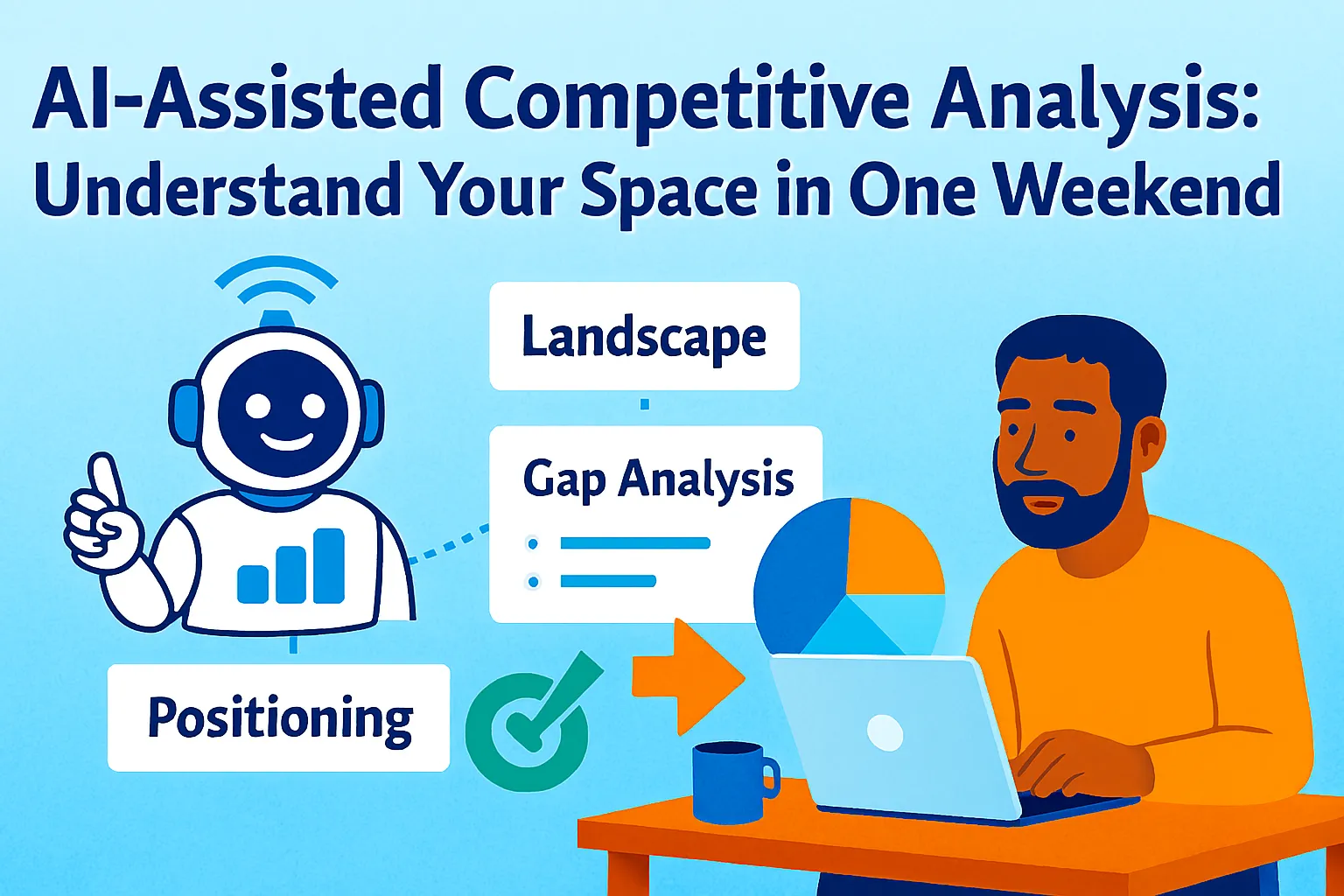
Most solo founders do competitive research the same way: they Google their product category, visit four or five websites, note that the space is "competitive but there's room for us," and move on.
That's not competitive analysis. That's a reassurance ritual.
Real competitive analysis does something those four website visits can't: it maps the full landscape, including competitors you haven't heard of yet; it identifies what each competitor owns in customers' minds; it finds the gaps — in features, in pricing, in segment coverage, in messaging — that are genuinely available; and it tells you specifically where you fit and why someone should choose you over the alternatives.
The reason founders skip it isn't laziness. It's time. Doing this manually — pulling pricing pages, reading reviews, analyzing positioning across six competitors, synthesizing the gaps — takes 15-30 hours of real work. Most founders don't have that in a single sprint.
AI competitive intelligence tools typically save 30 to 60 work hours per month compared to manual research. For a one-time competitive analysis sprint, that compression matters enormously. What used to take three weeks of background research — done properly — now takes a weekend: one day of structured data collection, one day of AI synthesis, one output that informs every positioning and messaging decision for the next 12 months.
This article is that weekend. Day one: map the landscape. Day two: find the gap and build your positioning.
Why Competitive Analysis Fails for Solo Founders
Before the weekend sprint, name the three ways competitive research typically goes wrong.
Failure 1: Only researching direct competitors
You search "[your product category] tool" and analyze the five results on page one. You miss the indirect competitors — the spreadsheet template people use instead of buying your product, the adjacent tool that solves 70% of your problem, the consulting firm that charges $5,000 to do manually what you automate. Indirect competition defines the full landscape of alternatives your ICP is actually considering.
Failure 2: Reading marketing pages instead of customer pages
Competitor websites tell you what they want you to believe. Their G2 reviews, their Reddit mentions, and their one-to-three-star Capterra complaints tell you what their actual customers experience. Looking at competitors who spent years solving the problem you've spent days thinking about reveals unknown-unknowns in your market perception — but only if you're reading customer-written content, not company-written content.
Failure 3: Describing gaps instead of owning them
Most competitive analysis ends with "there's an opportunity in the market for X." That's an observation, not a position. A position is a specific claim that a specific customer can evaluate: "If you're a [specific ICP] who's frustrated with [specific competitor gap], [product] is the only tool that [specific differentiator]." The analysis has to end in a statement that sharp enough to be falsified — either the claim is true and differentiating, or it isn't.
The Weekend Schedule
Saturday (Day 1): Map the landscape — 5-6 hours
Morning: Competitor identification and landscape mapping
Afternoon: Deep research on top 3-4 competitors
Sunday (Day 2): Find the gap — 4-5 hours
Morning: Synthesis and gap identification
Afternoon: Positioning statement and pitch
Total: One focused weekend. Output: a competitive map, a clear gap, a working positioning statement, and a competitive monitoring system you refresh monthly.
Day 1, Morning: Map the Full Landscape (2-3 Hours)
Step 1: Generate the complete competitor list
Start wider than you think you need to. Most founders' first-pass competitor list is 3-5 names. The real list is usually 15-20.
Generate a complete competitive landscape map
for my product.

MY PRODUCT: [One sentence — what it does, for whom]
MY ICP: [Specific description]

Map ALL competition across four categories:

1. DIRECT COMPETITORS
Products that solve the same problem for the
same customer in the same way.
For each: name, URL, founding year,
approximate size (if known), primary ICP.

2. INDIRECT COMPETITORS
Different solutions to the same underlying problem.
Include: manual workarounds, adjacent tools used
as substitutes, consultants/agencies who do this
as a service, internal tools companies build themselves.

3. SUBSTITUTES
What does the customer do instead of buying
any solution at all?
(Often: nothing, spreadsheets, or a junior hire)
This is important — "do nothing" is always
your most common competitor.

4. EMERGING THREATS
Products launched in the last 18 months
that are adjacent to or entering my space.
Where are well-funded startups or major
platforms moving that could intersect with
my category in 12-24 months?

For each competitor listed, add:
- One-sentence positioning statement
  (how they describe themselves)
- Estimated price range
- Primary ICP they serve

Flag: Which 3-4 are most important to
analyze deeply?
The emerging threats category is what most competitive analyses miss entirely. A well-funded startup entering adjacent space, or a platform adding your core feature as a free tier — these threats aren't visible in the "top 5 competitors" Google search but define the competitive landscape 18 months from now.
Step 2: Build the positioning matrix
Once you have the full list, create a map of where each competitor lives in the landscape.
Create a positioning matrix for these competitors.

COMPETITORS: [List from Step 1]

Map each competitor on two axes that reveal
the most meaningful differentiation in my space.

First, suggest the two axes most relevant
for this competitive landscape:
(Examples: Simple ↔ Powerful,
  Affordable ↔ Premium,
  SMB ↔ Enterprise,
  Generalist ↔ Specialist,
  Self-serve ↔ High-touch)

For each competitor: where do they sit on each axis?

Then identify:
1. CROWDED QUADRANTS: Where are multiple
   competitors clustered?
2. EMPTY QUADRANTS: Where is nobody positioned?
3. MY CURRENT POSITION: Where would I sit
   with my current approach?
4. AVAILABLE POSITIONS: Where could I
   credibly position that no one currently owns?

Output: Text description of the matrix
plus your recommended "open quadrant"
for me to consider.
The empty quadrant isn't automatically the right position — some quadrants are empty because there's no viable business there. The prompt asks for "credible" positions — where the market exists and you could plausibly win.
Day 1, Afternoon: Deep Competitor Research (3 Hours)
Pick your top three to four competitors — the ones most likely to come up when your ICP is evaluating alternatives. Run full research on each.
The competitor deep-dive prompt:
Run this once per competitor. Input: their website, pricing page, and 10-15 customer reviews.
Run a deep competitive analysis on [Competitor Name].

THEIR WEBSITE/PRICING: [Paste key sections —
  homepage headline, features page, pricing tiers]

CUSTOMER REVIEWS (1-5 stars from G2/Capterra/Reddit):
[Paste 10-15 reviews — include star rating,
  reviewer role/company size if available, date]

Analyze across six dimensions:

1. POSITIONING STATEMENT
How do they describe themselves in one sentence?
What ICP are they clearly targeting?
What pain point is their headline addressing?
What outcome are they promising?

2. FEATURE STRENGTHS
What capabilities do they do genuinely well?
(Based on positive reviews, not their marketing)
What do customers consistently praise?

3. FEATURE GAPS
What are customers consistently frustrated by?
What feature requests appear repeatedly?
What do churned customers say was missing?
Rank by frequency: [Most mentioned → Least]

4. SEGMENT FIT
Which customer segment is most satisfied
with this product? (Look for patterns in
reviewers' roles and company sizes)
Which segment is most frustrated?
(This underserved segment is often an opportunity)

5. PRICING PERCEPTION
How do customers describe the pricing?
(Good value / Fair / Expensive / Confusing)
Are complaints about absolute price or
value-for-price?
What tier do most reviews seem to be from?

6. SWITCHING PATTERNS
Are customers switching to this product
from somewhere else? From where?
Are customers leaving this product? For what?
(Any "I switched from X to Y because..."
in the reviews)

OUTPUT: One-page competitive brief for
[Competitor Name] I can reference quickly.
The review mining prompt (separate pass for negative reviews only):
I have collected 1-3 star reviews of [Competitor].
Extract the competitive intelligence.

REVIEWS: [Paste 10-15 negative reviews]

Extract:

1. TOP 5 COMPLAINTS ranked by frequency
   For each: exact complaint, how many mention it,
   most vivid direct quote

2. CUSTOMER SEGMENTS COMPLAINING
   Who's writing these reviews?
   Any pattern by company size, role, or use case?

3. DEAL-BREAKERS vs FRUSTRATIONS
   Which complaints caused people to leave
   vs which did they tolerate?
   ("I cancelled because..." = deal-breaker)
   ("frustrating but I still use it" = friction)

4. MY POSITIONING OPPORTUNITY
   The one-sentence gap statement:
   "Unlike [Competitor], a better tool would
   [specific thing] so [frustrated segment]
   could [outcome they want]."

5. COPYCAT RISK
   Which complaints could this competitor
   fix in the next 6-12 months?
   Which are architectural or strategic
   — unlikely to be fixed?
The "architectural or unlikely to be fixed" distinction is the most strategically important output. A complaint that stems from a competitor's core design decision (they're built for enterprise, not SMB; they're async-first, not real-time; they're horizontal, not vertical) is a durable gap. A complaint about a missing feature that any developer could add in a sprint is a temporary gap you shouldn't base your positioning on.
Day 2, Morning: Find the Gap (2-3 Hours)
You now have deep research on three to four competitors. The morning of Day 2 is synthesis — pulling all of that into a clear picture of what's actually available in this market.
The gap synthesis prompt:
I've completed deep research on my top competitors.
Synthesize it to identify the clearest gaps
I can own.

MY PRODUCT: [Description]
MY ICP: [Description]
MY CONSTRAINTS: Solo founder, [budget],
  [technical ability], [distribution advantage if any]

COMPETITOR RESEARCH SUMMARIES:
[Paste the one-page brief from each competitor]

Identify gaps across four types:

1. FEATURE GAP
A specific capability that multiple competitors
lack and multiple customers are requesting.
Is this gap structural (hard to fix) or
tactical (easy to add)?
Could I own this gap sustainably, or would
competitors close it within 12 months if
I gained traction?

2. SEGMENT GAP
A customer segment that is using competitor
products but is consistently underserved by them.
Not "small businesses" — which specific type,
role, industry, or situation is frustrated
despite being a paying customer?
What would make a product genuinely right
for this segment in a way the incumbents
aren't?

3. PRICING GAP
Is there an underserved price point?
A tier where customers' willingness to pay
isn't being captured?
A pricing model the market wants that
nobody is offering?

4. CHANNEL GAP
Are competitors all acquiring through
the same channel, leaving another channel
unclaimed?
(All doing SEO but no community presence.
 All high-touch sales but no self-serve.
 All outbound but no content-led.)
Is there a channel where my ICP spends
time that's underserved by competitive content?

FOR EACH GAP:
- Gap description (specific, not vague)
- Evidence strength (Strong / Moderate / Speculative)
- Durability (would this gap still exist in
  18 months?)
- My ability to own it (given my constraints)

RECOMMENDED GAP: Which single gap gives me the
best combination of evidence strength,
durability, and my ability to own it?
The "can I win here?" test:
Once you've identified the gap, run the ownership test before committing to a position:
I've identified this competitive gap:
[Describe the gap]

Test whether I can credibly own this gap:

1. DISTRIBUTION: Do I have or can I build
   a path to the customers who want this?
   Or am I relying on hoping they find me?

2. PROOF: Can I demonstrate this advantage
   in a way that's visible and verifiable —
   not just claimed?
   What would make a skeptical customer believe
   my claim over a competitor's counter-claim?

3. DURABILITY: If I gain traction here,
   what stops the best-funded competitor
   from copying this gap-closing feature or
   repositioning to take this segment?
   What makes my ownership of this gap
   defensible over 12-24 months?

4. FOUNDER FIT: Does my background, expertise,
   or network give me an authentic advantage
   in serving this segment or delivering
   this capability?
   Or would any founder with a credit card
   have the same shot?

Verdict: Can I credibly win this gap?
Strong yes / Conditional yes (with specifics) /
Unlikely (with reasoning)
A gap that scores "Unlikely" isn't necessarily abandoned — but it means the positioning needs to be rethought before the weekend ends. Gap selection is strategy. Choosing a gap you can't defensibly own just moves your competitors' problem to you.
Day 2, Afternoon: The Positioning Statement and Pitch (2 Hours)
Competitive analysis earns its cost only when it produces something usable. The output of a weekend sprint is three artifacts: a positioning statement, a one-paragraph pitch, and a competitive one-pager.
The positioning statement:
The classic positioning statement format, made specific:
Write a positioning statement based on my
competitive analysis.

MY PRODUCT: [Description]
TARGET SEGMENT (from gap analysis): [Specific ICP]
COMPETITIVE GAP OWNED: [The gap I'm positioning against]
PROOF POINTS: [What makes the claim credible]
NEAREST COMPETITOR: [Who I'm most directly replacing]

Write a positioning statement using this structure:

"For [specific ICP], who [specific situation
that creates urgency], [Product Name] is the
[category] that [specific differentiator] —
unlike [nearest competitor], which [specific gap]."

Write 3 versions:
Version 1: Most specific and bold
  (narrowest claim, highest credibility)
Version 2: Balanced
  (specific enough to differentiate,
   broad enough to not exclude too many)
Version 3: Broadest
  (still differentiating but wider net)

For each version:
Who does this include? Who does this exclude?
What's the risk of this positioning
(could this be countered easily)?
The most common positioning mistake is choosing Version 3 because it feels safer. Broad positioning is the least defensible — every competitor can claim it equally. The version that feels uncomfortably narrow is usually the right one: specific enough to be credible, exclusive enough to mean something.
The one-paragraph pitch:
The positioning statement is internal strategy. The pitch is what you say to a prospect.
Turn my positioning statement into a
one-paragraph pitch I can use in outreach,
on my landing page, and in sales conversations.

POSITIONING STATEMENT: [Paste chosen version]
ICP: [Description — their situation and pain]
OUTCOME THEY WANT: [What success looks like for them]
SOCIAL PROOF AVAILABLE: [Any early customers,
  relevant credentials, or comparison evidence]

Write:
1. THE PITCH (100-150 words):
   - Opens with their situation, not my product
   - Names the specific frustration
     with the status quo
   - Positions the product as the specific solution
   - Makes the differentiator concrete
     (not "better" — what specifically)
   - Ends with a clear next step

2. THE ONE-LINER (under 15 words):
   The version for a Twitter bio, a cold email
   subject line, or a conference introduction.
   Should pass the "elevator door closing" test —
   someone gets it in 5 seconds.

3. THE OBJECTION HANDLER:
   The most likely pushback from my target ICP
   when they hear this pitch
   ("we already use [Competitor X]")
   and a one-sentence response that doesn't
   sound defensive.
The competitive one-pager:
This single page becomes your competitive reference document — updated quarterly, referenced before every sales conversation, used as the basis for the monthly monitoring system.
Create a competitive one-pager for my business.

MY PRODUCT AND POSITION: [Description]
COMPETITIVE RESEARCH: [Paste summaries]

Structure:

OUR POSITION:
[One-sentence positioning statement]

THE COMPETITIVE LANDSCAPE:

| Competitor | Who They Serve Best |
  Their Strength | Their Gap | Our Advantage |
[Complete for each major competitor]

COMMON OBJECTIONS AND RESPONSES:
[The 3 most likely competitor comparisons
 a prospect will make, with responses]

WHEN TO CHOOSE US OVER X:
[2-3 specific situations where we are
 clearly the better choice]

WHEN THEY MIGHT CHOOSE X OVER US:
[Honest: situations where a competitor
 might genuinely be the better fit]
(This builds trust in sales conversations —
 honesty about fit is a differentiator itself)

LAST UPDATED: [Date]
NEXT REVIEW: [Date — 90 days]
The "when they might choose X over us" section is the most counter-intuitive element — and the most valuable in sales conversations. Prospects who hear you honestly describe when a competitor is the better fit trust your judgment on when you're the better fit.
The Monthly Monitoring System
The competitive analysis you built this weekend becomes outdated the moment a competitor ships a feature, changes pricing, or gets acquired. The monthly monitoring system keeps it current in 30 minutes.
Set up competitive alerts (one-time, 30 minutes):
Google Alerts: One alert per major competitor name. Catches press, funding announcements, major launches.
Competitor newsletters: Subscribe to every competitor's product newsletter and changelog. What they ship tells you where they're investing.
G2/Capterra: Add competitors to your "comparison" list — you'll see new reviews as they appear.
LinkedIn: Follow each competitor's company page. Job postings signal product direction before it's public.
The monthly 30-minute refresh:
Run my monthly competitive monitoring update.

MONITORING SOURCES THIS MONTH:
New Google Alerts: [Paste any relevant items]
Competitor changelog/product updates: [Paste]
New reviews mentioning competitors: [Paste]
Competitor job postings: [Paste titles]
Any other signals: [Paste]

Update my competitive picture:

1. WHAT CHANGED: Any meaningful moves by
   competitors this month?

2. GAP STATUS: Does my identified gap still exist?
   Did any competitor move to close it?

3. NEW OPPORTUNITIES: Did anything create
   a new gap or opportunity?

4. POSITIONING CHECK: Does my positioning
   statement still hold, or does anything
   need to be updated?

5. ONE ACTION: Based on this month's
   intelligence, what's one thing to do
   differently in sales, marketing, or
   product this month?

Update the competitive one-pager with
any changes. Note the date.
This 30-minute monthly ritual is what separates competitive intelligence from competitive research. Research is a project. Intelligence is a system.
Tools and Cost for the Weekend Sprint
DATA COLLECTION:
G2, Capterra, Trustpilot (browser):      $0
Reddit, Hacker News (browser):           $0
LinkedIn Jobs (browser):                 $0
Product Hunt (browser):                  $0
Google Alerts (email):                   $0

AI SYNTHESIS:
Claude Pro or ChatGPT Plus:              $20/month

COMPETITOR TRAFFIC ESTIMATES:
Similarweb free tier:                    $0
(Rough traffic numbers, top referrals)

SEO VISIBILITY:
Ahrefs free tier or
Google Search Console:                   $0
(Which keywords competitors rank for)

DOCUMENTATION:
Notion free:                             $0

TOTAL WEEKEND SPRINT:                    $20
ONGOING MONTHLY MONITORING:             $0
(Using free alerts + your AI subscription)
When paid tools are worth it:
Competitive intelligence tools like Competely automatically scan competitor pages every two to four weeks — worth considering at $29-49/month if you're in a fast-moving market where monthly manual checks feel insufficient. Semrush ($99/month) and Ahrefs ($99/month) are worth adding if content and SEO are your primary channel and you need keyword gap analysis at scale. Below $10K MRR, the free-tier approach captures 80% of what matters.
Common Mistakes in Competitive Analysis
1. Building a competitor matrix instead of finding your position
A beautiful comparison table showing 47 features across 8 competitors is not a positioning strategy. It's a research artifact. The output that matters is one sentence: what you own, for whom, and why it's credible. Work backward from that sentence, not forward from the table.
2. Picking a gap that doesn't matter to your ICP
"No competitor has a dark mode" is a gap. It's not a positioning opportunity unless dark mode is something your ICP specifically loses deals over or churns from competitors for. The gap has to be a gap in something that drives purchase decisions — not just a difference you can point to.
3. Building your whole pitch around competitor weakness
Positioning against a competitor's gap is useful context, not your primary value proposition. The pitch should lead with your customer's situation, not with what your competitors lack. Customers aren't motivated by your competitor's failures — they're motivated by their own outcomes.
4. Treating the competitive landscape as stable
You completed a thorough competitive analysis in January. It's now October. Three competitors have shipped major features. One raised a Series A. A new entrant appeared from an adjacent space. Your January positioning is partially wrong and you don't know which parts. Monthly monitoring exists to prevent this.
5. Skipping indirect competitors
"We don't have real competitors" almost always means "we only looked at direct competitors." The customer who could use your product is using something instead of it — a spreadsheet, an adjacent tool, a manual process, a VA. Understanding the full substitution landscape is what makes your positioning genuinely differentiated rather than differentiated only from the tools you bothered to research.
The Real Talk on Competitive Positioning
The goal of competitive analysis is not to find a market where you have no competition. That market doesn't have customers either.
The goal is to find the specific intersection — a customer segment, a use case, a price point, a channel — where you have genuine advantage and where competitors are genuinely failing the customers who are most like your ICP. That intersection exists in almost every established market. Finding it requires looking at the market honestly, not just at the evidence that confirms the position you've already chosen.
The weekend sprint produces a hypothesis. The first six months of customer conversations, sales calls, and churn interviews confirm or refute it. Competitive positioning is iterative — the sprint gives you a starting point that's much better than guesswork, and the monthly monitoring system keeps it current.
One weekend. One gap. One positioning statement sharp enough to tell you who to say no to.
That's it.



Comments (0)
Leave a Comment