

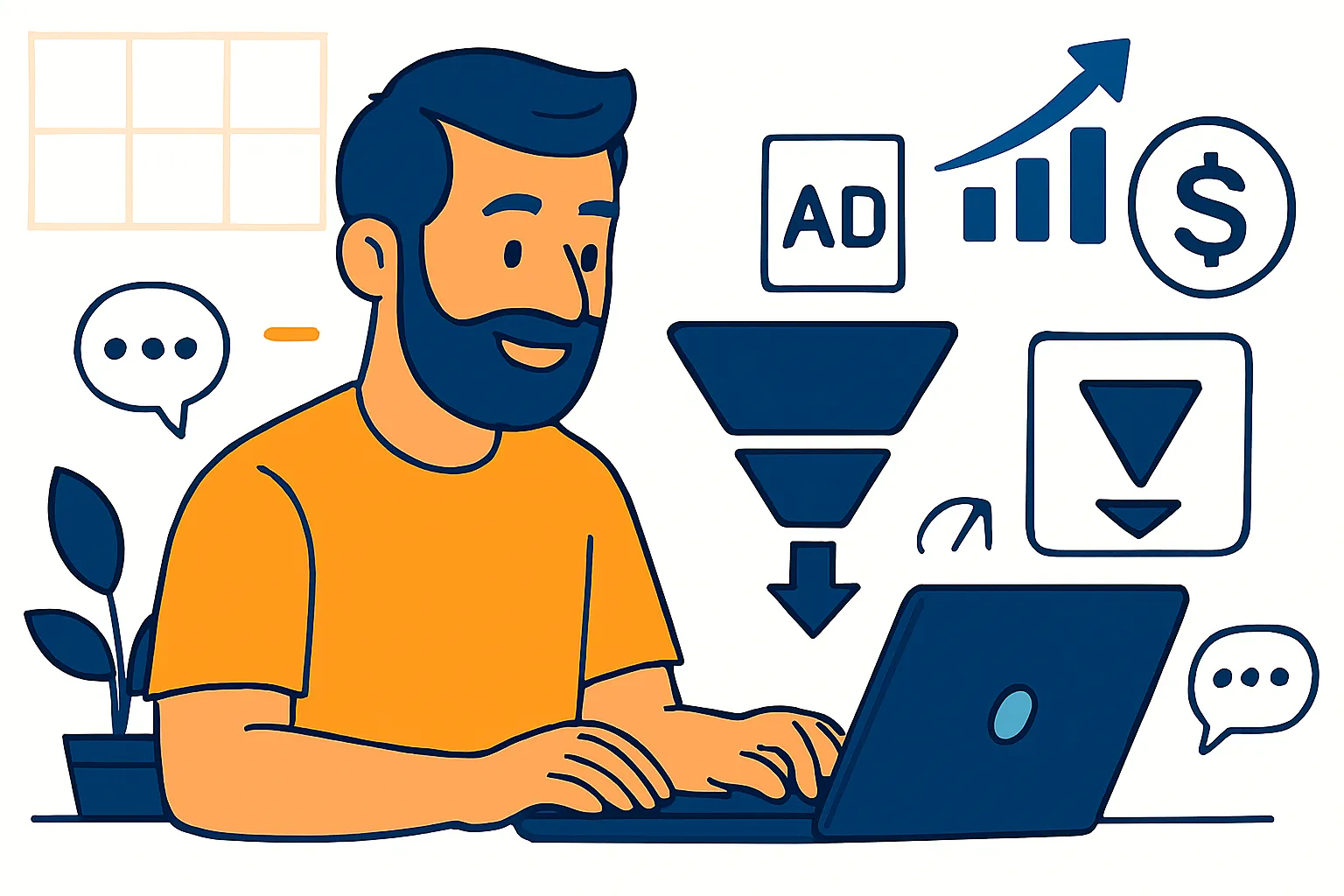
Running ads as a solo founder feels like throwing money into a void.
You're competing against companies with full marketing teams and six-figure budgets.
But here's what most founders miss: you don't need to fight for cold traffic.
Your warm leads—people who already visited your site, opened your emails, or engaged with your content—are waiting.
They're cheaper to convert, easier to reach, and more likely to buy. The problem? Most solo founders either ignore retargeting entirely or set it up wrong and watch their budget disappear.
This guide shows you how to use AI-powered retargeting to convert warm leads without the complexity, wasted spend, or marketing degree required.
Why Retargeting Is the Only Ads Game Solo Founders Should Play
Cold ads are a trap for solo founders. You pay premium prices to interrupt strangers who've never heard of you, competing against established brands with massive budgets. The result? High costs, low conversions, and burned cash.
Retargeting flips this equation. You're reaching people who already raised their hand—they visited your site, downloaded your lead magnet, or started a free trial. They know who you are. They're just not ready yet.
The numbers prove it. Retargeting consistently delivers 2-10x better conversion rates than cold ads at a fraction of the cost per click. For solo founders wearing ten hats, this isn't just about efficiency—it's about survival. You need wins fast, and retargeting gives you the shortest path to revenue.
More importantly, retargeting scales with your business. Whether you have 50 visitors a month or 5,000, you're only spending on people who've shown real interest. No wasted impressions. No paying to educate strangers about problems they don't know they have.
What "Warm Leads" Actually Mean for a Solo Founder
Forget the marketing textbook definitions. As a solo founder, your warm leads fall into four simple buckets:
Website visitors who didn't convert. They checked out your pricing page, read your features, maybe even started signup. They're researching, comparing, or just got distracted.
Email subscribers who opened but didn't click. They gave you permission to reach them. They're interested enough to stay on your list. They just haven't taken the next step.
Free users or trial accounts that went dormant. They tried your product. They saw the value. Something stopped them from converting to paid.
Social media engagers who liked, commented, or shared. They're signaling interest publicly. They're familiar with your brand. They're warm.
Here's the truth most founders need to hear: you don't need thousands of visitors to make retargeting work. A small, intent-rich audience of 100 engaged visitors beats 10,000 cold impressions every time. Those 100 people already know your name, understand your offer, and showed enough interest to engage. That's your retargeting goldmine.
The mistake? Treating all visitors the same. Someone who spent five minutes reading your pricing page is not the same as someone who bounced in three seconds. Focus your retargeting on high-intent actions: pricing page views, demo requests, cart additions, trial signups. These are your money makers.
The Solo Founder Retargeting Funnel (Simple, Not Fancy)
Forget complex funnels with twelve stages and seventeen touchpoints. You're running a business alone. Your retargeting funnel needs three stages, maximum.
Stage 1: They visited. Someone landed on your site but didn't take action. Your retargeting reminds them you exist and shows what they missed. Goal: get them back to your site.
Stage 2: They considered. They viewed pricing, read features, maybe even started signup. They're evaluating. Your ads address objections, showcase social proof, or offer a nudge like a discount or bonus. Goal: move them to decision.
Stage 3: They almost bought. They abandoned cart, let a trial expire, or dropped off during checkout. These people are closest to revenue. Your ads remove friction with urgency, guarantees, or direct value propositions. Goal: close the deal.
One goal per stage. Not brand awareness. Not "engagement." Conversions. Signups. Sales.
Complex funnels fail for solo founders because you're trying to optimize and manage multiple campaigns, audiences, and creatives simultaneously. You don't have time to babysit dashboards. Simplicity wins. Three stages, clear goals, and you can manage this in 30 minutes a week.
How AI Ads Save You Time (Not Just Money)
AI isn't just a buzzword—it's the equalizer for solo founders competing against marketing teams.
Traditional ad management means manual audience building, creative testing, bid adjustments, and constant optimization. You're spending hours tweaking campaigns instead of building your product.
AI handles this automatically. It tests creative variations, adjusts bids in real-time, and optimizes targeting based on performance data you'd never spot manually. What used to take a marketing team now runs itself.
The real win? Decision fatigue. As a solo founder, you make hundreds of decisions daily. AI removes dozens of micro-decisions from your plate—which creative to test, which audience segment to prioritize, what bid to set. The algorithm handles it faster and better than you could manually.
Modern AI ad platforms analyze patterns across millions of conversions to predict what will work for your specific audience. They learn which messages resonate, which images convert, and which times to show ads. You set the goal, provide the raw materials, and let AI optimize.
This doesn't mean "set and forget." You still need to check performance, provide new creative, and make strategic decisions. But you're spending minutes instead of hours, focusing on high-level direction instead of tactical execution.
For solo founders, AI isn't optional anymore—it's the only way to compete without hiring a team.
Budget Rules: How Much Solo Founders Should Actually Spend
The most common question: "What's the minimum I need to spend?"
For retargeting, start with $10-20 per day. This isn't about scale—it's about learning what works while staying in business. At this level, you'll get enough data to see patterns without risking significant capital.
This assumes you have at least 200-500 visitors per month to retarget. Below that, retargeting struggles to deliver consistent results because your audience is too small for platforms to optimize effectively.
Set daily budget caps, not monthly. Daily caps prevent surprise spend spikes and give you control. If something goes wrong—bad targeting, poor creative, technical glitch—you lose one day's budget, not your entire monthly allocation.
Start small and increase only when you see positive returns. Many solo founders make the mistake of "going big" too early, assuming more spend equals better results. It doesn't. Retargeting performs well at small budgets because you're reaching highly targeted audiences.
The real rule: spend what you can afford to lose while testing. Once you prove ROI (you're making more than you spend), scale gradually. Double your budget, measure results, repeat. This compounds slowly but safely.
Consistency beats scaling. $15 daily for 30 days teaches you more and builds better optimization than $450 spent in three days of aggressive testing.
AI Retargeting Creatives That Convert (Without Being Cringe)
Solo founder ads have an advantage: authenticity. You're not a faceless corporation. Use it.
The best retargeting ads feel like helpful reminders, not desperate sales pitches. Your tone should acknowledge their previous interest and provide value or address why they didn't convert.
Example: Instead of "BUY NOW - 50% OFF!!!", try "Still thinking about [product]? Here's what helped others decide." It's direct, respectful, and actually helpful.
Use AI to rewrite one core message into multiple angles without starting from scratch. Feed your AI tool your value proposition and ask for five variations emphasizing different benefits—time savings, cost reduction, ease of use, results, social proof. Test them all.
Founder-led messaging builds trust. People buy from people, especially in early-stage products. Consider simple formats: your photo, a direct quote, and a clear value statement. It doesn't need polish—it needs honesty.
Avoid corporate jargon, hype, or vague promises. Solo founders connect by being real. "This tool saves me 3 hours weekly" beats "Revolutionary platform disrupting productivity" every time.
Dynamic creative works well for retargeting. If someone viewed a specific feature, show that feature in the ad. If they abandoned a specific product, show that product. The more personalized without being creepy, the better.
Visual simplicity wins. Clean designs, readable text, clear call-to-action. You're not trying to win design awards—you're trying to get clicks from people who already know you.
The Only Metrics Solo Founders Should Care About
Most ad dashboards overwhelm you with data you don't need. As a solo founder, track three metrics ruthlessly:
Cost per conversion. What are you paying to acquire a customer, signup, or trial? This is your north star. If it's lower than your customer lifetime value (with room for profit), you're winning. Everything else is noise.
Frequency. How many times has the average person seen your ad? Keep this between 3-7. Below 3, you're not getting enough impressions for impact. Above 7, you're annoying people and wasting money on overexposure.
Conversion rate by audience segment. Which warm audiences convert best? Pricing page visitors? Email subscribers? Trial users? Double down on what works, cut what doesn't.
Ignore vanity metrics. Impressions, reach, clicks without context—these don't pay your bills. A thousand impressions with zero conversions is worthless.
Quick decision rules:
If cost per conversion is too high after 2 weeks: kill the ad or audience
If frequency exceeds 8: rotate creative or pause the campaign
If an audience segment converts at 5x the rate of others: increase its budget
Check your dashboard 2-3 times weekly. More frequent checking leads to premature decisions based on insufficient data. Less frequent means you miss problems until you've wasted serious money.
The goal isn't perfect metrics—it's profitable ones. You're running a business, not an optimization science project.
Common Retargeting Mistakes That Drain Solo Founder Budgets
Retargeting everyone. Not all visitors are equal. Someone who bounced in five seconds isn't worth the same ad spend as someone who viewed pricing. Create separate audiences based on engagement depth and allocate budget accordingly.
Running ads too long without changes. Ad fatigue is real. After 2-3 weeks, even good ads lose effectiveness. Rotate creative regularly, even if performance hasn't dropped yet.
Over-automation without clear goals. AI is powerful, but it needs direction. If you tell the algorithm to "maximize conversions" without defining what that means or setting constraints, it'll optimize for cheap, low-quality conversions. Set clear goals and guard rails.
Not excluding converters. Once someone buys, stop retargeting them with the same "buy now" ads. Either exclude them entirely or retarget with upsell/retention campaigns. Continuing to show acquisition ads wastes budget and annoys customers.
Ignoring mobile. Most retargeting impressions happen on mobile. If your ads or landing pages aren't mobile-optimized, you're throwing away money. Test everything on mobile first.
Setting up retargeting and never touching it. Retargeting isn't "set and forget." Markets change, products evolve, audiences shift. Review monthly minimum, optimize based on data.
The biggest mistake? Not running retargeting at all because it seems complex. It's not. Start simple, learn fast, improve gradually.
Quick AI Retargeting Stack for Solopreneurs
You don't need a dozen tools. You need one ad platform and one AI assistant.
Ad Platform: Start with one. Facebook Ads or Google Ads. Not both. Pick based on where your audience spends time. B2B software? LinkedIn or Google. Consumer products? Facebook/Instagram. Don't spread yourself thin.
AI Tool: Use your ad platform's built-in AI (Smart Campaigns, Performance Max, Advantage+ Shopping) or add a simple layer like AdCreative.ai for creative generation. Skip the expensive all-in-one platforms until you're spending $1,000+ monthly.
 Analytics: Your ad platform's native analytics are sufficient. Google Analytics is overkill unless you're running complex multi-touch attribution.
Creative: Canva for images, your phone for video, AI writers (ChatGPT, Claude, Jasper) for copy. Professional production isn't necessary at this stage.
No complex integrations. No agencies. No consultants. Everything "out of the box" until you prove the model works and need to scale.
The worst thing you can do is over-complicate your stack, spending more time managing tools than running your business.
When Retargeting Is Working—and When to Stop
Signs retargeting is paying off:
Cost per conversion trends downward over weeks
Conversion rate exceeds your direct traffic or organic channels
Customers mention "I kept seeing your ads" as a buying factor
ROAS consistently exceeds 3:1 (three dollars returned for every dollar spent)
These indicate your retargeting engine is functioning. Keep it running, optimize incrementally, scale slowly.
Signs diminishing returns are kicking in:
Frequency keeps climbing despite creative refreshes
Cost per conversion increases week over week
You've saturated your audience (everyone who would convert has converted)
ROAS drops below 2:1 and stays there
When this happens, pause instead of forcing scale. Retargeting has limits. Once you've converted your best warm leads, you need to either wait for your audience to refresh (new visitors, new subscribers) or shift strategy.
Know when to stop. Not every business, product, or audience size can sustain continuous retargeting profitably. If you've tested for 90 days, optimized aggressively, and still can't get profitable unit economics, retargeting might not be your channel. That's okay. Better to know than to keep bleeding money.
The goal isn't to run retargeting forever—it's to convert warm leads cost-effectively when they exist. Some seasons you'll run it heavily. Others you'll pause and focus on audience building.
Final Takeaway: Retarget Less, Convert More
Retargeting isn't about volume—it's leverage. You're not trying to reach millions. You're trying to convert the handful of people who already care.
AI levels the playing field, letting solo founders compete without teams, agencies, or massive budgets. You're optimizing smarter, not spending bigger.
The winning formula: focus on intent, not reach. A small audience of engaged prospects beats a large audience of strangers. Every time.
Start simple. Test one platform, one audience, one offer. Learn what works. Scale what converts. Cut what doesn't. Repeat.
Most importantly: retargeting is a tool, not a strategy. Your real job is building something people want. Retargeting just helps you reconnect with people who already showed interest but needed another look.
Run lean, optimize ruthlessly, and let AI do the heavy lifting. That's how solo founders win with retargeting.



Comments (0)
Leave a Comment