


You're spending 2 hours every morning deciding which leads to chase.
You open your CRM, scan through yesterday's form submissions, check who opened your emails, revisit notes from last week's inquiries, and try to remember which prospects seemed serious versus which were just browsing. By the time you've mentally ranked everyone, half your morning is gone—and you still haven't talked to a single person.
This is the manual lead scoring trap, and it's quietly killing your momentum.
The brutal truth: as a solo founder, you don't have time to be both salesperson and sales operations analyst. Every hour you spend ranking leads is an hour you're not closing deals, building product, or doing literally anything else that moves your business forward.
AI lead scoring fixes this. Not someday with a data science team and enterprise budget. Right now, with tools you can set up this week.
This guide will show you exactly how to replace manual lead scoring with AI-powered automation—so every lead gets a score the moment they arrive, and you only spend time on the ones that matter.
What Lead Scoring Actually Means (Without the Sales Jargon)
Let's strip away the corporate buzzwords.
Lead scoring is prioritization. That's it.
When 10 leads come in, you can't talk to all of them immediately. Lead scoring tells you which 3 to call first, which 5 to email, and which 2 to ignore entirely.
The score itself is just a number that represents "how likely is this person to buy from me?" Higher score = more likely to buy = handle first.
Two types of signals create that score:
Explicit signals (who they are):
Company size, industry, role
Budget range, geography
Technology they use
You gather these directly—they tell you or you look it up.
Implicit signals (what they do):
Pages they visit on your site
Emails they open, links they click
Questions they ask, urgency in their tone
How many times they've engaged
These are behavioral clues about their interest level.
Manual lead scoring means you look at all these signals yourself and make a gut call: "This person seems hot, that one seems lukewarm, this one is probably wasting my time."
AI lead scoring means software looks at the same signals, compares them to patterns from past leads, and outputs a number automatically.
The goal isn't prediction perfection. It's consistent prioritization without burning your mental energy every single morning.
The Hidden Cost of Manual Lead Scoring
Manual scoring doesn't just waste time. It leaks money in ways that are hard to see until you add them up.
Opportunity cost:
Every lead you score manually is one you're not actively selling to. If it takes you 5 minutes per lead to evaluate and you process 20 leads per week, that's 100 minutes—nearly 2 hours—spent on admin work instead of revenue-generating conversations.
Over a year? That's 100+ hours you could have spent closing deals.
Delayed follow-ups:
You score leads in batches—maybe once in the morning, once after lunch. That means a hot lead who submitted a form at 2pm doesn't hear from you until tomorrow morning. By then, they've moved on or talked to your competitor who responded in 10 minutes.
Research shows that responding within 5 minutes versus 1 hour drops your odds of connecting by 10x. Manual scoring makes fast response impossible.
Cognitive overload:
Scoring isn't a one-time decision. It's constant re-evaluation. "Wait, did that lead say they had budget?" "Was the company in my target size range?" "How long ago did they last engage?"
You're solving the same puzzle repeatedly, draining mental energy that could go toward creative problem-solving or strategic thinking.
Biased decision-making:
On Monday morning after a great weekend, you're optimistic—everyone looks qualified. On Friday afternoon after a week of rejections, you're burned out—nobody seems worth the effort.
Your scoring criteria shift with your mood, which means identical leads get treated differently based on when they arrive. Inconsistency like this costs you deals.
The real cost of manual lead scoring isn't the time. It's the compounding effect of slow response, missed opportunities, mental fatigue, and inconsistent judgment over months.
When Manual Lead Scoring Stops Working
There's a point where manual scoring breaks from "annoying" to "actively hurting your business." Here's how to know if you've crossed that line.
Tipping point #1: Inbound volume exceeds 10 leads per week
When you're getting 2-3 leads weekly, manual evaluation is fine. You remember each conversation, the context is fresh, and you can afford to spend 10 minutes thinking about each one.
At 10+ per week, you're spending an hour or more just on triage. Details blur together. You forget who said what. Manual scoring becomes a bottleneck.
Tipping point #2: Multiple inbound channels
Leads are coming from website forms, email inquiries, chat, social media DMs, and maybe even inbound calls. Each channel lives in a different place—your inbox, your CRM, Slack, wherever.
Now you're not just scoring leads, you're hunting them down across platforms before you can even evaluate them. This is when leads start slipping through cracks entirely.
Tipping point #3: Sales cycles longer than 2 weeks
Short cycles mean you score once and close fast. Longer cycles mean leads engage multiple times over weeks or months. Now you need to re-score constantly as new signals come in.
"This lead was cold last week but just visited our pricing page 3 times yesterday" requires continuous re-evaluation that manual processes can't sustain.
Self-diagnosis questions:
Are you scoring leads in "batches" instead of instantly?
Do you sometimes forget to follow up with leads because they got buried?
Have you ever lost a deal because someone responded faster?
Does lead evaluation feel like a mental burden rather than a quick decision?
If you answered yes to two or more, manual scoring is holding you back. Time to automate.
What AI-Based Lead Scoring Looks Like for a Solo Founder
Forget the enterprise sales operations playbook. Here's what AI lead scoring actually means when you're running solo.
The simple version:
A lead arrives (form, email, chat, anywhere)
AI instantly evaluates them against your criteria
Lead gets a score (0-100, or whatever scale you choose)
Score triggers automatic actions:
High score → book calendar link sent immediately
Medium score → nurture email sequence
Low score → polite rejection or generic resource
You only engage with leads that cleared your threshold
What this looks like in practice:
Someone fills out your demo request form at 3pm while you're in a customer call. The AI:
Pulls their company data (size, industry, tech stack)
Checks their website behavior (pricing page visits, time on site)
Analyzes their form responses (budget, timeline, pain points)
Compares these signals to leads that converted historically
Assigns a score: 85/100
Instantly sends: "Based on what you shared, it sounds like we can help. Here's my calendar—grab a slot that works for you."
The lead books a call. You show up prepared with all the context. The whole thing happened while you were busy doing other work.
Key principles:
Transparency: You should always be able to see why a lead got a certain score. No black boxes. If the AI says "65 points," you should know which signals contributed what.
Control: You set the rules. The AI executes them consistently, but you decide what matters. You're not handing over judgment—you're codifying your judgment so it scales.
Continuous feedback: The system should learn from outcomes. If leads with profile X consistently convert, their score should adjust upward over time. If profile Y never buys, scores adjust down.
AI lead scoring for solo founders isn't about replacing your brain. It's about getting your brain out of the repetitive evaluation loop so you can focus it on high-value conversations.
Signals AI Can Use to Score Leads
The score is only as good as the signals feeding it. Here's what AI can evaluate—using data you likely already have.
Demographic / Firmographic signals (who they are):
These are static attributes about the person or company:
Company size (employees, revenue)
Industry or vertical
Geographic location
Job title / seniority
Company funding stage (if B2B SaaS)
Technology stack they use
Example: If you sell to mid-market SaaS companies, a lead from a 50-person Series A software company scores higher than a solo consultant.
Behavioral signals (what they do):
Actions that indicate interest level:
Pages visited (especially pricing, case studies, product pages)
Time spent on site
Repeat visits
Email opens and clicks
Downloads (whitepapers, guides)
Video watch time
Form submissions or chat initiations
Example: Someone who visited your site 5 times, read 3 blog posts, and checked pricing twice is hotter than someone who bounced after 10 seconds.
Intent signals (how serious they are):
These come from what they say or ask:
Specific questions about implementation or timelines
Mentions of budget or buying process
Urgency indicators ("need this ASAP" vs "just exploring")
Competitor mentions ("currently using X, looking for Y")
Pain point specificity ("struggling with Z" vs vague interest)
Example: "We need to replace our current tool by end of quarter and have $50K budgeted" scores much higher than "just browsing."
Engagement recency and frequency:
Not just what they did, but when and how often:
Last interaction date (engaged today vs 3 months ago)
Frequency of engagement (one-time vs multiple touchpoints)
Consistency (steady interest vs sporadic)
Example: A lead who engaged once 6 months ago and never returned scores lower than one who's interacted 3 times this week.
The critical rule: Only score signals you actually have.
Don't build a system that requires data you can't access. If you don't track website behavior, don't score on page visits. If you can't enrich company data, focus on what people tell you directly.
Start with 5-7 signals you reliably collect. You can always add more later.
Rule-Based vs AI-Assisted Lead Scoring
There are two ways to build lead scoring. Understanding the difference helps you choose the right starting point.
Rule-based scoring (deterministic):
You define explicit if/then logic:
IF company size > 50 employees → +20 points
IF role = decision-maker → +15 points
IF visited pricing page → +10 points
IF budget mentioned → +25 points
IF timeline > 6 months → -10 points
The AI applies your rules exactly, every time. There's no learning or pattern recognition—just consistent execution of your criteria.
- Totally transparent (you know exactly why each score is what it is)
- Easy to debug and adjust
- Works with small data sets
- You maintain full control
- Requires you to define all the rules upfront
- Misses nuanced patterns humans wouldn't catch
- Doesn't improve over time unless you manually update rules
Best for: Solo founders just starting with AI scoring, or those with clear, simple qualification criteria.
AI-assisted scoring (pattern recognition):
The AI analyzes historical data—leads that converted vs those that didn't—and identifies patterns:
"Leads who visited the pricing page AND downloaded the guide AND had 100+ employees converted 8x more often"
"Leads from X industry with Y job title rarely buy, even when other signals look good"
"Urgency language matters more than company size for our deals"
The AI adjusts scoring weights based on what actually predicts conversions, not what you think matters.
- Discovers patterns you'd miss manually
- Improves automatically as it learns from outcomes
- Handles complex signal combinations
- Adapts to changes in your market or ICP
- Requires more historical data (50+ leads minimum, ideally 100+)
- Less transparent ("why did this lead score 73?")
- Can make mistakes if trained on biased or incomplete data
- Requires monitoring to catch drift
Best for: Founders with established track records (6+ months of lead data), higher volume, or complex buying patterns.
The recommended approach:
Start with rule-based scoring. It's faster to implement, easier to understand, and works with limited data.
After 50-100 scored leads, look for patterns:
Which rules are predicting outcomes well?
Which are useless?
Are there combinations of signals that matter together?
Then layer in AI-assisted scoring to refine weights and discover patterns you missed. Think of it as graduated automation—rules first, learning second.
Designing a Simple Lead Scoring Model
You don't need a PhD in data science. Here's how to build a scoring model in under an hour.
Step 1: Define 3-5 high-value signals
Pick the signals that most reliably separate good leads from bad. Focus on what you know matters, not what might theoretically matter.
Example for a B2B SaaS founder:
Company size (20-500 employees)
Decision-making authority (director level or above)
Active pain point (mentioned specific problem you solve)
Timeline (need solution within 90 days)
Budget awareness (acknowledges cost range)
Write these down explicitly. These become your scoring inputs.
Step 2: Assign rough weights
Not all signals matter equally. Give each one a point value based on importance.
Example scoring breakdown:
Company size in range: 20 points
Decision-maker: 25 points
Active pain point: 30 points
Timeline under 90 days: 15 points
Budget awareness: 10 points
Total possible score: 100 points
You don't need precision here. Rough weights work fine. You'll refine based on results.
Step 3: Set clear thresholds
Decide what scores trigger what actions.
Example thresholds:
70-100 points: Qualified (auto-send calendar link)
40-69 points: Nurture (email sequence)
0-39 points: Disqualify (polite rejection)
These bands should reflect your capacity. If you can only handle 5 sales calls per week, set the "qualified" threshold high enough that only ~5 leads per week clear it.
Step 4: Make it explainable
You should be able to look at any lead and quickly understand their score:
"This lead scored 75:
+20 for company size
+25 for decision-maker role
+30 for mentioning our core use case
+0 for timeline (none mentioned)
+0 for budget (didn't come up)"
If you can't explain a score in 30 seconds, your model is too complex.
Step 5: Document the logic
Write down your scoring model in a simple doc:
List of signals
Point values
Thresholds and actions
Date created
You'll revisit this weekly at first, monthly once it stabilizes. Having it documented makes adjustments easy.
Common beginner mistakes to avoid:
Using 15+ signals (cognitive overload, start with 5)
Scoring things you don't actually track
Setting thresholds before you see real score distributions
Making it too complex to explain
Keep it dead simple. Complexity comes later if needed.
Automating Lead Scoring Across Channels
Leads don't arrive in one neat place. AI scoring needs to work wherever they show up.
The omnichannel scoring problem:
A typical solo founder gets leads from:
Website contact forms
Demo request pages
Email inquiries (info@, hello@, your personal email)
Chat widget conversations
Social media DMs (LinkedIn, Twitter)
Inbound calls or voicemails
If you're scoring manually, you're checking all these places, copying information into a spreadsheet or CRM, then evaluating. It's fragmented and slow.
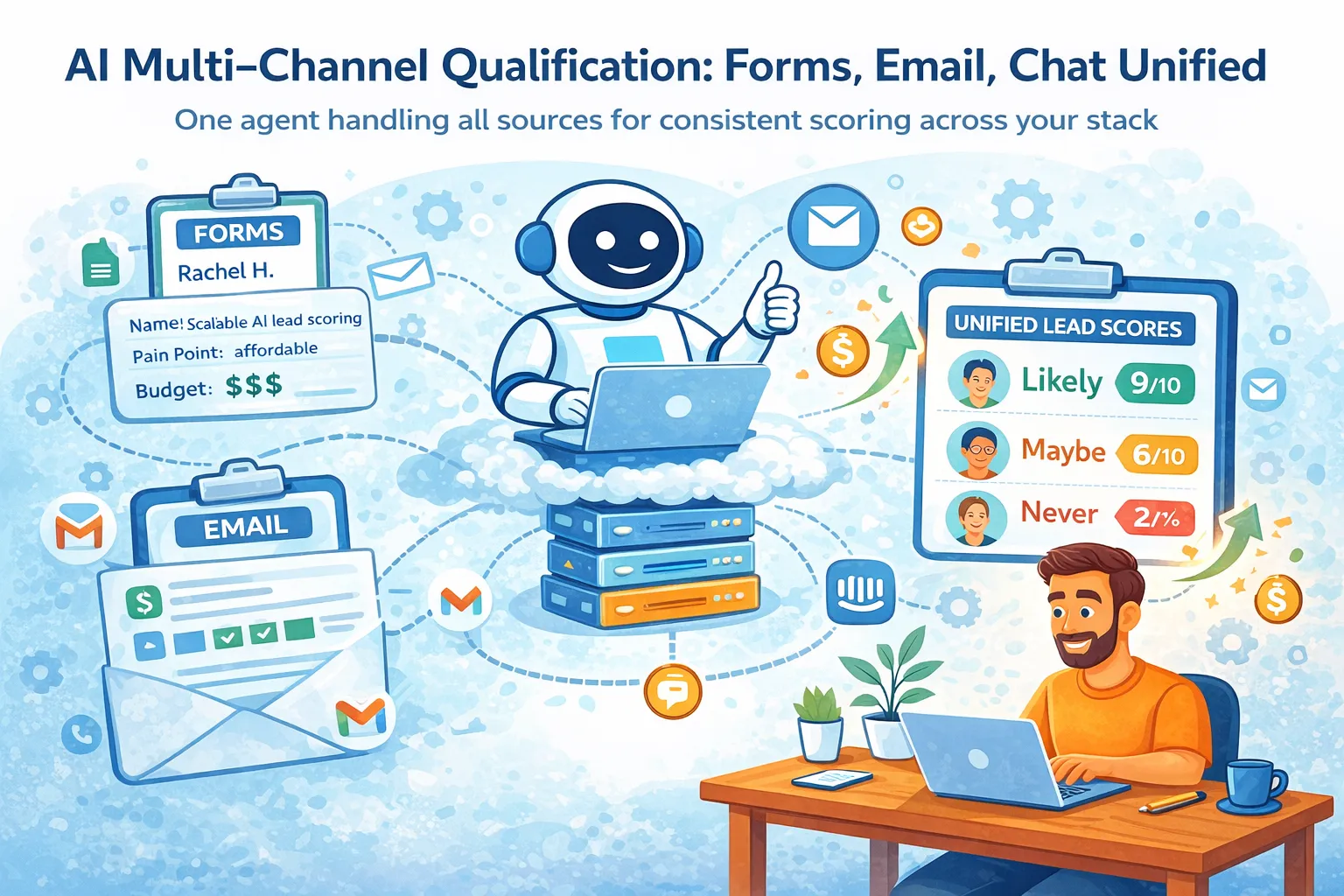
How AI unifies scoring:
Modern AI scoring tools connect to all your inbound channels and:
Capture data automatically
When a lead arrives anywhere, the system logs it immediately—name, company, source, message, timestamp.Enrich in real-time
For B2B leads, the AI can look up company data (size, industry, funding) and individual data (title, seniority) from enrichment databases.Pull behavioral history
If the lead has visited your website before, the AI pulls their browsing history—pages visited, time on site, downloads.Score instantly
All signals feed into your scoring model. The lead gets a number within seconds.Route automatically
Based on the score, the appropriate action triggers—whether that's sending a calendar link, adding to nurture, or filing away.
What this looks like in practice:
Someone sends you an email inquiry. Normally you'd:
Read the email
Google their company
Check if they've visited your site before
Decide if they're worth a call
Add to CRM manually
Set a reminder to follow up
With automated scoring:
Email arrives
AI extracts: name, company, question content
AI enriches: company has 75 employees, Series B, target industry
AI checks: they visited pricing page twice last week
Score: 82/100
Action: Auto-reply with calendar link
Total time for you: zero. The system handled it.
Integration requirements:
To make this work, you need:
A central system (CRM or database) where lead data consolidates
Connections from each channel (form tool, email, chat) to that system
An AI scoring engine that reads from the central system
Automation platform to trigger actions based on scores
Most modern CRMs and AI agent platforms have these connections built-in or available through Zapier/Make.
The key: eliminate manual cross-checking. Every lead should flow automatically from "first contact" to "scored and routed" without you touching it.
Tools Solo Founders Can Use for AI Lead Scoring
You don't need enterprise software. Here are the categories of tools that make AI scoring accessible.
CRMs with built-in AI scoring:
Many modern CRMs include lead scoring features powered by AI:
They integrate with your email, website, and forms
Score leads based on rules you define or patterns they learn
Trigger automations when scores hit thresholds
Provide dashboards showing score distributions
Good for: Founders who already use or plan to use a CRM. Keeps everything in one place.
Considerations: Some CRMs charge extra for AI features. Evaluate if the cost justifies consolidation.
AI agent platforms with scoring:
Purpose-built AI tools that handle conversation and scoring:
Engage leads conversationally (chat, email)
Extract qualifying information through dialogue
Score based on responses
Route to your calendar or CRM
Good for: Founders who want conversational qualification, not just passive scoring.
Considerations: Typically more focused on engagement than broad data integration. May need to connect to your CRM separately.
No-code automation platforms:
Tools like Zapier, Make, or n8n let you build custom scoring:
Pull lead data from various sources
Run it through scoring logic (using formulas or AI services)
Write scores to your CRM or spreadsheet
Trigger actions based on results
Good for: Technical founders comfortable with logic and workflows, or those with unique scoring needs.
Considerations: More setup work upfront, but maximum flexibility. You control every piece.
Enrichment services (supporting tools):
These don't score leads themselves but provide data that feeds scoring:
Look up company information from an email address
Pull website visitor behavior
Identify job titles and seniority
Good for: Enhancing the signals available for scoring.
Considerations: Usually paid per lookup. Budget accordingly based on lead volume.
Decision framework:
If you want simple and integrated: Choose a CRM with AI scoring built-in.
If you want conversational qualification: Choose an AI agent platform.
If you want maximum control and customization: Build with no-code automation.
Most important consideration: Ease of setup and maintenance. The best tool is the one you'll actually use consistently, not the one with the most features.
Start with one tool. Get it working. Expand your stack only when you hit clear limitations.
Acting on Scores Automatically
A score without action is just a number in a database. The leverage comes from what happens next.
High-score leads (qualified):
Automatic action: Send calendar link immediately
Template: "Hi [Name], thanks for reaching out. Based on what you shared, it sounds like we can definitely help with [specific pain point]. Here's my calendar—grab a 30-minute slot that works for you: [link]."
The lead books directly. You show up to the call with full context (their score breakdown, responses, behavior history) already in front of you.
Why this works: Speed wins deals. Responding in minutes instead of hours dramatically increases connection rates. Automation makes instant response possible even when you're busy.
Medium-score leads (nurture):
Automatic action: Enter email sequence
These leads have potential but aren't ready to buy yet. Put them in a sequence that builds value over time:
Email 1 (immediate): Helpful resource related to their interest
Email 2 (3 days later): Case study or customer story
Email 3 (7 days later): Address common objection or FAQ
Email 4 (14 days later): Soft CTA—"Still exploring? Let's chat: [calendar link]"
Sequence stops if they reply, book a call, or their score increases based on new activity.
Why this works: Keeps you top of mind without manual follow-up. Leads re-enter consideration when timing improves.
Low-score leads (disqualify):
Automatic action: Polite rejection with resources
Template: "Thanks for your interest! Based on what you've shared, we're likely not the best fit right now—[brief reason]. Here are some resources that might help: [links]. Best of luck!"
This closes the loop professionally without wasting anyone's time.
Why this works: Protects your calendar from low-fit conversations. Maintains goodwill even when declining.
Score-triggered re-engagement:
Scores aren't static. When a lead's behavior changes, their score should update and trigger new actions:
Lead was 45 points (nurture), visits pricing page 3 times this week → score jumps to 75 → auto-send calendar link
Lead was 80 points (qualified), goes silent for 30 days → score drops to 50 → move to long-term nurture
This ensures you're always acting on current intent, not outdated evaluations.
The action framework:
For each score band, define:
What happens immediately
What happens if they engage/don't engage
When you personally get involved
Write this down so your automations can execute it consistently:
Score | Immediate Action | If No Response (7 days) | If They Engage |
|---|---|---|---|
70+ | Calendar link | Reminder + value add | You take call |
40-69 | Nurture email 1 | Continue sequence | Rescore → may upgrade to qualified |
0-39 | Polite rejection | Archive | Resurface if behavior changes |
The goal: you only manually touch leads when they're either (a) ready to buy, or (b) asking questions the AI can't answer.
Everything else runs automatically.
Keeping AI Scoring Aligned With Reality
AI scoring isn't set-and-forget. Markets change, your ICP evolves, and what predicted success last quarter might not work this quarter.
Build feedback loops:
Weekly: Review wins and losses
Every Friday, look at:
Leads that scored high and converted → What did they have in common?
Leads that scored high but didn't convert → Why did we miss?
Leads that scored low but should've been higher → What signals did we miss?
Use these insights to adjust weights. Maybe "visited pricing page" is predicting conversions better than you thought. Maybe "company size" matters less than "timeline urgency."
Monthly: Audit score accuracy
Pull a month's worth of leads and check:
What % of 70+ score leads actually booked calls?
What % of those calls turned into deals?
Did any low-score leads slip through that shouldn't have?
If high scores aren't converting, your threshold is too low or your signals are off. If you're missing good leads, your model is too restrictive.
Quarterly: Recalibrate for market changes
Your ICP might shift. Economic conditions change buying behavior. New competitors alter what "qualified" means.
Every quarter, ask:
Is our ICP still the same?
Have new signals become important? (e.g., "must use X software")
Should we retire signals that no longer predict? (e.g., company funding stage mattered less than we thought)
Update your model accordingly.
Monitor for drift:
AI-assisted scoring (machine learning) can "drift" over time if it's learning from bad data:
If you close deals with poor-fit customers just to hit revenue targets, the AI learns those profiles are "good"
If market conditions change but your training data is old, the AI optimizes for outdated patterns
Prevent drift by:
Regularly feeding the AI updated win/loss data
Flagging outlier deals ("we closed this but it's not our ICP")
Retraining the model quarterly on fresh data
Stay close to the data:
You should personally review at least 10-20 scored leads per month, especially:
Edge cases (scores near your thresholds)
Leads the AI got very wrong
Complaints or confusion from prospects
This keeps you connected to how the system actually performs versus how you think it performs.
The rule: Trust but verify.
Let AI handle the volume, but you remain the quality control. The system should save you time, not make invisible mistakes that cost you deals.
Common Mistakes Solo Founders Make With AI Lead Scoring
Here's what kills AI scoring implementations—and how to avoid each trap.
Mistake #1: Over-engineering the model
Trying to score 20 different signals with complex weighting formulas and conditional logic before you've even processed 50 leads.
Fix: Start with 5 signals, simple addition, clear thresholds. Complexity earns its place through iteration, not upfront planning.
Mistake #2: Blind trust in AI
Setting up scoring and never checking if it's working. Assuming high scores = good leads without validating.
Fix: Review scored leads weekly for the first month. Check if the AI's judgment matches yours. Adjust until they align.
Mistake #3: Scoring signals you don't have
Building a model that requires "tech stack used" when you don't actually collect that data. Or scoring "email engagement" when you don't track opens/clicks.
Fix: Only score what you reliably capture. If you want to score something new, implement tracking first, then add it to the model.
Mistake #4: Ignoring qualitative context
Scoring purely on numbers and missing critical context. A lead with a "low" score might have written a detailed, thoughtful inquiry that shows serious intent—but the AI doesn't read nuance well.
Fix: Always include a human review layer for borderline cases. If a lead scores 65 but wrote a novel explaining their situation, escalate to you.
Mistake #5: Setting thresholds without data
Deciding "70+ is qualified" before you know what score distribution looks like. You might set it too high (nobody qualifies) or too low (everyone does).
Fix: Score 20-30 leads first without acting on the scores. See the distribution. Then set thresholds based on where natural breaks appear and your capacity.
Mistake #6: Not adjusting for capacity
Your scoring model says 15 leads per week are "qualified," but you can only handle 5 sales calls. Now you're overwhelmed and scoring became the problem, not the solution.
Fix: Set thresholds based on your availability. If you can do 5 calls/week, tune scoring so only 5-7 leads per week hit "qualified." Route the rest to nurture.
Mistake #7: Forgetting to communicate with leads
A lead scores low and gets auto-rejected, but they never hear back from you at all. They're left hanging, which damages your brand.
Fix: Every score outcome should trigger communication. Even "no" leads deserve a polite response with helpful resources.
The common thread: All these mistakes come from treating AI scoring like magic instead of a system you need to actively manage and refine.
It's a tool that amplifies your judgment, not a replacement for thinking.
Metrics That Matter (And Ones That Don't)
You can drown in lead scoring metrics. Focus on these and ignore the rest.
Metrics that matter:
1. Time-to-first-response
How quickly do qualified leads hear from you after they arrive?
Target: Under 5 minutes for high-score leads.
Why it matters: Speed is the strongest predictor of connection rates. AI scoring enables instant response.
2. Close rate by score tier
What percentage of high-score leads actually convert to customers?
Example:
70-100 score: 30% close rate
40-69 score: 5% close rate
0-39 score: 0% close rate
Why it matters: Tells you if your scoring model actually predicts buying intent. If high scores aren't closing, your criteria are off.
3. Founder hours saved per week
How much time did you spend on lead evaluation before vs after AI scoring?
Track for a month. If you were spending 8 hours/week manually and now spend 1 hour reviewing scores, you saved 7 hours—350+ hours annually.
Why it matters: ROI measurement. Time saved is money earned (or at least, money-making capacity unlocked).
4. Lead coverage
What percentage of inbound leads are getting scored and routed automatically?
Target: 95%+
Why it matters: Gaps mean leads are slipping through. If only 60% get scored, you still have a manual problem.
Metrics that don't matter (yet):
Total leads scored:
Vanity metric. Doesn't tell you if the scores are accurate or actions are effective.
Average score:
Meaningless without context. Score distribution matters more than average.
Number of signals tracked:
More signals ≠ better scoring. Focus on signal quality, not quantity.
AI model accuracy percentage:
Enterprise sales ops cares about this. You don't. You care whether qualified leads close, not model training precision.
The dashboard you actually need:
A simple weekly view:
Leads scored this week: [number]
High/Medium/Low breakdown: [%]
Calls booked from high-score leads: [number]
Deals closed: [number]
Time spent on manual review: [hours]
That's it. If these numbers look good, your system is working.
A 7-Day Transition Plan From Manual to AI Scoring
You don't need months to implement this. Here's how to go from manual scoring to AI-powered in one week.
Day 1-2: Define signals and criteria
Tasks:
List 5-7 signals you reliably collect
Assign point values to each
Set qualification thresholds (high/medium/low)
Document your scoring model
Time investment: 3-4 hours total
Deliverable: A one-page document explaining your scoring logic
Day 3-4: Configure rules and connect tools
Tasks:
Choose your AI scoring tool (CRM, AI platform, or automation tool)
Set up scoring rules in the platform
Connect your inbound channels (forms, email, chat)
Test with 5-10 dummy leads to verify scoring works
Time investment: 4-6 hours total
Deliverable: Working scoring system that processes test leads correctly
Day 5-6: Automate actions and routing
Tasks:
Configure automatic responses for each score tier
Set up calendar booking for high scores
Build nurture email sequence for medium scores
Create rejection template for low scores
Connect to your CRM or tracking spreadsheet
Time investment: 3-4 hours total
Deliverable: End-to-end automation from "lead arrives" to "action taken"
Day 7: Go live and review
Tasks:
Turn on AI scoring for real inbound leads
Monitor the first 10-20 leads closely
Check if scores match your intuition
Adjust any obvious misalignments
Document what you learned
Time investment: 2-3 hours total
Deliverable: Live system processing real leads with initial refinements made
Week 2: Stabilization
Review outcomes daily for first week
Look for patterns in misscores
Adjust weights or thresholds as needed
Build confidence in the system
By end of Week 2, you should be comfortable letting AI handle the majority of scoring with minimal oversight.
Common question: "Can I really do this in 7 days?"
Yes, if you:
Keep the model simple (5 signals max to start)
Use tools with templates or built-in scoring
Don't try to perfect every edge case upfront
The goal isn't perfection. It's getting 80% of your scoring automated in one week so you can start saving time immediately.
Conclusion: AI Lead Scoring as Leverage, Not Delegation
Here's what AI lead scoring is really about.
It's not about removing yourself from sales. It's not about trusting a machine to decide who deserves your attention. It's not even about "efficiency" in the abstract.
It's about protecting your most limited resource: your time and mental energy.
As a solo founder, you're already doing the work of five people. Every minute spent on repetitive evaluation is a minute stolen from building product, closing deals, or thinking strategically.
AI lead scoring doesn't replace your judgment. It amplifies it.
You define what matters. You set the criteria. You determine the thresholds.
The AI just applies your rules consistently, instantly, and without the cognitive load that drains you after the 47th lead of the week.
What changes with AI scoring:
Before: You spend 10 hours per week deciding who to talk to.
After: You spend 10 hours per week talking to qualified prospects.
Before: Hot leads wait hours or days for your response.
After: Hot leads get instant engagement while their interest is peak.
Before: Your scoring criteria shift based on mood, energy, and how your morning is going.
After: Every lead gets evaluated by the same consistent standards.
Before: Leads slip through cracks because you're overwhelmed.
After: Every inbound lead gets scored, routed, and handled—even while you sleep.
This isn't about working less. It's about directing your work toward what actually grows your business.
Solo founders who scale successfully don't do it by working harder. They do it by identifying the repetitive work that doesn't require their unique skills and systematizing it ruthlessly.
Lead scoring is one of the clearest examples of work that should be systematized.
The technology exists. The tools are accessible. The only question is whether you'll keep burning mental energy on manual evaluation or finally build a system that gives you leverage.
Start this week. Define your 5 signals. Set up your first scoring rule. Score 10 leads automatically.
Then take the 2 hours you just saved and spend them doing something only you can do.
That's the point.



Comments (0)
Leave a Comment