

You're talking to 15 leads this week. Maybe 2 will close. The rest? Time wasters who disappear after the first call or "circle back" forever.
You can't afford to spend an hour on a discovery call with someone who was never going to buy. You need to know who's likely to close before you invest the time. Here's how to use free AI to predict which leads will actually convert—without a CRM, without a sales team, and without weeks of data.
Why Solo Founders Need Predictive Scoring (Not More Leads)
More leads don't solve the problem. Better leads do.
When you're handling product, support, and sales yourself, you don't have time to follow up with everyone. Every hour spent on a call is an hour not spent building or serving customers who already paid.
The real bottleneck isn't lead generation. It's lead qualification.
Late-stage qualification is a killer. You spend 30 minutes on a call, another 30 minutes on a proposal, then they ghost. That's an hour you'll never get back. If you'd known after the first DM that they weren't serious, you could've saved yourself the time.
Predictive lead scoring solves this:
Instead of reacting to whoever emails you, you predict who's likely to close. Then you focus your energy there. The rest get automated responses or get ignored completely.
Goal: spend time where revenue is likely. Skip everything else.
What Predictive Lead Scoring Actually Means (Without the Enterprise Bullshit)
Forget pipelines, stages, and dashboards. You don't need any of that.
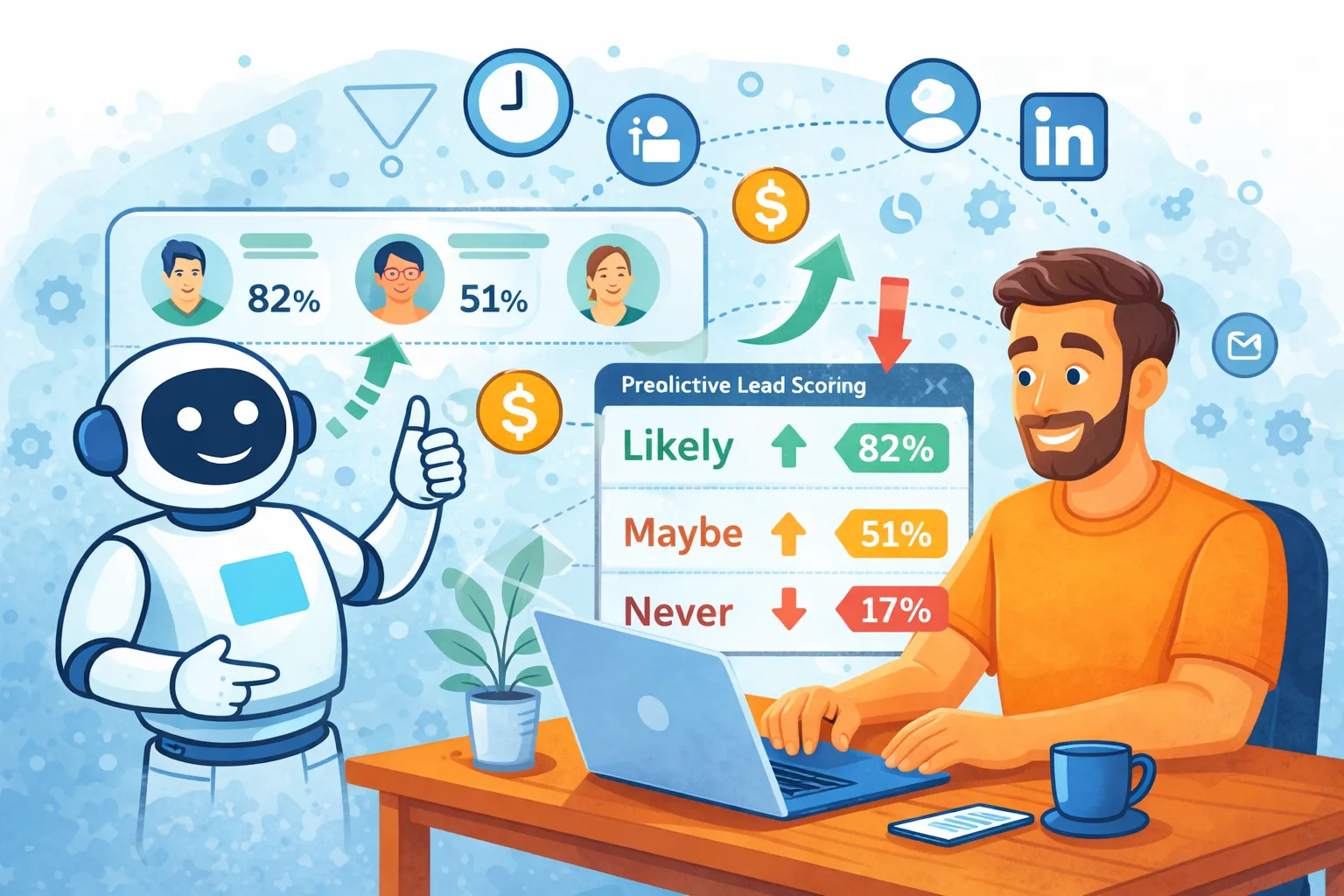
Predictive lead scoring for solo founders is simple: likely / maybe / never.
That's it. Three buckets.
Likely: This person is probably going to buy. Respond immediately, schedule a call, whatever it takes.
Maybe: Not enough signals yet. Auto-reply or check back in a week.
Never: Clear time-waster. Archive and move on.
You're not building a scoring model with 47 variables. You're making a quick judgment call based on early signals—and AI helps you make it faster and more accurately than your gut.
This works with:
DMs on LinkedIn and X
Emails from your website contact form
Replies to cold outreach
Comments and mentions
No CRM required. No weeks of data. Just early signals that predict who's actually going to close.
Early Signals That Actually Predict a Close
Most founders look at the wrong signals. Follower count, job title at a big company, enthusiastic language—none of that predicts whether someone will buy.
Here's what does:
Problem clarity: Vague interest ("this looks cool") scores low. Specific problem description ("we're currently using X and it's not handling Y") scores high.
Urgency language: "Looking to implement this quarter" or "need to solve this by end of month" = high intent. "Might be interested down the road" = low intent.
Timeline mentions: Any reference to a specific date, deadline, or event. "We're launching in March and need this ready" is predictive. "Let me know when you have time to chat" is not.
Budget hints: They don't need to ask for pricing directly. But phrases like "what's the investment look like" or "we have budget allocated for Q2" are strong signals.
Reply speed: Someone who responds in 10 minutes cares more than someone who takes 3 days. Fast follow-ups predict closes.
Follow-up quality: Do they ask detailed questions or give one-word replies? Detailed = likely buyer. One-word = time-waster.
Compare these two messages:
"Hey, saw your product. Looks interesting. Let's chat sometime."
vs.
"We're a 15-person team currently using Airtable to manage our lead flow. It's breaking at ~200 leads/month. Need something that can handle 500+ and integrate with HubSpot. What does implementation look like?"
The first one scores 1/10. The second scores 9/10. AI can tell the difference automatically.
How to Use Free AI to Score Leads Automatically
You don't need paid software. You need one prompt and 30 seconds per lead.
Here's the system:
Take the raw message (DM, email, form submission) and paste it into Claude or ChatGPT with this prompt:
"Score this lead on a scale of 1-10 based on buying intent. Consider: problem specificity, timeline urgency, budget signals, and quality of engagement. Respond with just the score and 1-2 sentence reasoning."
That's it. The AI reads the message, looks for the signals that predict a close, and gives you a score.
Example:
Input: "Hey! Love what you're building. Would be great to connect and see if there's a fit."
Output: "Score: 2/10. Generic interest with no problem specificity, no timeline, no budget signals. Likely a networking request, not a buyer."
Input: "We're currently evaluating tools for our lead qualification process. Need something that handles 300+ leads/month, integrates with Salesforce, and can be implemented within 6 weeks. Budget approved for Q1. Can we schedule a demo?"
Output: "Score: 9/10. Clear problem, specific requirements, timeline urgency, budget confirmation, and direct ask for next step. High buying intent."
Why AI beats your gut:
When you're tired, stressed, or overwhelmed, you make bad calls. You waste time on leads that sound promising but aren't. Or you dismiss leads that are actually serious.
AI doesn't get tired. It looks at the same signals every time and scores consistently.
You still make the final decision. But AI gives you the data to make it faster.
Scoring Cold DMs and Social Messages
Most DMs and social messages are noise. Predictive scoring helps you find the signal.
On LinkedIn:
People reach out for three reasons: they want to sell you something, they want free advice, or they want to buy. Only the third one matters.
Scoring LinkedIn DMs:
Score 7-10: Mentions their current solution, asks about pricing/implementation, references a timeline, or shows they've researched your product.
Score 4-6: Asks vague questions about what you do, but shows some level of problem awareness. "How does your tool handle X?" without context.
Score 1-3: Generic networking, "let's connect," or compliments with no follow-up ask.
On X (Twitter):
X DMs are usually lower intent than LinkedIn. But replies to your tweets can be high intent if someone's been engaging with your content consistently.
Scoring X DMs:
High score: They've liked/commented on 3+ recent tweets, then DM with a specific question. They're warm.
Medium score: First-time DM with a specific question about your product.
Low score: Generic pitch, random connection request, or vague "interested in what you're doing."
When to skip the AI and just archive:
If it's clearly spam or recruitment, don't even bother scoring. Set up filters for common patterns:
"I came across your profile and..."
"We help companies like yours..."
"Looking for [job title] opportunities..."
"Would love to explore partnership..."
Auto-archive these. They'll never score above 2 anyway.
Scoring Email and Contact Form Submissions
Email scoring is different than DM scoring. People who fill out your contact form are warmer than cold LinkedIn messages. But not all form submissions are equal.
High-intent email signals:
Used their work email (not Gmail/Yahoo)
Filled out optional fields (company size, timeline, budget)
Wrote a detailed message instead of "I'm interested"
Mentioned they tried your demo or read your docs
Low-intent email signals:
Personal email address
One-sentence message with no detail
Student or researcher identifying themselves
"Just exploring options" language
Scoring contact forms:
Feed the entire form submission into AI. Include all fields: email, company, message, anything they filled out.
Prompt: "Score this contact form lead 1-10 based on buying intent. Look for: work email vs personal, specificity of the problem, timeline urgency, and whether they've engaged with the product."
Example low-intent form:
Name: John Smith
Email: johnsmith123@gmail.com
Message: "Interested in learning more about your product."
Score: 3/10. Personal email, zero specificity, no indication of timeline or budget.
Example high-intent form:
Name: Sarah Chen
Email: sarah.chen@techstartup.com
Company: TechStartup Inc
Message: "We're currently using Zapier for lead routing but need something more robust. Handling 400+ leads/month, need better filtering and Slack integration. Looking to implement in next 30 days."
Score: 9/10. Work email, clear problem, volume indication, specific requirements, timeline urgency.
Workflow:
Contact form submission comes in
Copy all fields
Paste into AI with scoring prompt
AI returns score
Score 7+: Reply immediately
Score 4-6: Add to weekly review
Score 1-3: Auto-reply with resources, don't follow up
Takes 30 seconds. Saves hours.
The Zero-Setup Solo Founder Workflow
You don't need a system. You need a habit.
Here's the entire workflow:
Every morning (10 minutes):
Check inbox/DMs
Copy/paste new messages into AI
Score each one
Reply to 7+ scores immediately
Archive 1-3 scores
Ignore 4-6 scores for now
Every Friday (15 minutes):
Review 4-6 scores from the week
Most will now be clear no's (no reply, no follow-up)
Occasionally one will have followed up and moved to 7+
Reply to those, archive the rest
That's it.
No CRM. No pipeline management. No syncing data. No dashboards.
Just a simple decision: engage now, review later, or never.
The prompt lives in a note on your phone or desktop. When a lead comes in, you paste it, get the score, act accordingly. Total time: 30 seconds per lead.
This works when you're busy. It works when you're traveling. It works when you're deep in product work and don't want to context switch.
The system survives real life.
Common Mistakes Solo Founders Make
Over-engineering too early:
You don't need a scoring model with 23 variables. You need likely/maybe/never. That's it.
Don't build a spreadsheet to track scores. Don't set up automations. Don't create a Notion database. Just score, decide, act.
Over-engineering becomes another thing to maintain. Which becomes another distraction from building and selling.
Treating scores as truth instead of guidance:
AI scores aren't gospel. They're guidance.
If a lead scores 4 but your gut says they're serious, reply anyway. If a lead scores 8 but you realize they're not your ICP, skip it.
The score helps you make faster decisions. It doesn't make decisions for you.
Re-scoring too late:
Don't wait until after the first call to re-score. Do it after the first reply.
Someone scores 5 on initial contact. They reply with detailed questions and a timeline. That's now an 8. Reply immediately.
The score should update as the conversation evolves. Not just at the beginning.
Letting tools become a distraction:
If you spend more time setting up your scoring system than actually talking to buyers, you've lost the plot.
The goal is less time managing leads, more time closing them. If the system doesn't save you time, abandon it.
What Success Actually Looks Like
You're not trying to score more leads. You're trying to talk to fewer, better ones.
Success metrics for solo founders:
Inbox time drops from 2 hours/week to 20 minutes/week. You're not reading everything. AI reads for you.
First-call-to-close rate improves. Because you're only talking to people who are likely to buy.
Faster "no" decisions. You archive low-scoring leads immediately instead of keeping them in limbo for weeks.
More confidence in where to spend time. No more second-guessing whether someone is serious or not.
Clearer pipeline. You know exactly who's likely to close this month vs who's just exploring.
The biggest win is psychological. When you trust the scoring system, you stop feeling guilty about not replying to everyone. You know you're focusing on the right people.
The Real Goal: More Energy for Customers Who Already Paid
Lead scoring isn't about leads. It's about protecting your time for what actually matters.
You're a solo founder. You can't hire a sales team. You can't build a CRM pipeline. You can't spend all day qualifying leads.
What you can do: use free AI to predict who's likely to close in 30 seconds. Then only engage with those people.
Everyone else gets an auto-reply or gets ignored. And that's fine. Because you're not running a networking club. You're building a business.
The leads who score high get your attention. The rest don't. Simple as that.
Start tomorrow: Take your last 10 inbound messages. Score them with AI. See which ones you wasted time on that were never going to close anyway. You'll immediately see the pattern.
Then use it going forward. Every new message gets scored before you reply.
That's it.




Comments (0)
Leave a Comment