


You're getting 47 LinkedIn DMs this week. Maybe 3 are worth responding to. The rest? Recruiters who didn't read your profile, agencies selling you services, and people who want to "pick your brain" over coffee.
You don't have time to read them all. You also can't afford to miss the one person who actually wants to buy.
Here's how to use AI to filter the noise and only respond to people with real buying intent.
The Real Cost of Reading Every DM
Time isn't your bottleneck as a solo founder. Context switching is.
Every DM you open pulls you out of building, selling, or shipping. Even if it takes 30 seconds to read and dismiss, you've already broken your focus. Now you're thinking about that recruiter's pitch instead of your customer call in 20 minutes.
Here's what reading every message actually costs:
3-5 hours per week scanning DMs across LinkedIn and X 20+ context switches per day from real work to inbox management
Zero additional revenue from polite replies to tire-kickers
The opportunity cost is simple: every minute spent on curiosity conversations is a minute not spent on buyer conversations.
Your goal isn't inbox zero. Your goal is to talk only to people who might actually buy.
What "Buying Intent" Looks Like in a DM
Most founders confuse interest with intent. Interest is someone saying your product looks cool. Intent is someone asking about pricing, implementation, or when they can start.
Here are the signals that actually matter:
Timeline language – "We're looking to implement this quarter" or "Need something live by March"
Budget mentions – Any reference to budget, pricing, or approval process
Problem specificity – Detailed description of the exact problem they're trying to solve
Decision-maker language – "I need to show this to my team" or "I handle procurement for this"
Compare these two DMs:
"Hey, love what you're building! Would be great to connect and learn more."
vs.
"We're currently evaluating tools to automate our lead qualification. Need something that integrates with HubSpot and can handle 500+ leads/month. What does pricing look like?"
The first one wants your time. The second one wants to buy.
Ignore vanity signals. Follower count doesn't matter. Job title at a recognizable company doesn't matter. Compliments about your content don't matter. The only thing that matters is whether they're showing signs of actual buying intent.
How AI Reads Intent (Not Just Keywords)
AI doesn't just scan for words like "pricing" or "demo." It reads the entire message and scores intent based on context.
Here's what modern AI can detect:
Urgency indicators – Phrases like "currently evaluating," "need by," "looking to switch"
Qualification clues – Mentions of budget, team size, existing tools, decision-making process
Specificity – Generic questions score low, detailed problem descriptions score high
Follow-up behavior – Someone who responds quickly and asks clarifying questions scores higher
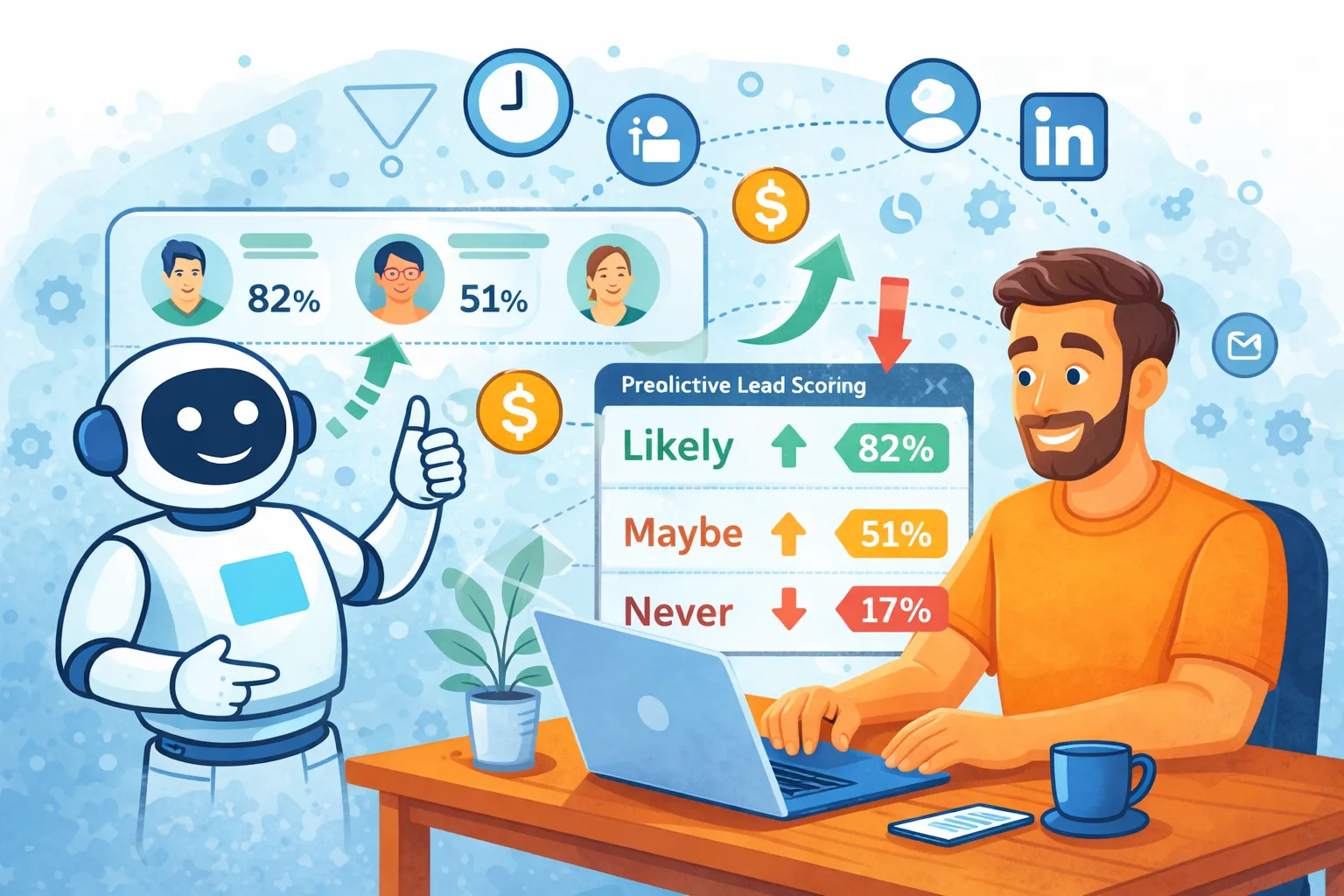
Instead of reading 47 messages manually, you let AI score them. Messages over a certain threshold get flagged for immediate response. Everything else gets auto-archived or sent a templated reply.
You can set up scoring rules like this:
Message mentions budget or pricing: +3 points
Includes specific problem description: +2 points
References timeline or urgency: +2 points
Asks about implementation or integrations: +2 points
Generic "let's connect" message: 0 points
Mentions "pick your brain" or "coffee chat": -1 points
Score 5+: Reply immediately
Score 2-4: Review later
Score 0-1: Auto-archive
This isn't about being rude. It's about respecting your own time and only engaging where there's mutual value.
Spam Patterns Solo Founders See (And How to Filter Them)
You know spam when you see it. AI can spot it before you waste a second.
Recruiter messages – "I came across your profile and think you'd be a great fit for..."
Agency pitches – "We help companies like yours with [generic service]..."
Partnership requests – "I'd love to explore ways we can collaborate..."
Pick your brain – "Would love to grab coffee and learn about your journey..."
Follow-for-follow – "Just wanted to connect with fellow entrepreneurs..."
Set up AI rules to auto-archive these patterns. No manual review needed. Your inbox stays clean, and you never see them.
The psychological benefit is real. When you open your inbox and see 5 messages instead of 47, you actually respond. When you see 47, you avoid the whole thing.
Filtering X (Twitter) DMs
X DMs have different signals than LinkedIn. The platform moves faster, messages are shorter, and buying intent shows up differently.
What works on X:
Look for replies to your tweets, not just cold DMs. Someone who's been engaging with your content for weeks, then DMs you? That's warm. Random person sliding in with "hey let's chat"? That's cold.
AI can track engagement history. If someone liked your last 3 tweets and commented twice before DMing, they're showing genuine interest. If they've never interacted with you before and their first message is generic, they're mass-messaging.
X-specific intent signals:
Referenced something specific from your recent tweets
Engaged with your content before messaging
Mentioned a problem you tweeted about solving
Asked a specific question (not "can we chat?")
When to move off-platform:
X DMs are for quick triage. If someone shows real intent, move the conversation to email or a calendar link. Don't try to close deals in Twitter DMs.
AI can auto-reply with: "Thanks for reaching out. Best way to continue this conversation is via email: [your email]. What's your timeline for solving this?"
If they email, they're serious. If they don't, they weren't.
Filtering LinkedIn DMs
LinkedIn is where the real buying conversations happen for B2B founders. It's also where you get the most spam.
Buyer intent vs job-seeker intent:
AI can tell the difference. Buyers talk about problems, budgets, and timelines. Job seekers talk about their skills and availability. One gets a reply, one gets archived.
Agency and SDR spam:
Most LinkedIn spam comes from agencies selling you marketing services or SDRs doing cold outreach for their company. The pattern is always the same:
"Hi [First Name], I noticed you're building [generic description of your company]. We help companies like yours with [service you didn't ask for]. Would you be open to a quick call?"
Auto-archive anything matching this pattern. You'll never miss a real lead.
Profile + message analysis:
Good AI reads both the message AND the sender's profile. Someone with "Founder at [Company]" in their title asking about your product? Flag it. Someone with "Business Development at [Agency]" asking to chat? Archive it.
Prioritize decision-makers:
Founders, VPs, Directors, Heads of [Department]. These are the people who can actually buy. Filter your inbox to show these first.
Your Inbox Protection System
Here's the system that actually works:
One inbox rule: AI reads everything first
Nothing hits your inbox without going through AI scoring. You never manually scan a list of 47 messages wondering which ones matter.
Daily review flow (10 minutes, not 2 hours):
Open inbox
See 5-8 flagged high-intent messages
Respond to those
Ignore everything else
What gets auto-replied:
Low-intent but polite messages get a template: "Thanks for reaching out. I'm currently focused on [current priority]. If you have a specific question about [your product/service], feel free to email [email address]."
This keeps you from looking like a jerk while still protecting your time.
What gets flagged:
Anything with real buying signals. These go to the top of your inbox with a notification.
What gets archived:
Spam, recruiters, agencies, generic networking requests, anything score 0 or below.
Simple Solo Founder Workflow (No CRM Required)
You don't need a complex system. You need one tool and one decision rule.
The tool:
Use AI (Claude, ChatGPT with API access, or purpose-built inbox AI) to score messages. Most of these can connect to LinkedIn and X.
The decision rule:
Score 5+: Reply now
Score 2-4: Review on Friday
Score 0-1: Auto-archive
That's it. No CRM. No pipeline management. No lead stages. Just a filter that separates buyers from noise.
Weekly cleanup:
Every Friday, spend 10 minutes reviewing the "score 2-4" bucket. Most of them will still be non-buyers, but occasionally you'll find someone who was real but just poorly worded their initial message.
Focus stays on building and selling. Not managing an inbox.
Mistakes Solo Founders Make
Over-replying to be "nice":
You don't owe strangers your time. A polite auto-reply is fine. Spending 5 minutes crafting a personal response to someone who's never going to buy is a waste.
Chasing conversations instead of outcomes:
You replied, they replied, now you're three messages deep and still no buying signal. End it. "Let me know when you're ready to move forward" then move on.
Treating all inbound as equal:
All inbound is not equal. A founder at a funded startup asking about pricing is worth 100x more than a student wanting career advice.
Doing manually what AI should handle:
If you're still reading every single message to determine if it's worth responding to, you're wasting 10+ hours per month.
What Success Actually Looks Like
You're not trying to respond to more messages. You're trying to respond to fewer, better ones.
Success metrics:
Inbox time drops from 2 hours/week to 20 minutes/week
Response rate to high-intent leads increases (because you're not overwhelmed)
Close rate improves (because you're only talking to qualified buyers)
Zero inbox anxiety (because you trust the filter)
The goal is more energy for your actual work. More time building your product. More focus on the customers who already paid. Less time wondering if you missed something important in that pile of 47 DMs.
You won't miss the real buyers. The AI will catch them. What you'll miss is all the noise that was never going to convert anyway.
Start tomorrow: Pick one platform (LinkedIn or X). Set up AI filtering. Let it run for a week. You'll see exactly which messages were worth your time and which ones you can ignore forever.
That's it.



Comments (0)
Leave a Comment