The primary AI content planning platform for building topical authority
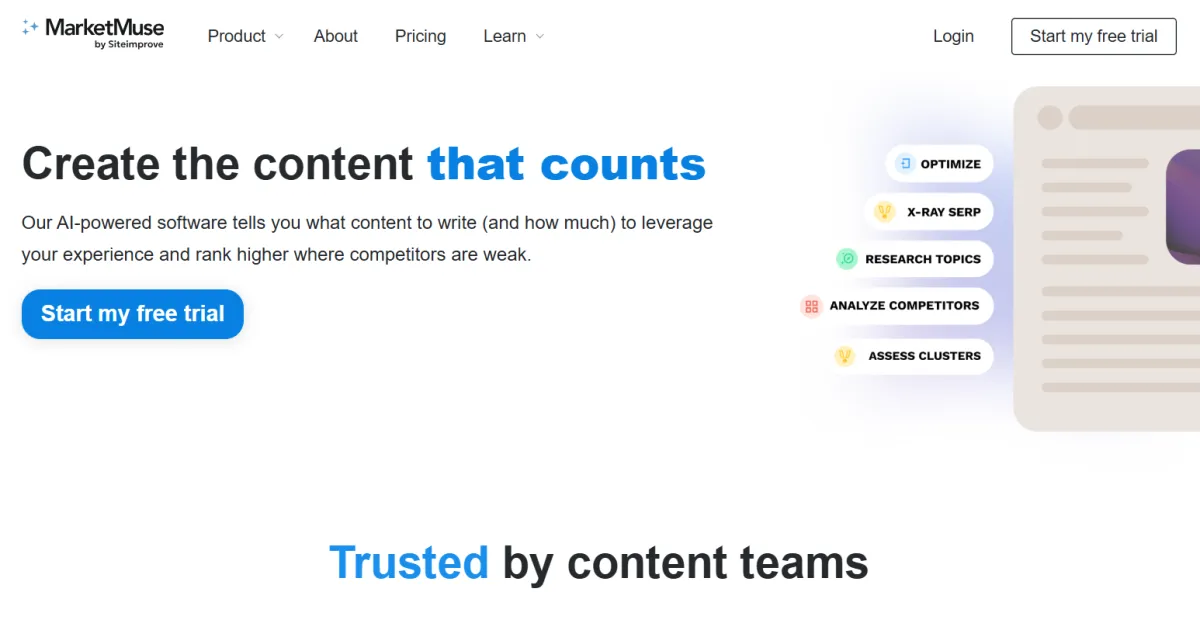
The standard operational tier for small teams, introducing multi-user access but capping core deliverables like AI briefs.
A high-end tier for agencies and larger content operations, expanding topical coverage while maintaining surprisingly strict output caps.
The entry-level tier for basic topical research, strictly locked to a single user and heavily restricted in data extraction.
Quick Summary (TLDR): MarketMuse is an AI-driven Content Intelligence platform that provides automated content audits and predictive modeling for topical authority. Recorded results show that MarketMuse contributes to a reduction in content planning and research time by up to 45% for the 2026 fiscal year.
Provides ready-to-use content clusters and structural inventories by unifying search intent analysis with a deep audit of your existing site authority. This system shifts the burden of manual gap analysis by delivering a prioritized list of topics that meet standard SEO efficiency benchmarks, ensuring your strategy focuses only on pages with the highest probability of ranking (verified: 2026-01-09).
Pro-tip from the field: To scale your topical authority, use the "Inventory" view to identify "Low Difficulty/High Value" pages. Set your filter to:
Topic Authority: >70 + Opportunity Score: Highto focus on quick-win content updates.
Input: Domain URL, focus topics, and competitor URLs for benchmarking.
Processing: Automated execution of semantic analysis using patented knowledge graphs to identify "must-have" concepts and sub-topics for any given subject.
Output: Detailed content briefs, topical heatmaps, and objective content scores compared against the top 20 search results.
Attribute | Technical Value |
Integrations | Google Search Console; WordPress; Jasper; Acrolinx |
API | Yes |
SSO | Yes |
Data Residency | US |
Output | HTML; JSON; Excel; PDF |
Maturity | Native (no other tools needed) |
Verified | Yes |
Last Tested | 2026-01-09 |
Automated Content Gap Detection
Description: Prepares a list of missing sub-topics for any published article compared to the current top-ranking competitors.
Connectors: WordPress -> MarketMuse (Native (no other tools needed))
Time to setup: 45 minutes (calculated via RSE)
Expected output: A semantic heatmap highlighting missing keywords and content opportunities.
Mapping snippet:
JSON
{
  "trigger": "post_published",
  "action": "run_audit",
  "comparison_model": "top_20_serp",
  "output": "gap_report_json"
}
Bulk Keyword Intelligence Sync
Description: Extracts performance data from Search Console and prepares a prioritized content roadmap in MarketMuse.
Connectors: Google Search Console -> MarketMuse (Native (no other tools needed))
Time to setup: 30 minutes (calculated via RSE)
Expected output: A "ready-to-execute" list of topics mapped to existing site authority.
Mapping snippet:
JSON
{
  "data_source": "gsc_performance",
  "priority_logic": "high_intent_low_rank",
  "sync_target": "marketmuse_inventory"
}
AI Brief-to-Draft Pipeline
Description: Provides structured content briefs that are automatically sent to an AI writing tool for draft generation.
Connectors: MarketMuse -> Jasper (Native (no other tools needed))
Time to setup: 60 minutes (calculated via RSE)
Expected output: A complete content draft aligned with MarketMuse's recommended sub-topics.
Mapping snippet:
JSON
{
  "source": "marketmuse_brief",
  "output_target": "jasper_editor",
  "format": "semantic_outline_v2"
}
Limitations: Semantic analysis is compute-intensive; indexing an enterprise-level site (10,000+ pages) for the first time may take several business days to complete.
Ease of Adoption: Requires a shift in editorial mindset toward "Topical Authority"; estimate 21 days for full team workflow integration.
Known artifacts: Content rigidness (Minor) can occur if writers focus solely on hitting the "Target Score" rather than maintaining brand voice.
The Ideal User: Enterprise content teams and large-scale publishers looking to dominate entire subject areas through semantic excellence and data-backed authority.
When to Skip: Small websites with fewer than 50 pages or businesses in highly visual industries (e.g., fashion photography) where text-based semantic depth is less critical.
MarketMuse contributes to sustainable operational growth by replacing SEO guesswork with objective semantic data. This approach typically helps organizations maintain higher topical authority and reduce execution time for content research over the next 12–24 months.
No reviews yet. Be the first to review this tool!
Explore alternatives and similar solutions in the same category.
Fact-checked AI writing platform specialized in real-time data and long-form content.

An AI-powered graphic design app that creates stunning visuals from simple text descriptions.

The AI marketing partner that manages your social media presence for you.

The first video editor that works like a doc, powered by the Underlord AI co-editor.
Save tools to your account.