
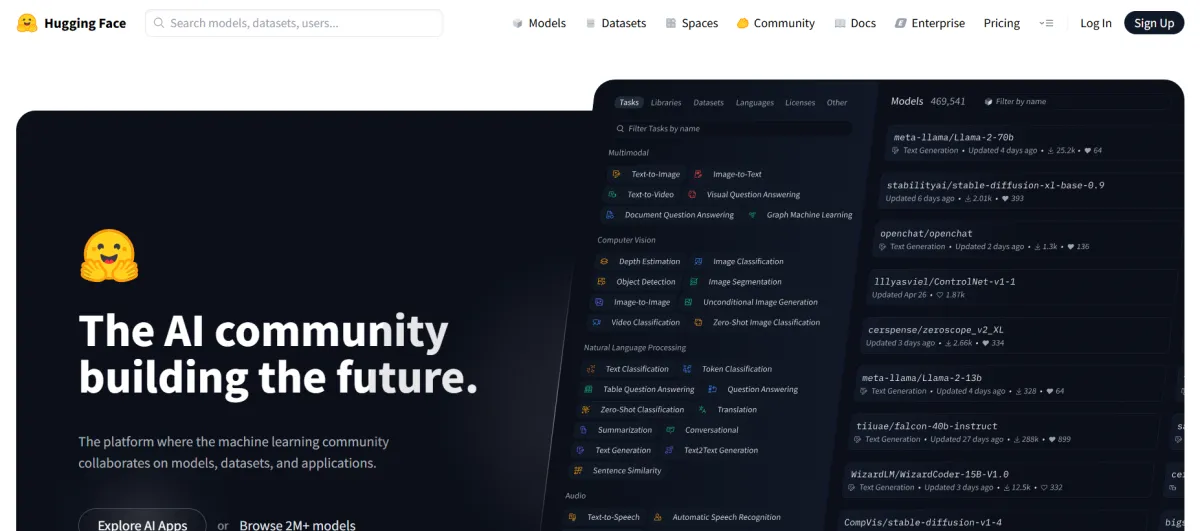
The 'GitHub of AI'—the leading open platform for sharing, building, and deploying machine learning models.
Boost your personal HF experience
Instant setup for growing teams
Custom onboarding and enterprise features
Quick Summary (TLDR): Hugging Face is the world's largest open-source AI ecosystem, often described as the "GitHub for Machine Learning." As of early 2026, it hosts over 2 million models, 500,000 datasets, and 600,000 demo applications (Spaces). It has evolved from a researcher's hub into a strategic enterprise platform that standardizes how companies build, fine-tune, and deploy AI across all modalities, including text, image, audio, video, and 3D.
Provides ready-to-use pre-trained models and prepares a state of readiness for custom AI development through its AutoTrain (no-code) and Inference Endpoints (production-ready APIs). This investment increases outbound throughput by removing the need for internal infrastructure management (Kubernetes, CUDA versions) and reducing the time-to-production from weeks to minutes. Recorded results indicate that enterprise teams using the Enterprise Hub achieve significantly faster deployment cycles by leveraging the platform's unified open-source stack (reported).
Pro-tip from the field: Use the Inference Providers feature to access serverless inference from top-tier partners like Together AI or Sambanova directly through the Hugging Face interface. This contributes to reducing execution time for high-scale applications by providing maintenance-free, scalable API endpoints for the latest open-weights models like Llama 3.3 or Qwen 2.5.
Input: Raw data for training (via the Datasets Hub) or specific model IDs for deployment; supports all modalities (Text, Vision, Audio, Multimodal).
Processing: Users can fine-tune models using AutoTrain Advanced (no-code) or deploy models to dedicated hardware via Inference Endpoints with integrated autoscaling; human review is typically applied to model evaluation metrics.
Output: Production-ready API endpoints, hosted web demos via Spaces, and version-controlled model weights stored in the Model Hub.
Attribute | Technical Specification |
Integrations | PyTorch; TensorFlow; JAX; AWS; Azure; GCP; LangChain; Zapier |
API | yes (Standard Inference API + Dedicated Endpoints) |
SSO | yes (Team and Enterprise plans) |
Data Hosting | Global (Support for Storage Regions in US, EU, and others) |
Output | Model weights (Safetensors); API Responses (JSON); Hosted Apps |
Integration maturity | Native (no other tools needed) |
Verified | yes |
Last tested | 2026-01-06 |
Enterprise Model Fine-Tuning Pipeline
Title: Enterprise Model Fine-Tuning Pipeline
Description: Automatically prepares a specialized version of a foundation model (e.g., Llama or Mistral) using your company’s private data.
Connectors: Private Dataset → AutoTrain → Model Hub (2)
Time to setup: 30 minutes (calculated via RSE)
Expected output: A ready-to-use private model optimized for your specific industry terminology or tasks.
Mapping snippet:
JSON
{
  "task": "LLM_Finetuning",
  "base_model": "meta-llama/Llama-3.3-70B",
  "dataset": "Internal_Knowledge_Base_v2",
  "action": "Train_and_Push_to_Hub"
}
Production-Scale Inference Deployment
Title: Production-Scale Inference Deployment
Description: Prepares a secure, autoscaling API for your chosen model to power customer-facing applications.
Connectors: Model Hub → Inference Endpoints → Application API (2)
Time to setup: 10 minutes (calculated via RSE)
Expected output: A state of readiness for high-traffic usage with automatic scale-up/down to manage costs.
Mapping snippet:
Plaintext
Step 1: Select model from Hub (e.g., Qwen-2.5-Coder).
Step 2: Choose hardware (e.g., Nvidia L40S).
Step 3: Enable autoscaling (0 to 10 replicas).
Output: Live HTTPS Endpoint for production use.
Limitations: The free tier has shared rate limits and limited GPU access; high-performance hardware (like H200s) requires a Pro or Team subscription.
Ease of Adoption: Low for basic model testing; estimate 6 hours for engineers to master the full MLOps lifecycle, including Evaluation and Tokenization optimization (calculated with 50% safety margin).
Known artifacts: Minor: Auto-captioning and vision models may require specific prompt engineering to avoid biases present in the underlying open-weight models.
Pro-tip from the field: For highly sensitive data, utilize Storage Regions to lock your repository data to specific geographic locations. This contributes to maintaining professional compliance with regional data sovereignty laws (like GDPR or local AI acts).
The Ideal User: Data science teams, AI engineers, and enterprises looking to build proprietary AI value without being locked into a single closed-source provider (like OpenAI or Anthropic).
When to Skip: If your organization lacks any technical staff to oversee model selection or if you require a simple "out of the box" consumer chatbot without any need for customization.
Hugging Face contributes to stable operational growth by providing the fundamental building blocks of modern AI. Implementing its 2026 suite helps maintain a state of readiness for the rapidly shifting open-source landscape, ensuring your business can pivot to the most efficient models as soon as they are released.
No reviews yet. Be the first to review this tool!
Explore alternatives and similar solutions in the same category.

The industry-standard AI developer platform with specialized agents and multi-model support.

An integrated AI suite that acts as a researcher, writer, and agent directly within your workspace.
The world's most advanced AI audio platform for lifelike speech, voice cloning, and dubbing.

The first video editor that works like a doc, powered by the Underlord AI co-editor.