

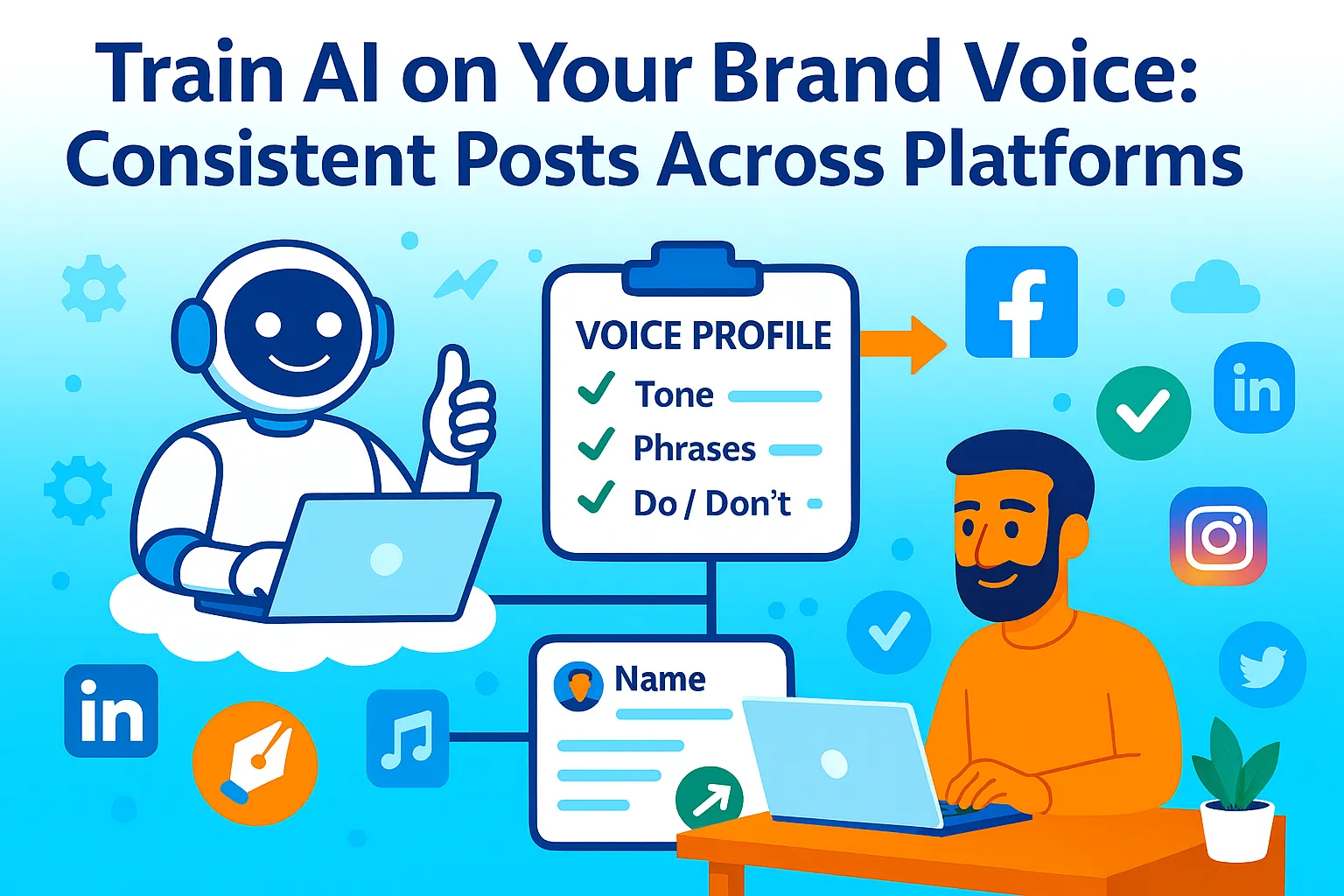
You're posting on LinkedIn and sound like a corporate VP. You tweet and sound like a motivational poster. Instagram captions feel like someone else wrote them.
Because they did. Every time you use generic AI prompts, you get generic AI voice. Professional but soulless. Engaging but not you.
Here's what actually works: teaching AI to write the way you write. Not some random "professional" tone. Not "casual but authoritative" with no context. Your actual voice — the way you'd explain something to a founder friend over coffee.
The problem? Most people think training AI on your voice requires uploading 100 blog posts or spending $200/month on specialized tools. It doesn't. You need 10 representative posts, 30 minutes to create a voice profile, and prompts that know when to be punchy (Twitter) and when to go deep (LinkedIn).
This guide shows you how to train AI to sound like you across every platform, generate 30 days of consistent content in 2 hours, A/B test variations to find what resonates, and refine based on performance data. All without sounding like you hired a generic marketing agency.
Why Generic AI Content Kills Your Brand
Before we get into the training system, let's talk about why AI-generated content usually sounds terrible.
The problem with default AI:
It's trained to sound "professional"
Which means corporate, bland, forgettable
No personality, no edge, no memorable phrases
Could be written by anyone in your industry
It optimizes for safety
Won't take controversial positions
Won't challenge conventional thinking
Won't use the direct, founder-to-founder tone that actually converts
It lacks context
Doesn't know your audience's pain points
Doesn't know your product's unique angle
Doesn't know which frameworks work for your niche
The result? Content that's grammatically correct but completely forgettable. Posts that get scrolled past. Tweets that disappear without engagement.
What changes everything: Training AI on how you actually write. Not how marketing blogs say you "should" write. How you actually sound when you're explaining something that matters.
The 10-Post Voice Training System
Here's how to teach AI to write in your voice using just 10 examples.
Step 1: Collect Your Best 10 Posts (20 minutes)
Don't just grab random content. Pick posts that represent your voice at its best.
What to collect:
3 posts that got high engagement
These show what resonates with your audience
They're you at your most authentic
They balance personality with value
3 posts that explain complex topics simply
Shows your teaching style
Demonstrates how you break down ideas
Reveals your unique frameworks or analogies
2 posts where you took a contrarian position
Shows your point of view
Demonstrates your willingness to challenge
Reveals your edge
2 posts that tell personal stories or share lessons
Shows your storytelling voice
Demonstrates vulnerability (if that's your style)
Reveals how you connect experiences to insights
Where to find them:
Twitter: Top tweets from your analytics
LinkedIn: Posts with 100+ reactions or 20+ comments
Blog: Articles you're most proud of (even if traffic was low)
Pro tip: Don't pick posts that performed well because of external factors (you tagged someone big, rode a trend, etc.). Pick posts that performed because of how you wrote them.
Step 2: Create Your Voice Profile (30 minutes)
Now you're teaching AI the patterns, tone, and structure that make your writing yours.
AI Voice Training Prompt:
I want you to analyze my writing style and create a detailed voice profile.

Here are 10 examples of my writing:

[Paste all 10 posts, separated by ---]

Based on these examples, create a voice profile that captures:

1. Tone & Personality
   - How formal or casual am I?
   - Do I use humor? Sarcasm? Direct statements?
   - What's my default attitude (skeptical, optimistic, pragmatic)?

2. Sentence Structure
   - Do I use short sentences? Long ones? A mix?
   - Do I start sentences with "And" or "But"?
   - Do I use questions to engage readers?

3. Word Choice
   - Which words or phrases do I use repeatedly?
   - Do I avoid jargon or embrace it?
   - Do I use contractions (you're vs you are)?

4. Framework Patterns
   - How do I structure arguments (Problem-Solution, Before-After, Data-Insight)?
   - Do I use numbered lists? Bullet points? Paragraphs?
   - How do I open posts (question, bold claim, story)?

5. Unique Markers
   - What makes my writing distinctly "me"?
   - Are there phrases only I would use?
   - What topics or angles do I consistently return to?

Output this as a comprehensive "Voice Profile" document I can reference when creating content.
What you're getting: A detailed breakdown of your writing DNA. This becomes your AI style guide.
Example Output:
VOICE PROFILE FOR [YOUR NAME]

Tone & Personality:
- Direct, no-fluff approach
- Casual but not unprofessional
- Skeptical of conventional wisdom
- Uses humor sparingly (dry, not cheesy)
- Default attitude: pragmatic realist

Sentence Structure:
- Mix of short (impact) and medium (explanation) sentences
- Frequently starts with "Here's the thing:", "Look:", "The reality is:"
- Uses rhetorical questions to transition ("Why does this matter?")
- One-sentence paragraphs for emphasis

Word Choice:
- "Solo founders" not "entrepreneurs"
- "Works" not "is effective"
- "You" not "one" or "people"
- Avoids: "leverage," "synergy," "best practices"
- Contractions: always ("you're" not "you are")

Framework Patterns:
- Opens with pain/problem (2-3 sentences)
- Provides context (why it matters)
- Shares solution (step-by-step or principles)
- Ends with "do this tomorrow" action
- Rarely uses bullet points in main text (only for lists)

Unique Markers:
- "That's it." to end posts
- Admits limitations ("This works until X, then you need Y")
- Includes specific numbers and costs
- Never says "Let me know in comments"
Save this profile. You'll reference it every time you generate content.
Step 3: Generate Platform-Specific Content (30 minutes)
Your voice stays the same. But each platform has different formats and audience expectations.
AI Platform Adaptation Prompt:
Using my voice profile below, create content for [Platform].

VOICE PROFILE:
[Paste your voice profile from Step 2]

CONTENT TOPIC: [Your topic]

PLATFORM: Twitter / LinkedIn / Instagram

Platform-specific requirements:

FOR TWITTER:
- 280 characters max
- Punchy, one idea per tweet
- No fluff, immediate value
- Use line breaks for readability
- End with insight, not question

FOR LINKEDIN:
- 1,200-1,500 characters
- Story or data-driven opening
- 3-5 paragraphs with line breaks
- Professional but conversational
- Can go deeper than Twitter

FOR INSTAGRAM:
- 150-200 word caption
- Visual-first (mention what the carousel/image shows)
- Casual, relatable tone
- 3-5 line breaks
- Can use emojis if it matches my voice

Generate 3 variations for [Platform] on this topic, all in my voice.
Example Output (Twitter):
Version A: You're burning $500/month on ads.
Your landing page converts at 2%.
That means 98 visitors look at your offer and leave.
The problem isn't your traffic. It's your headline.
AI can test 10 headline variations in 10 minutes. Find the one that actually converts.
Version B: Most landing pages fail because they're written by designers.
Beautiful layout. Terrible copy.
Visitors don't care how pretty it is. They care if you solve their problem.
AI-written headlines + benefit bullets = 15% conversion. No designer required.
Version C: You don't need a $2,000 copywriter.
You need proven frameworks + AI that knows your voice.
Problem-Agitation-Solution headlines convert 3x better than "clever" ones.
Train AI on 10 posts. Generate 30 days of landing page copy. Deploy.
Pick the version that feels most "you." Or post all 3 across different weeks.
Step 4: Generate a 30-Day Content Calendar (1 hour)
Now that AI knows your voice and platform requirements, batch-generate a month of content.
AI 30-Day Calendar Prompt:
Using my voice profile, create a 30-day content calendar for [Platform].

VOICE PROFILE:
[Paste your voice profile]

PLATFORM: [Twitter / LinkedIn / Instagram]

TOPICS TO COVER:
1. [Topic 1]
2. [Topic 2]
3. [Topic 3]
4. [Topic 4]
5. [Topic 5]

For each day, create:
- Post copy in my voice
- Post type (Thread, Single post, Story, Carousel idea, etc.)
- Engagement goal (Insight, CTA, Question, Share-worthy)

Mix post types:
- 40% Educational (how-to, frameworks, insights)
- 30% Personal (lessons learned, behind-the-scenes)
- 20% Contrarian (challenge common advice)
- 10% Promotional (soft pitch for product/service)

Output as:
Day 1: [Post type] | [Post copy]
Day 2: [Post type] | [Post copy]
etc.
What you're getting: 30 posts written in your voice, formatted for your platform, balanced across content types.
Time saved: Writing 30 posts manually = 10+ hours. AI generates in 5 minutes. You edit in 60 minutes.
Step 5: A/B Test Voice Variations (Ongoing)
Your first voice profile won't be perfect. Test variations to find what resonates.
What to test:
Week 1-2: Tone variations
Post half your content with current voice
Post half with slightly more casual / slightly more formal voice
Track engagement rate
Week 3-4: Opening hook variations
Test question hooks vs bold statement hooks
See which gets more stops-scrolling
Month 2: Framework variations
Test Problem-Solution vs Story-Lesson posts
See which drives more profile clicks
Month 3: Length variations
Test short posts (100 words) vs long posts (300 words) on LinkedIn
See which gets more comments
Solo Founder Tracking:
Use Google Sheets (free):
Tab 1: Voice Variations Tested
Date | Platform | Voice Variation | Engagement Rate | Profile Clicks
Tab 2: Winning Patterns
Voice Element | Performance | Use More / Use Less
Update weekly: 10 minutes to log which posts performed best and why.
Refinement Prompt:
Based on this performance data, update my voice profile.

CURRENT VOICE PROFILE:
[Paste profile]

PERFORMANCE DATA:
- Posts with [Element A] got 3x more engagement
- Posts with [Element B] got 50% more profile clicks
- Posts with [Element C] had lower engagement

Update my voice profile to:
1. Emphasize elements that drove engagement
2. Reduce elements that underperformed
3. Maintain my core personality while optimizing for results

Output the revised voice profile.
Your voice evolves. Every 30 days, refine based on what's working.
Step 6: Maintain Consistency Across Platforms (15 minutes/week)
You're posting on Twitter, LinkedIn, and Instagram. Your voice should stay consistent even as format changes.
Cross-Platform Voice Check:
I posted this on Twitter:
[Paste tweet]

Adapt it for LinkedIn while maintaining my voice:

VOICE PROFILE:
[Paste profile]

LINKEDIN REQUIREMENTS:
- Expand from 280 chars to 1,200-1,500 chars
- Add context and storytelling
- Keep same core message and tone
- Professional but still "me"

Generate LinkedIn version.
Same idea. Different depth. Consistent voice.
Pro tip: Start with your best Twitter thread each week. Expand it into a LinkedIn post. Condense key points into an Instagram carousel. Same content, three platforms, all in your voice.
Tools You Actually Need (Budget Breakdown)
Free Tier (works for most solo founders):
ChatGPT free or Claude free (voice training, content generation)
Google Sheets (performance tracking)
Native analytics (Twitter Analytics, LinkedIn Analytics, Instagram Insights)
Total: $0/month
Upgrade Tier ($20-30/month when making revenue):
ChatGPT Plus ($20/month) for longer context windows and faster responses
Notion ($10/month) to store voice profile + content calendar
Total: $30/month
Pro Tier ($50-100/month when scaling):
ChatGPT Plus ($20/month)
Jasper AI ($49/month) with brand voice feature (if you're generating 100+ posts/month)
Blaze AI ($34/month) with brand voice generator
Total: $54-103/month
Don't buy until: You've posted 30 days using the free method and proven you won't quit after Week 2. Tools don't fix inconsistency.
Common Mistakes Solo Founders Make
1. Training AI on posts that don't represent your voice
Don't include guest posts, formal press releases, or content you hated writing. Only use posts where you sound most like yourself.
2. Never updating the voice profile
Your voice changes as your business evolves. Refresh your profile every 3 months based on what's working.
3. Using the same exact voice on every platform
Voice stays consistent. Tone and depth adapt. Twitter is punchy. LinkedIn is thoughtful. Instagram is visual.
4. Posting AI output without editing
AI gets you 80% there. The other 20% is adding specific examples, fixing awkward phrasing, and ensuring accuracy.
5. Not tracking what works
If you don't know which voice elements drive engagement, you're guessing. Track religiously for the first 90 days.
6. Trying to sound like someone else
Don't train AI on Gary Vee's posts if you're not Gary Vee. Train it on YOUR best work.
When You've Outgrown This System
You'll know it's time to upgrade when:
You're posting 5+ times per day across 4+ platforms and manual voice checking takes more than 30 minutes. At this point, invest in Jasper or Blaze with built-in brand voice.
You have a team and need consistent voice across multiple writers. Tools like Jasper's Brand Voice (team plan) or Copy.ai's Brand Voice let multiple people generate on-brand content.
You want voice cloning for video/audio. If you're doing podcasts or video content, tools like Descript or ElevenLabs can clone your actual speaking voice (not just writing style).
You're managing 5+ brands (agencies, multiple products). At this point, you need enterprise tools that manage multiple voice profiles.
But honestly? Most solo founders never hit this point. The free voice training system works until you're doing $100K+/year and hiring a content team.
Your Weekend Implementation Plan
Saturday Morning (1 hour):
☐ Collect your best 10 posts (Twitter, LinkedIn, blog)
☐ Run AI voice profile analysis
☐ Save voice profile document
Saturday Afternoon (1 hour):
☐ Generate 3 test posts for each platform using voice profile
☐ Review for accuracy (does it sound like you?)
☐ Adjust voice profile if needed
Sunday Morning (1.5 hours):
☐ Generate 30-day content calendar for primary platform
☐ Edit AI output (add examples, fix awkward phrasing)
☐ Schedule first week of posts
Sunday Afternoon (30 minutes):
☐ Create performance tracking sheet
☐ Set weekly reminder to review metrics
☐ Plan first A/B test (tone variation)
Week 2:
☐ Check which posts performed best
☐ Note which voice elements drove engagement
☐ Generate Week 3-4 content using updated insights
Month 2:
☐ Analyze 30 days of data
☐ Update voice profile based on winners
☐ Generate next 30-day calendar with refined voice
Advanced Tactics (When You've Mastered Basics)
1. Create Voice Variations for Different Goals
Don't use the same voice for everything. Create variations:
Educational Voice: More patient, step-by-step, avoids assumptions
Promotional Voice: More direct, benefit-focused, includes CTAs
Thought Leadership Voice: More contrarian, challenges norms, deeper insights
Train AI on 5 posts for each variation. Use strategically.
2. Train AI on Engagement Winners Only
Every 3 months, retrain AI using only your top 10% performing posts. This compounds what works and eliminates what doesn't.
3. Voice Adaptation for Specific Audiences
Create audience-specific voice profiles:
For technical users: More jargon, deeper dives, assumes knowledge
For beginners: Simpler language, more examples, step-by-step
For executives: More data-driven, ROI-focused, strategic
4. Use Voice Profile for Other Content Types
Your voice profile isn't just for social media. Use it for:
Email newsletters (same voice, longer format)
Landing page copy (same voice, conversion-focused)
Product descriptions (same voice, benefit-driven)
Customer support responses (same voice, empathetic)
5. Create a "Voice Don'ts" List
Sometimes it's easier to define what you DON'T sound like:
Don't use: "Leverage," "Synergy," "Best practices"
Don't write: Generic "Thanks for reading!" endings
Don't adopt: Overly formal tone, emoji spam, clickbait hooks
Add this to your voice profile. AI will avoid these patterns.
The Real Talk on Voice Consistency
Look, training AI on your voice isn't about being lazy. It's about scaling yourself without losing yourself.
Every time you post, you're either reinforcing your brand or confusing your audience. Inconsistent voice = confused audience = no trust = no conversions.
The problem most solo founders have: They sound professional on LinkedIn, casual on Twitter, and like a completely different person in emails. Their audience doesn't know who they are.
What voice training fixes: You sound like YOU everywhere. Twitter is shorter. LinkedIn is deeper. But the personality, tone, and point of view? Consistent.
This system doesn't make you sound like a robot. It makes AI sound like you.
The hard part isn't generating content. It's showing up every day with the same voice, the same values, the same point of view. Most solo founders quit after 30 days because maintaining consistency is exhausting.
You won't quit. Because you're not manually writing every post from scratch. You're editing AI output that already sounds 80% like you.
Start this weekend. Collect 10 posts. Run the voice analysis. Generate your first 7 posts. Schedule them.
You'll have more consistent, on-brand content live in 30 days than most solo founders post in 6 months.
That's it.



Comments (0)
Leave a Comment