

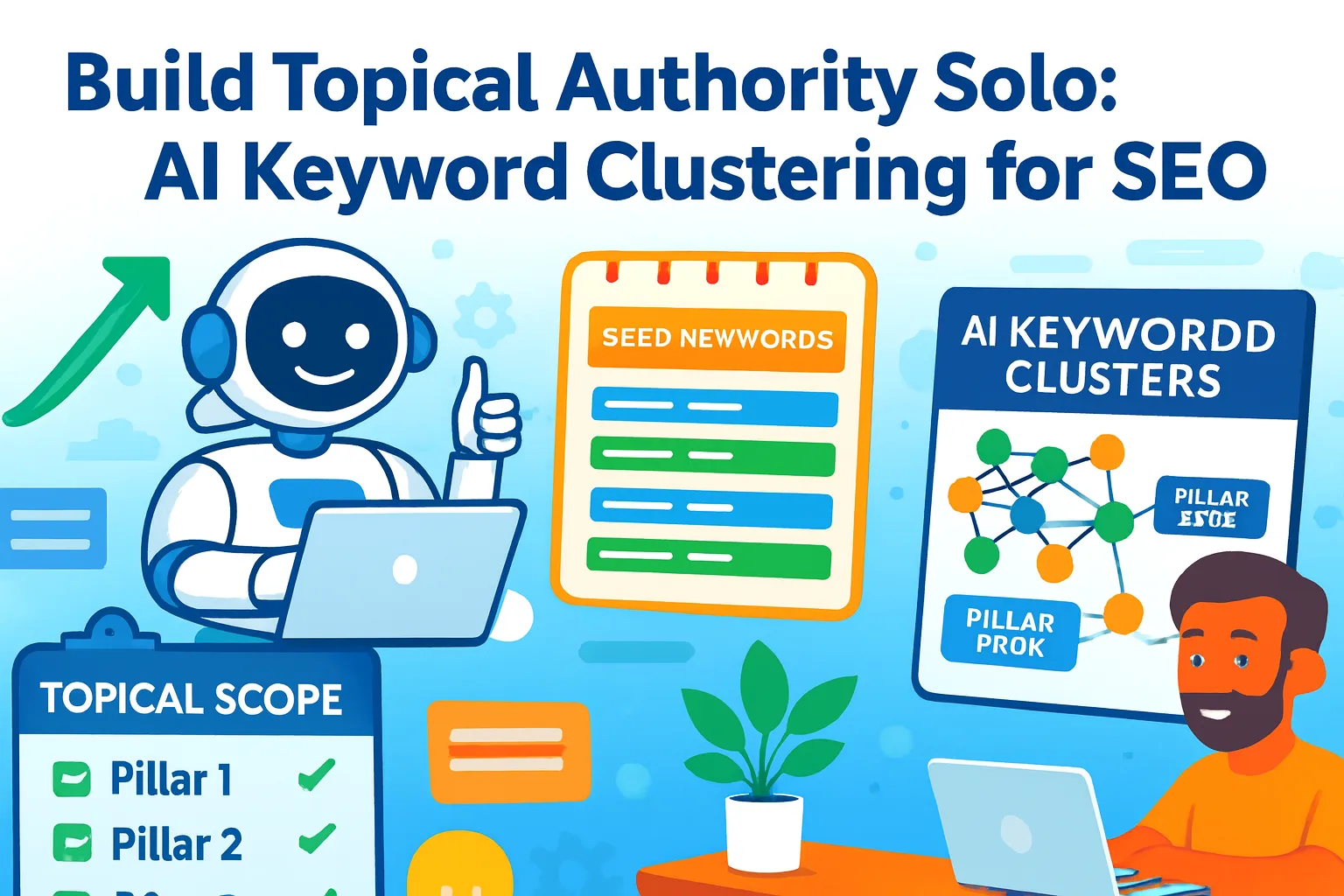
You're running product, managing support, and somehow still need to rank on Google.
The last thing you have time for is spending 12 hours clustering 200 keywords in a spreadsheet, manually mapping internal links, and praying you didn't accidentally create three pages competing for the same term.
Here's the thing: topical authority works. Sites with deep coverage on specific topics rank faster, attract more organic traffic, and beat competitors with higher domain authority. But traditional SEO clustering was built for teams with dedicated content managers and SEO specialists.
Not you.
You need a system that works in 3 hours, not 3 weeks. One that uses AI to do the heavy lifting while you focus on building your actual business. That's exactly what you're getting in this guide.
What Is Topical Authority (And Why Solo Founders Need It)
Topical authority means Google sees your site as the go-to resource for a specific subject. Instead of ranking for one or two keywords, you rank for dozens — sometimes hundreds — of related terms.
Example: A solo founder selling project management software doesn't just rank for "project management tool." They rank for "agile project management," "kanban vs scrum," "project roadmap templates," "sprint planning for startups," and 47 other variations.
Why this matters for you:
Faster rankings: Google trusts sites with comprehensive topic coverage
Less backlink dependency: Depth beats external links when you own a topic
Compounding traffic: Each piece feeds the others through internal linking
Lower keyword difficulty: Targeting clusters lets you attack easy keywords first, building authority to rank for harder ones later
The problem? Building this traditionally requires mapping keyword relationships, planning content hierarchies, and maintaining internal link structures — all things that take hours you don't have.
The 7-Step AI Clustering System for Solo Founders
Here's how to build topical authority in one weekend using AI tools you already have access to.
Step 1: Define Your Topical Scope (30 minutes)
Don't try to own "marketing." Pick a narrow slice you can actually dominate.
What to do:
Identify 3-5 core topics that directly connect to your product/service
Make them specific enough to cover completely in 20-30 articles
Verify there's actual search demand (we'll do this in Step 2)
Example: Bad: "SaaS marketing" (way too broad) Good: "Cold email for SaaS founders," "LinkedIn outreach for B2B SaaS," "Product-led growth for micro-SaaS"
Solo founder tip: Keep it narrow. Three well-covered topics beat five half-covered ones. You can always expand later.
Step 2: Gather Your Seed Keywords (1 hour)
You need 50-200 keywords. Not 5,000. Not 10. Somewhere in the middle where AI can actually find useful patterns.
Free/cheap tools that work:
Google Keyword Planner (free) — Start here, export related terms
Ubersuggest (free tier: 3 searches/day) — Good for long-tail variations
AnswerThePublic (free) — Mines question-based keywords
Google Search Console (free) — Shows what you already rank for (if you have existing content)
What to include:
High-volume head terms (harder to rank, but define the topic)
Low-volume long-tail terms (easy wins that add up)
Question keywords ("how to," "what is," "why does")
Your competitor's ranking keywords (check Ubersuggest's competitor analysis)
Time-saver: Spend 20 minutes on each topic. You want quantity, not perfection. AI will do the organizing.
Step 3: Cluster Keywords with AI (30 minutes)
This is where the magic happens. Feed your raw keyword list into AI and let it group related terms.
Option A: ChatGPT/Claude (Free)
Prompt:
I have a list of [150] keywords related to [cold email for SaaS].

Please:
1. Group them into 8-10 topic clusters based on search intent
2. Name each cluster with a clear pillar page topic
3. Identify which keywords are low-volume supporting content vs. high-volume pillar content
4. Format as a table with: Cluster Name, Pillar Keyword, Supporting Keywords, Estimated Search Intent

Here are my keywords:
[paste list]
Option B: Keyword Insights ($1 trial, then $49/month)
Upload keywords → Get SERP-based clusters in 10 minutes
Shows search intent (informational, commercial, transactional)
More accurate than pure AI, but costs money
Option C: Hybrid Approach (What I actually use)
Run keywords through ChatGPT for initial grouping
Spot-check 3-5 clusters with manual Google searches
Adjust obvious mismatches
Output: 8-10 clusters, each representing one pillar page with 5-15 supporting articles.
Step 4: Map Clusters to Pillar Pages (45 minutes)
Now you're building your content architecture.
For each cluster:
Assign one high-traffic keyword as the pillar (this becomes your comprehensive guide)
List 5-10 supporting keywords as individual articles
Note how supporting content links back to the pillar
Example: "Cold Email for SaaS" Cluster
Pillar Page: "Cold Email for SaaS: Complete Guide" (targets: cold email SaaS, SaaS cold outreach)
Supporting Articles:
"Cold Email Subject Lines That Actually Get Opened" → links to pillar section on "Writing Effective Emails"
"How to Find SaaS Decision Makers on LinkedIn" → links to pillar section on "Prospecting"
"Cold Email Templates for SaaS Founders" → links to pillar section on "Templates & Examples"
"When to Follow Up on Cold Emails" → links to pillar section on "Follow-Up Strategy"
Solo founder reality check: You don't need to write all of this tomorrow. Map it out now, write pillar pages first, add supporting content over 2-3 months.
Step 5: Generate Content Briefs with AI (2 hours for all pillars)
Don't just wing it. Create structured outlines so writing is faster.
For pillar pages, use this prompt:
Create a detailed content outline for an article titled "[Your Pillar Topic]"

Include:
- H2 and H3 headings
- Key points to cover under each section
- Internal link opportunities to these related articles: [list your supporting topics]
- Sections that answer common questions
- Target word count: 3,000-4,000 words

Audience: Solo founders with no SEO team
Tone: Direct, practical, no fluff
For supporting articles, use this:
Create a content outline for "[Supporting Article Title]"

This article supports the pillar page: "[Pillar Topic]"
Include:
- H2 and H3 headings
- Specific, actionable advice
- 1-2 internal links back to the pillar page (note where)
- Target word count: 1,200-1,800 words

Audience: Solo founders
Tone: Direct, practical, founder-to-founder
Time-saver: Generate all outlines in one sitting. You'll write faster when you're not figuring out structure on the fly.
Step 6: Automate Internal Linking (30 minutes setup, ongoing)
This is what prevents keyword cannibalization and tells Google how your content connects.
Manual approach (if you're just starting):
Create a simple spreadsheet: Article Title | URL | Links To | Links From
When publishing each piece, check the sheet and add 3-5 relevant internal links
Update the sheet every time you publish
Semi-automated approach (what I actually do):
Use LinkWhisper ($77/year) or Link Juice ($199/year, overkill for most solo founders)
These plugins suggest internal links as you write
Review AI suggestions (don't blindly accept — some are garbage)
Saves 15-20 minutes per article
Full automation (for when you scale):
Use Internal Link Juicer (free WordPress plugin)
Set keyword rules: "cold email" auto-links to your pillar page
Review monthly to catch weird links
The rule: Every supporting article should link to its pillar 1-2 times. Every pillar should link to all supporting articles at least once. Never link two supporting articles that compete for the same keyword.
Step 7: Track Performance Solo-Style (30 minutes/month)
You don't need a $200/month SEO suite. Track what actually matters.
Free dashboard (Google Search Console + Google Sheets):
Export GSC data monthly (Queries by page)
Create tabs for each cluster
Track 3 metrics:
Total impressions per cluster (shows topic visibility)
Average position for pillar keyword (shows authority growth)
CTR on supporting articles (shows if content matches intent)
What to look for:
Clusters gaining impressions: Double down, add more supporting content
Pillar pages stuck at position 8-12: Add more depth, update with fresh examples
Supporting articles ranking better than pillar: Merge content or promote supporting article to pillar
Solo founder hack: Set a monthly calendar reminder. Spend 30 minutes reviewing, not 3 hours obsessing.
Tools You Actually Need (And What They Cost)
Let's be honest about budget.
Free tier (works for most solo founders):
Google Keyword Planner (free)
Google Search Console (free)
ChatGPT free tier or Claude (free)
Internal link tracking (Google Sheets)
Total: $0/month
Upgrade tier (when you're making revenue):
Ubersuggest ($12/month) or Ahrefs Lite ($129/month)
ChatGPT Plus ($20/month) for faster responses
LinkWhisper ($77/year)
Total: $20-150/month depending on tool choice
Don't buy: Dedicated clustering tools unless you're doing this for clients. The free AI approach works fine.
Common Mistakes (And How to Avoid Them)
1. Trying to cluster 2,000 keywords You're not an agency. Start with 50-100 per topic. AI can't find meaningful patterns in massive lists, and you can't write that much content anyway.
2. Creating too many clusters 8-10 clusters = 8-10 pillar pages = 40-80 supporting articles. That's 2-3 months of content even if you write fast. Don't overplan.
3. Writing supporting articles first Pillar pages define the topic. Write those first (even if they're not perfect). Supporting articles are easier when you know what you're linking to.
4. Never updating clusters Your first groupings won't be perfect. When GSC shows two articles ranking for the same term, merge or redirect one. Topical authority is iterative.
5. Obsessing over exact keyword placement AI-based clustering is directional, not gospel. If a keyword feels wrong in a cluster, move it. You know your topic better than an algorithm.
When You've Outgrown This System
You'll know it's time to upgrade when:
You're managing 5+ topics and manually tracking internal links is a nightmare
You're creating 20+ articles per month and need workflow automation
You have budget for a dedicated SEO tool ($200+/month makes sense)
You're hiring writers and need to hand off the system
At that point, consider tools like Keyword Insights ($49/month) or Surfer SEO ($89/month) that automate more of the process. But honestly? Most solo founders never hit this point. The manual system works fine until you're doing 50+ articles.
Your Weekend Implementation Checklist
Here's what you're doing this weekend:
Saturday (3 hours):
☐ Define 3 core topics for your business
☐ Collect 50-100 seed keywords per topic using free tools
☐ Run keywords through ChatGPT/Claude for clustering
☐ Review clusters, adjust obvious mismatches
Sunday (3-4 hours):
☐ Map each cluster to a pillar page
☐ List 5-10 supporting articles per pillar
☐ Generate content outlines for your first 2 pillar pages
☐ Set up internal linking tracker (spreadsheet or plugin)
Next 2 weeks:
☐ Write and publish your first pillar page
☐ Write and publish 2-3 supporting articles
☐ Add internal links between them
Month 2-3:
☐ Complete first topic cluster (1 pillar + 5-10 supporting)
☐ Check GSC for early ranking signals
☐ Start second topic cluster
The Bottom Line
You don't need a team to build topical authority. You need a system.
AI clustering lets you do in 6 hours what used to take SEO specialists 40 hours: organize hundreds of keywords into coherent topic groups, map content hierarchies, and plan internal linking that actually works.
The difference between you and the solo founders who rank on page 1? They started. They picked one topic, clustered 50 keywords, wrote a pillar page, and kept going.
You can do the same thing this weekend.
Start with one topic. Feed it into ChatGPT. Map out 8 articles. Write the first one Monday. You'll have your first cluster ranking in 60 days.
That's it.




Comments (0)
Leave a Comment